

Executive Overview: The Data Center Paradigm Shift
The relentless growth of data-intensive workloads, particularly Artificial Intelligence (AI) and High-Performance Computing (HPC), has exposed the limitations of traditional storage area networks (SANs) . The bottleneck has fundamentally shifted from spinning disk latency to the protocol stack and network infrastructure . NVMe over Fabrics (NVMe-oF) emerges not merely as an evolution but as a revolutionary protocol specification designed to extend the efficiency of NVMe storage across network fabrics . By decoupling storage from the confines of the PCIe bus, NVMe-oF enables organizations to build high-performance, scale-out storage networks capable of delivering ultra-low latency and high throughput across distributed environments . This guide provides a comprehensive technical deep-dive into NVMe-oF, examining its architecture, transport options, performance metrics, and deployment strategies for the modern enterprise.

Core Architecture: Extending NVMe Across the Network
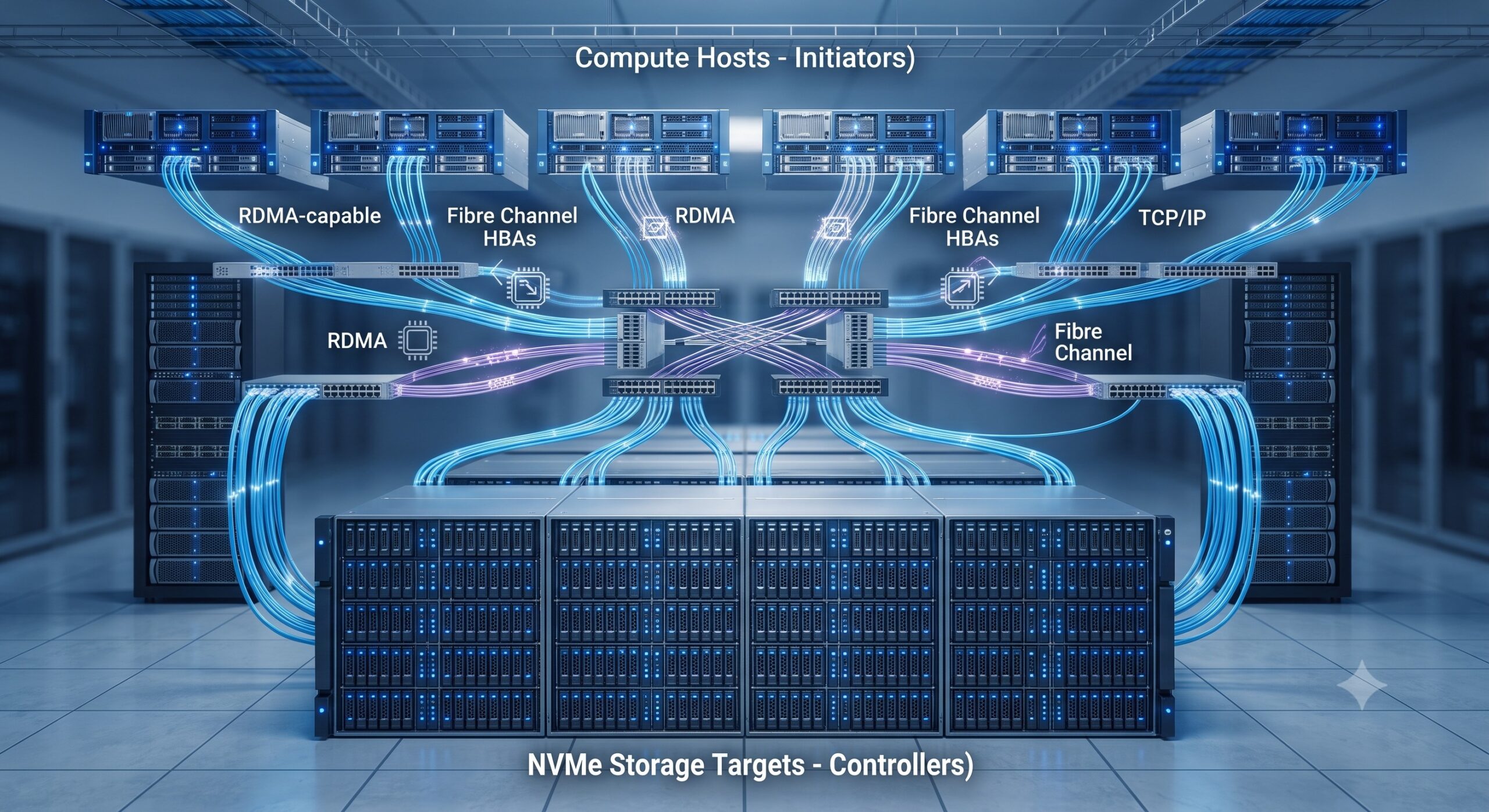
At its core, NVMe-oF replaces the traditional PCIe transport with a fabric technology, allowing the NVMe command set to traverse networks such as Ethernet, Fibre Channel, and InfiniBand . The specification first published in 2016 established a common architecture for accessing NVMe block storage over a storage networking fabric, enabling many-to-many connections between servers and storage elements . Approximately 90% of the NVMe-oF protocol is identical to the base NVMe protocol, ensuring minimal translation overhead and preserving the parallelism that makes NVMe so efficient .
The NVM Subsystem and Endpoint Roles
A fundamental concept is the NVM subsystem, which includes one or more controllers, namespaces (storage devices), and ports . Within the NVMe-oF network, devices assume specific roles: the initiator (host) consumes storage services, while the target (controller) provides them . These components can support massive parallelism, with the NVMe architecture allowing for up to 64K controllers and 64K ports per subsystem . Unlike the traditional SCSI stack, which can take up to 12 steps to process an I/O, NVMe-oF streamlines this to as few as 4 steps, collapsing single I/O latency to under 100 microseconds .
Transport Layer Deep Dive: RDMA, FC, and TCP
NVMe-oF is a framework, not a single protocol, and its performance is heavily dependent on the chosen transport. The specification supports multiple binding options, each with distinct characteristics for latency, throughput, and operational complexity .
NVMe/RDMA (RoCE, InfiniBand, iWARP)
Remote Direct Memory Access (RDMA) is considered the gold standard for ultra-low latency NVMe-oF deployments . By bypassing the host CPU and kernel for data transfers, RDMA provides direct memory-to-memory transfers, delivering latencies as low as 10-20 microseconds . Solutions like NVMe/RoCE v2 are common in large-scale data centers, but they require a lossless Ethernet fabric, which adds configuration complexity . The industry-leading hardware offload solutions from major vendors can process all regular I/O requests in hardware, achieving near-zero CPU utilization .
- NVMe/RoCE: Uses RDMA over Converged Ethernet, requiring PFC and ECN for lossless operation.
- NVMe/InfiniBand: Offers sub-microsecond latency and is ideal for HPC and large-scale AI clusters .
- NVMe/iWARP: Implements RDMA over TCP, simplifying integration into existing networks without requiring specialized hardware features .
NVMe/FC (Fibre Channel)
For enterprises heavily invested in existing SAN infrastructure, FC-NVMe provides a natural path to modernization . It allows NVMe commands to run over existing Fibre Channel fabrics, leveraging mature management tooling and stability. While latency typically falls in the 50-100 microsecond range—higher than RDMA—it still offers a massive improvement over legacy SCSI over FC .
NVMe/TCP
The newest and arguably most disruptive transport, NVMe/TCP, enables the protocol to run over standard IP networks without specialized NICs or lossless Ethernet requirements . Modern CPU and NIC offload features have narrowed the performance gap significantly, with latencies typically in the 100-200 microsecond range . This dramatically lowers the barrier to entry, making NVMe-oF accessible for cloud environments, brownfield data centers, and Kubernetes-native platforms.
| Transport Protocol | Typical Latency | Key Requirements | Best Use Case |
|---|---|---|---|
| NVMe/RDMA (RoCE) | 10-20 µs | Lossless Ethernet (PFC/ECN), RoCE-capable NICs | AI/ML training, High-Frequency Trading, HPC |
| NVMe/FC (Fibre Channel) | 50-100 µs | FC Infrastructure (HBAs, Switches) | Legacy SAN modernization, Enterprise storage |
| NVMe/TCP | 100-200 µs | Standard IP Networks, TCP Offload (Optional) | Cloud-native storage, Brownfield deployments, Kubernetes |
Quantified Operational Gains: Latency, Throughput, and TCO
The value proposition of NVMe-oF is starkly quantified in performance benchmarks. Traditional protocols like iSCSI can induce I/O processing delays of 500-1000 microseconds, whereas NVMe-oF collapses this to under 100 microseconds . In AI training pipelines, a storage bottleneck can leave GPUs idle for up to 25% of the time. Migrating to an NVMe-oF fabric can reduce model training cycles by over 70%, as seen in implementations where training periods dropped from 72 hours to 18 hours .
From a TCO perspective, the efficiency gains are dramatic. Benchmarks indicate that NVMe-oF can deliver 3 to 4 times the IOPS per CPU core compared to iSCSI . By reducing CPU overhead by up to 24%, enterprises can consolidate infrastructure, reduce power consumption, and maximize ROI .
Deployment Architectures and Management
Deploying NVMe-oF in an enterprise environment requires careful architectural planning. Typical models use a CLOS architecture for network redundancy and load balancing . Switches play a critical role in managing registration information for hosts and storage devices, acting as a control plane for service discovery and fault detection .
Discovery and Connectivity
NVMe-oF supports Discovery Services, which allow hosts to query a discovery controller to obtain a list of accessible NVM subsystems and available paths . Connections are established using the nvme-cli tool, specifying the transport type, address, port (default 4420), and the NVMe Qualified Name (NQN) . Native multipathing is a key feature, allowing for controller failover and load balancing across multiple network paths .
Security and Authentication
Security in NVMe-oF is multi-layered. At the network level, zoning or domain isolation can be used to restrict access between hosts and storage devices . Additionally, the protocol supports DHCHAP authentication, which uses a shared secret handshake to verify the identity of the host before granting access to a namespace . However, it is critical to note that DHCHAP authenticates the host but does not encrypt the data in transit, requiring complementary security measures for sensitive data flows.
Conclusion: The Future of High-Performance Storage
NVMe over Fabrics is the definitive solution for overcoming the data bottleneck in modern, distributed data centers. By extending the speed and efficiency of NVMe storage across network fabrics, it enables a new class of shared, high-performance storage architectures that are essential for AI, real-time analytics, and enterprise workloads . The choice of fabric—whether it is ultra-low latency RDMA, stable Fibre Channel, or the pragmatic simplicity of TCP—allows organizations to tailor the technology to their specific operational and financial requirements. As hardware offload technologies mature and the ecosystem continues to expand, NVMe-oF is set to become the de facto standard for building scalable, high-efficiency storage networks.

Leave a comment