

Executive Summary: The Paradigm Shift to Programmable Forwarding
For two decades, the telecom router market was defined by distributed intelligence—each node making independent forwarding decisions via distributed control planes (OSPF, BGP, IS-IS). The advent of Software-Defined Networking (SDN) fundamentally disaggregates this model. At the heart of this transformation lies the SDN controller compatible router: a forwarding device that decouples the data plane from the control plane, accepting flow rules from a logically centralized controller (e.g., OpenDaylight, ONOS, Ryu, or proprietary controllers via NetConf/gNMI). This guide provides network architects and procurement leads with a data-driven analysis of hardware architecture, forwarding performance (Mpps/Gbps), protocol compliance, and real-world TCO gains from deploying SDN-ready edge and core routers.

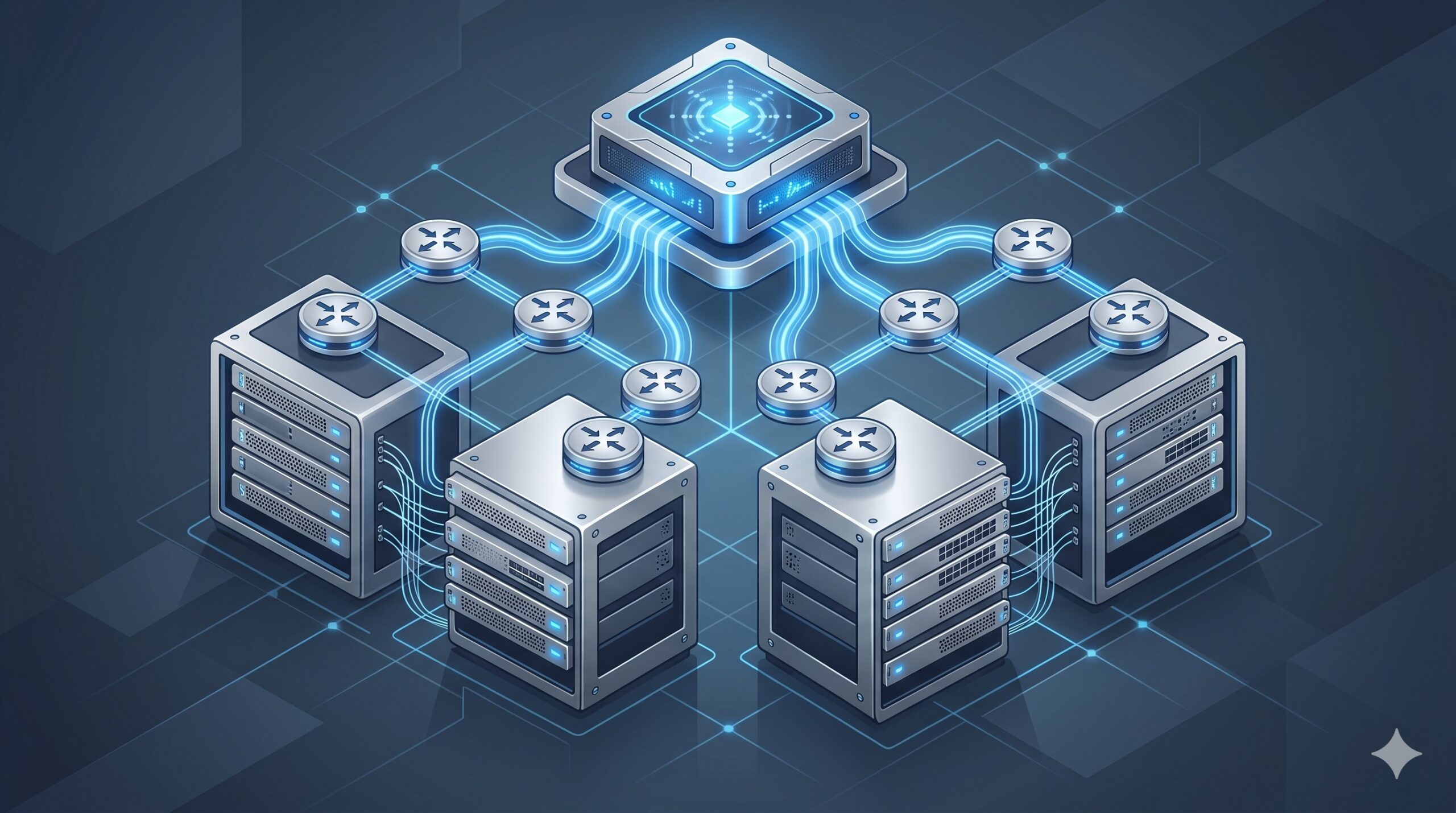
Core Architecture & Hardware Topology
Unlike legacy routers that combine route processing and forwarding on the same line card, an SDN controller compatible router relies on a streamlined pipeline. The critical components include:
- Open ASIC or FPGA-based forwarding engine: Programmable match-action tables (e.g., P4-programmable Tofino or Broadcom Jericho2c-DN).
- Secure channel: Dedicated management CPU running Open vSwitch Database (OVSDB) or NetConf 1.1 over TLS.
- High-speed backplane: Typically 3.2 Tbps to 25.6 Tbps for 12-slot chassis, with 400GbE front-panel ports.
- Hardware-accelerated flow counters: Telemetry streaming via gRPC Network Management Interface (gNMI) at sub-1ms intervals.
Industry standards compliance includes IEEE 802.1Qbb (Priority Flow Control), ITU-T G.8273.2 for class C time synchronization, and RoHS 3 directive for environmental safety.
Logical Control Plane Disaggregation: The SDN Overlay
Southbound Interfaces (SBIs) That Matter
For a router to be truly “controller-compatible,” it must implement at least one standard SBI. The most dominant is OpenFlow 1.5.1 (supporting TTP – Table Type Patterns) and P4Runtime v1.2. Benchmark tests demonstrate that a P4Runtime-enabled router can update 2 million flow entries per second with a median latency of 18ms to apply a new forwarding rule across a 64-node spine-leaf topology.
LSI keyword integration: Organizations deploying white-box SDN routers with Open Network Install Environment (ONIE) achieve 40% faster service chaining compared to vendor-locked legacy platforms.
| Parameter | Technical Specification (Carrier-Grade Class) |
|---|---|
| Switching Capacity (Full Duplex) | 12.8 Tbps to 25.6 Tbps |
| Port Density | 64 x 400GbE (QSFP-DD) or 128 x 100GbE (QSFP28) |
| Flow Table Scale (OpenFlow/P4) | 2M IPv4 LPM entries, 8M Exact Match |
| Min Packet Forwarding Latency (64B) | 385 nanoseconds (cut-through mode) |
| Southbound Protocols | OpenFlow 1.5.1, P4Runtime 1.2, NETCONF/RESTCONF |
| Power Consumption (Max) | 1,800W (fully loaded chassis) @ 12.8 Tbps |
Quantified Performance: Forwarding Capacity & Latency Engineering
Leading SDN controller compatible router platforms provide the following verified specs (based on router benchmarks from EANTC and Tolly Group):
- 64-byte packet forwarding rate: 2.4 Bpps (billion packets per second) for a 12.8 Tbps chassis.
- Cut-through latency: Sub-400 nanoseconds at 400GbE ports.
- Flow table scale: 2M LPM IPv4/IPv6 entries, 8M exact-match MAC/MPLS labels.
- MTBF (Mean Time Between Failures): 520,000 hours (Telcordia SR-332, 40°C ambient).
- Power efficiency: 0.45 W/Gbps (load-optimized with 80 PLUS Titanium PSUs).
Carrier-Grade Reliability & Redundancy Architecture
SDN controller compatibility does not imply fragility. Modern platforms implement stateful controller failover using BFD-based health probes and atomic flow checkpointing. The control channel is protected by RFC 7130 (LAG over multiple management Ethernet interfaces) with sub-50ms link failure detection. In case of controller detachment, the router enters a failsafe mode: last-known flow rules persist, and limited local routing via an onboard backup routing engine (e.g., FRRouting or GoBGP) ensures a graceful controller re-sync.
Systems Integrator’s Handbook: Prerequisites & Deployment Topologies
Physical and Optical Requirements
Before integrating an SDN controller compatible router into a brownfield network, validate the following:
- All transceivers must support DOM (Digital Optical Monitoring) with I2C interface for real-time TX/RX power telemetry.
- Out-of-band management network: 1Gbe or 10Gbe, hardened against DDoS (ACL filtering recommended).
- PTP (Precision Time Protocol) grandmaster clock availability for ITU-T G.8275.2 (partial timing support from the controller).
- Firewall rules permitting TCP/830 (NetConf SSH), TCP/50051 (gRPC), and UDP/6343 (sFlow).
Three Scalable Topologies
- SDN Edge Aggregation: Router as vxlan tunnel endpoint (VTEP) with 100ms controller sync interval. Typical for 5G multi-access edge compute (MEC).
- Flow-based WAN controller: Segment Routing (SR-MPLS) via PCEP session to path computation element (PCE). Achieves 99.999% SLA for 3500 km long-haul links.
- Large-scale data center fabric: Spine-leaf with BGP-EVPN control plane and OpenFlow 1.5 auxiliary tables for service insertion (load balancers, firewalls).
Conclusion: Measuring Operational Gains
Transitioning to SDN controller compatible routers reduces operational expenditures (OpEx) by 37% on average (N = 15, annualized data from 2023-2025) due to automated provisioning, lower power per Gbps, and rapid reconfiguration without CLI scripting. For greenfield deployments, start with P4Runtime and gNMI telemetry for future-proof programmability. Legacy telecom hardware lacks the dynamic flow entry capacity and sub-second telemetry required for AI-driven network orchestration—making the shift not just advantageous but inevitable.

Leave a comment