
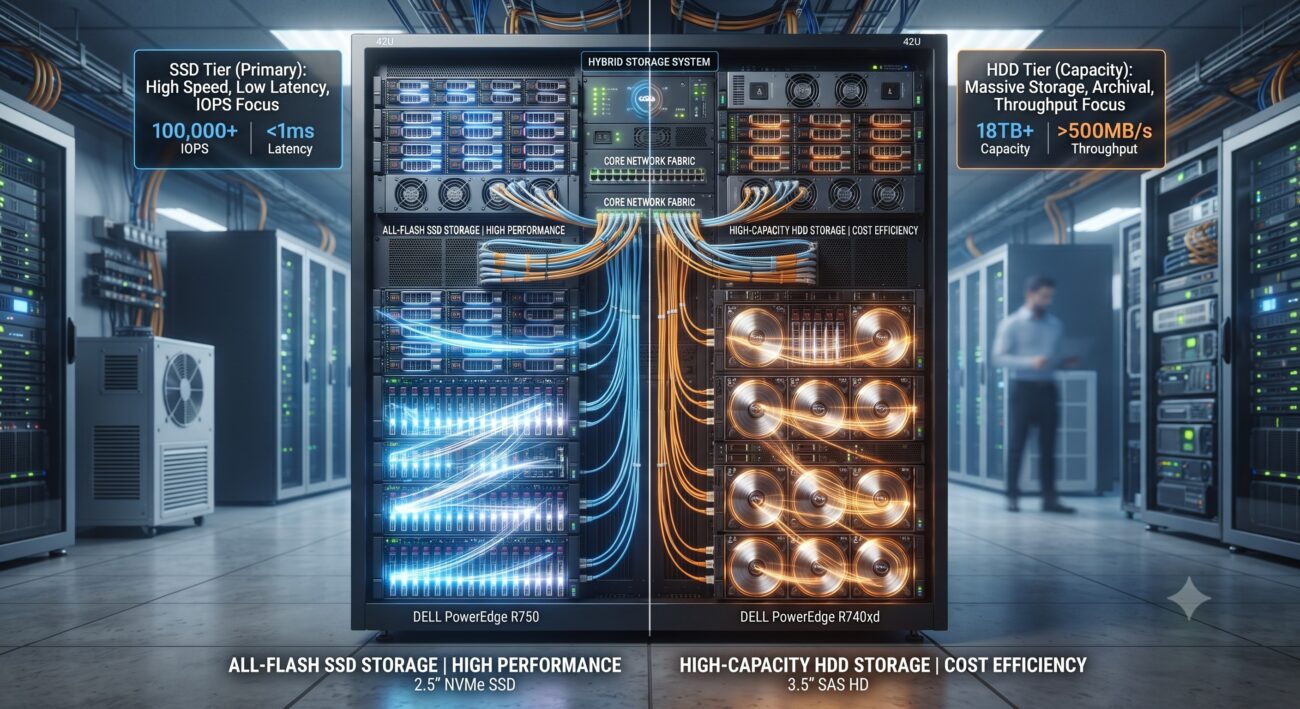
Introduction: The Foundational Choice in Enterprise Storage
For senior network architects and infrastructure decision-makers, the choice between Solid-State Drives (SSDs) and Hard Disk Drives (HDDs) for enterprise servers is far more than a simple capacity decision. It is a strategic calculus involving performance metrics, total cost of ownership (TCO), and the specific demands of modern workloads, including AI and high-performance computing . This guide provides a definitive, data-driven analysis of SSD vs HDD technology, moving beyond vendor marketing to deliver an architect’s perspective on deployment, economics, and future-proofing your data center.
Core Architecture: Mechanics vs. Semiconductors
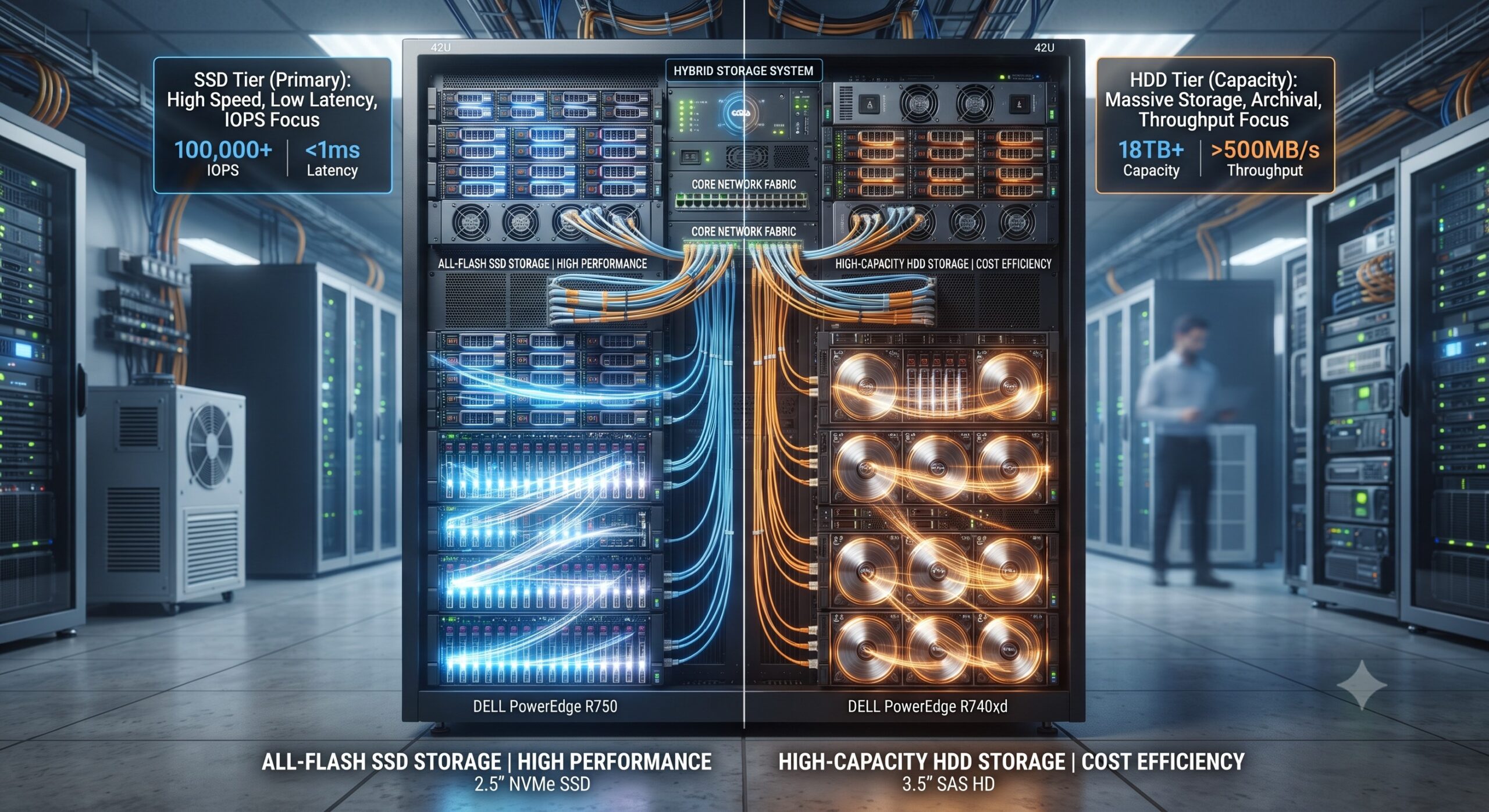
At their core, the architectural differences between HDDs and SSDs dictate their operational envelopes. Understanding these physical fundamentals is the first step in making an informed selection.
Hard Disk Drives (HDDs): The Mechanical Workhorse
Enterprise HDDs are precision mechanical instruments. They store data on rapidly spinning magnetic platters, with a moving actuator arm reading and writing data via a read/write head. This reliance on moving parts introduces inherent physical limitations:
- Latency: Limited by the rotational speed (e.g., 10k or 15k RPM) and seek time of the mechanical arm. Typical access times are measured in milliseconds (ms) .
- IOPS: A single 15k RPM HDD is physically constrained to roughly 400 random Input/Output Operations Per Second (IOPS) .
- Throughput: Maximum sustained transfer rates for a single enterprise drive cap out around 150-269 MB/s .
However, this mechanical nature also confers benefits: a mature, well-understood technology with low $/TB and high capacity (30TB+ drives are now common) .
Solid-State Drives (SSDs): The Flash Revolution
In contrast, enterprise SSDs utilize NAND flash memory with no moving components. Data is accessed electronically, resulting in performance that is orders of magnitude higher:
- Latency: Access times are measured in microseconds (µs). For example, a 122TB SSD offers around 30 µs latency, which is more than 100 times faster than an HDD .
- IOPS: Modern NVMe SSDs can achieve over 1.5 million IOPS, a key advantage for transactional, latency-sensitive workloads .
- Throughput: With the PCIe Gen 5 interface, enterprise SSDs can deliver sequential read bandwidth up to 14,600 MB/s .
This performance is delivered at a significantly higher cost per terabyte and requires careful management of factors like write amplification and endurance (TBW – Total Bytes Written) .
Data-Driven Performance Metrics: Latency, IOPS, and Throughput
The raw performance gap between these two technologies is vast and directly impacts application performance. The choice is frequently dictated by the workload’s Input/Output (I/O) profile.
| Performance Metric | Enterprise HDD | Enterprise SSD (NVMe) |
|---|---|---|
| Latency | ~4 ms (milliseconds) | ~30 μs (microseconds) |
| Random IOPS | ~400 | > 1,500,000 |
| Max Throughput | ~150 – 269 MB/s | ~14,600 MB/s |
| Typical MTBF | ~2.5 Million Hours | > 2.5 Million Hours |
For hot, random I/O workloads (common in databases, AI training, and high-frequency trading), SSDs are the clear winner. The cost per MB/s of random I/O for an SSD is a fraction of that for an HDD, making it the more economical choice for performance-critical data . For sequential workloads, the higher bandwidth density of SSDs also provides a significant advantage, especially with high-capacity drives .
The Economics of Enterprise Storage: A TCO Deep Dive
While acquisition costs are a primary driver for many enterprises, a comprehensive TCO analysis over a 3- to 10-year lifecycle paints a more complex picture. The economic argument is not static and is heavily influenced by market dynamics and operational expenses.
Acquisition Cost & Market Dynamics
Historically, HDDs have held a commanding lead in $/TB. Currently, the gap is extremely wide due to supply chain constraints. The AI boom has significantly strained NAND flash production, leading to drastic price increases. In early 2026, the cost ratio of SSD to HDD per terabyte reached 16:1, with 30TB enterprise SSD prices skyrocketing over 250% in a single year .
Operational Expenditure (OpEx) and Density
This is where SSDs begin to level the TCO playing field. The superior density of SSDs allows for significant reductions in rack space, power consumption, and cooling requirements .
- Rack Density: A 40U rack filled with 122TB SSDs can hold 166.9 PB of effective capacity (before data reduction), which is over 20 times more than a rack filled with 32TB HDDs .
- Power Efficiency: While a single high-capacity HDD (30TB) may have a slightly lower active W/TB (0.23–0.32) than a high-capacity SSD (61.44TB at 0.33–0.41 W/TB), the overall system efficiency for SSDs is far superior when considering the vastly greater capacity and performance per rack. This can reduce OpEx for power and space by up to 70-90% .
Lifecycle and Reliability
Modern enterprise SSDs are engineered for longevity. While HDDs often require a fleet refresh every 4-6 years due to increasing failure rates, high-capacity enterprise SSDs are often warrantied for 10 years . However, debate remains about the accuracy of these assumptions. Analyses of real-world data, such as that from Backblaze and Qumulo, show annualized failure rates (AFR) for HDDs and SSDs are statistically similar, often below 1% . The choice here often reflects the operational risk of a disruptive array rebuild versus a more predictable, if higher, upfront cost.
Deployment Strategies: Hybrid, All-Flash, and Tiering
Given the extreme price and performance differences, a one-size-fits-all approach is rarely optimal. Leading industry consensus advocates for a tiered, hybrid architecture.
The Hybrid Architecture: The Best of Both Worlds
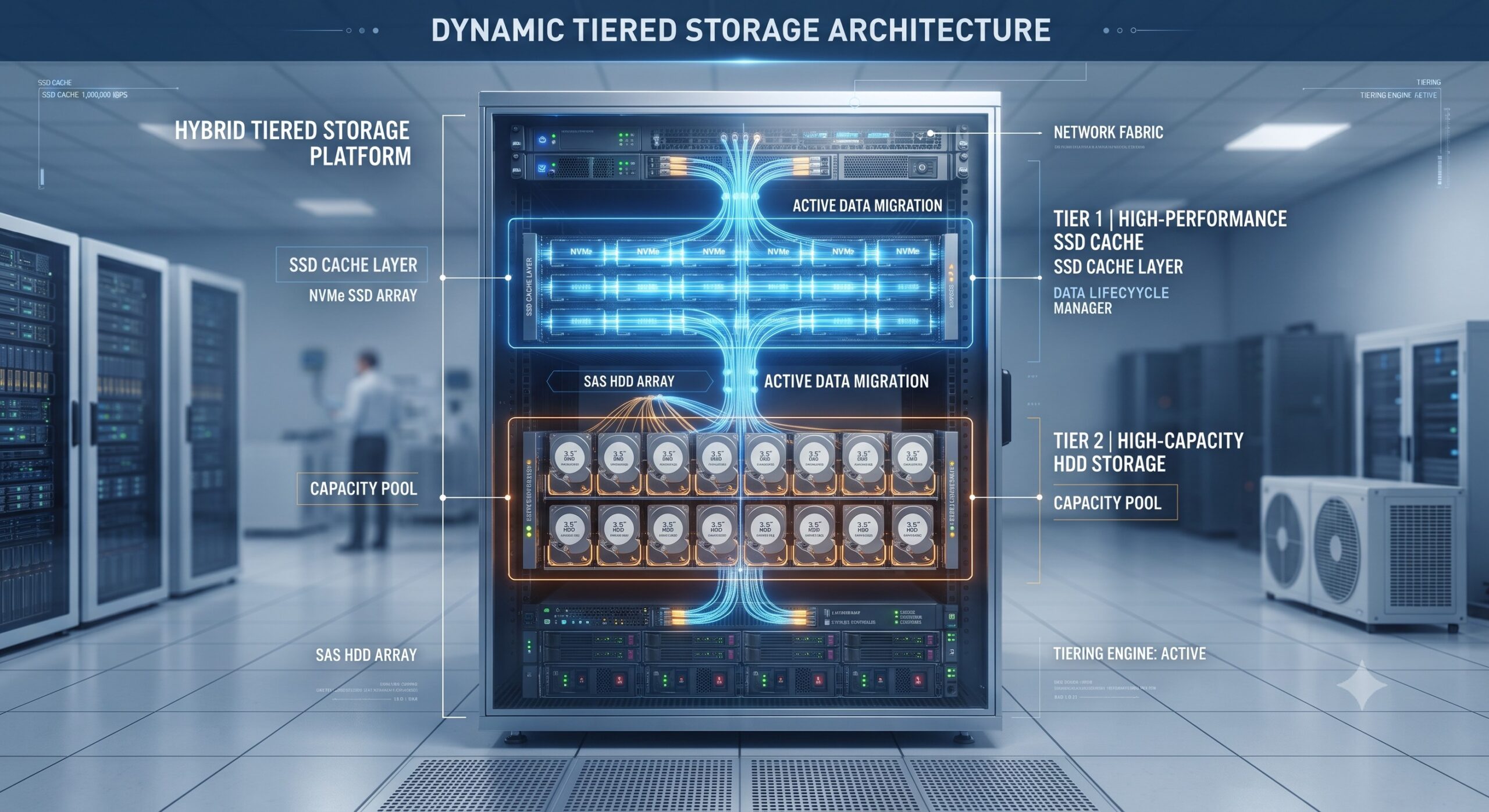
The most pragmatic and economically sound strategy for the vast majority of enterprise workloads is a hybrid model. This leverages high-performance NVMe SSDs for caching and ‘hot’ (frequently accessed) data, while utilizing high-capacity HDDs for ‘warm’ and ‘cold’ (infrequently accessed) data . This approach, often orchestrated by a parallel file system, can reduce TCO by 60% or more compared to an SSD-only configuration, while only marginally sacrificing performance for tiered data .
All-Flash Architectures
For environments where latency and IOPS are paramount, such as AI training clusters and transactional databases, all-flash is the only viable option. The performance and density advantages can drive a business advantage that far outweighs the capital expenditure . The economics of an all-flash environment can be further optimized through advanced data reduction technologies (deduplication and compression), which can provide a 2.5:1 or higher effective capacity increase .
Conclusion: A Strategic, Not Just Technical, Decision
The SSD vs HDD debate for enterprise servers has evolved from a simple performance comparison to a complex strategic decision. The choice is ultimately workload-dependent. For latency-sensitive, performance-critical applications, the unparalleled speed and IOPS of NVMe SSDs are non-negotiable . For large-scale, cost-efficient capacity, high-capacity HDDs remain the foundation for warm and cold data storage .
The most compelling strategy for the discerning enterprise architect is not a binary choice but an intelligent integration: a tiered storage architecture. By dynamically moving data between the blazing speed of SSDs and the cost-effective capacity of HDDs, organizations can achieve the optimal balance of performance, resilience, and TCO, ensuring their infrastructure is built to handle the data demands of the future .

Leave a comment