

PLATFORM INTRODUCTION
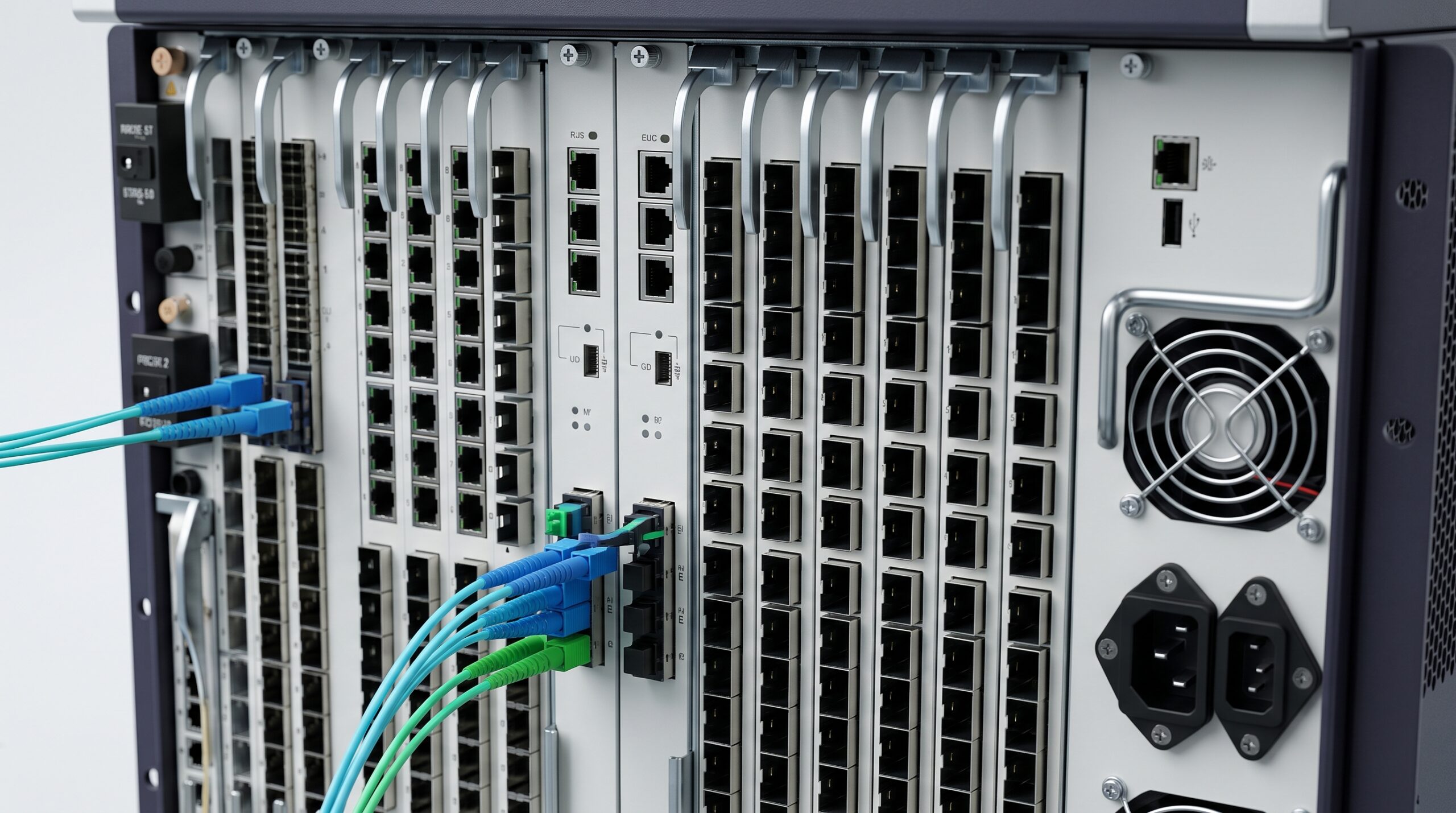
The Huawei SmartAX MA5800-X15 represents the industry’s first distributed-architecture intelligent aggregation Optical Line Terminal (OLT) platform, purpose-built for the ultra-gigabit broadband era. As the mainstay model within the MA5800 series, the X15 balances high port density with deployment flexibility, occupying an 11U, 19-inch standard subrack footprint. This comprehensive integration manual provides hardware installation engineers, network architects, and facility planners with authoritative technical specifications and procedural guidance for deploying the MA5800-X15 in central office and data center environments.
The MA5800-X15 serves as a unified service aggregation platform supporting GPON, XG-PON, XGS-PON, and P2P GE/10GE access technologies. It enables operators to consolidate multiple service types—residential broadband, enterprise leased lines, and mobile backhaul—onto a single fiber network infrastructure, thereby simplifying network architecture and reducing operational expenditure. This document covers physical installation prerequisites, cabinet space requirements, power and grounding specifications, and the complete technical parameter registry essential for successful equipment deployment.

PHYSICAL INSTALLATION PREREQUISITES
ENVIRONMENTAL AND CABINET REQUIREMENTS
The MA5800-X15 service subrack must be installed in an IEC60297-compliant cabinet with a depth of at least 300 mm to accommodate the 287 mm chassis depth plus a minimum 55 mm reserved space for cable and fiber routing after boards are installed. The cabinet must incorporate adequate ventilation, with an air inlet and door hole density of 60% or higher to ensure proper thermal management. When devices are operating, the cabinet door must remain closed to maintain directed airflow.
SPACE REQUIREMENTS AND THERMAL CLEARANCES
Proper clearance is critical for heat dissipation and maintenance access. When the cabinet accommodates a single MA5800-X15 subrack, a minimum of 2U space should be reserved at the air inlet for fiber routing, with 4U or more recommended to facilitate subsequent air inlet cleaning and dust filter maintenance. The heat dissipation of the MA5800-X15 is assured only when more than 2U space is reserved at the air inlet and 3U space is reserved at the air outlet. For cabinets housing both the MA5800-X15 and another active device, a minimum separation of 10U is required between devices, or alternatively, a 3U air deflector should be installed to redirect airflow and minimize mutual thermal impacts.
GROUNDING AND POWER DISTRIBUTION
Proper grounding is mandatory for safe operation and electromagnetic compatibility. When installed in a Huawei standard cabinet (such as the N66E-22), the subrack is grounded through the mounting ears and requires no separate grounding connection. However, installation in third-party cabinets necessitates a dedicated PGND cable connection, with the lap resistance between the PGND cable and ground bar required to be 0.1 ohm or less. The power distribution system must incorporate an over-current protection mechanism rated at 60 A for the MA5800-X15, with independent circuit breakers controlling each power input. The circuit breaker trip value of the upper-level device must be greater than or equal to the rated value specified on the device nameplate.
LEGACY ECOSYSTEM INTERACTION
The MA5800-X15 maintains comprehensive backward compatibility with Huawei’s established OLT ecosystem while introducing forward-looking architectural enhancements. The platform supports the full range of Huawei service boards including GPON interface boards (GPHF, GPSF), 10G PON boards (XGHD, TWED), and aggregation boards (OGHK, OXHD), enabling seamless migration from legacy MA5600T and MA5680T deployments.
Control board options include the MPLA and MPLB variants, with the MPLB delivering 7 Tbit/s switching capacity and 200 Gbit/s per-slot bandwidth in load-sharing mode. The backplane design accommodates mixed board configurations, allowing operators to populate the 15 service slots with a combination of PON, Ethernet aggregation, and TDM interfaces as network demands evolve. This modular approach ensures that existing service cards and optical modules remain fully operational, protecting prior infrastructure investments while enabling incremental capacity expansion.
KEY FEATURES
DISTRIBUTED ARCHITECTURE AND HIGH AVAILABILITY
The MA5800-X15 pioneers a distributed architecture that separates the control plane from the forwarding plane, delivering enhanced system throughput and carrier-grade reliability. The platform features comprehensive redundancy protection including dual control boards (slots 8 and 9), dual power boards, and a hot-swappable fan tray with six fans monitored by the H901FMLA board. This 2+1+1 redundancy architecture ensures that no single component failure results in service interruption, with system availability exceeding 99.999% and an MTBF of approximately 45 years.
HIGH-DENSITY SERVICE CAPACITY
The 20-slot chassis configuration comprises 15 service slots, 2 control slots, 2 power slots, and 1 universal interface slot. With MPLB control boards, the system achieves up to 240 GPON ports, 120 XGS-PON ports, 720 GE/FE ports, or 360 10GE ports, enabling massive subscriber density in a compact 11U footprint. The platform supports 262,143 MAC addresses and 65,536 IPv4 routing entries, accommodating large-scale network deployments without performance degradation.
COMPREHENSIVE PROTOCOL SUPPORT
The MA5800-X15 delivers full Layer 2 and Layer 3 functionality including VLAN+MAC forwarding, SVLAN+CVLAN, PPPoE+, DHCP option82, static routing, OSPF/OSPFv3, IS-IS, BGP/BGP4+, and VRF. MPLS and PWE3 capabilities encompass LDP, RSVP-TE, OAM, and BGP IP VPN, with tunnel protection switching and TDM/ETH PWE3 support. IPv6 readiness includes dual-stack operation, IPv6 L2/L3 forwarding, and DHCPv6 relay. Multicast support covers IGMP v2/v3, IGMP proxy/snooping, MLD v1/v2, and VLAN-based IPTV multicast.
VERIFIED SPECS
TECHNICAL SPECIFICATIONS
The following parameter registry represents the authoritative technical specifications for the Huawei SmartAX MA5800-X15 as verified through official documentation and field deployment data.
| Parameter | Specification |
|---|---|
| Form Factor | 19-inch standard, 11U high modular chassis |
| Dimensions (W x D x H) | 442 mm x 287 mm x 486 mm (excluding mounting ears); 482.6 mm x 287 mm x 486 mm (including IEC mounting ears) |
| Maximum Weight | 35 kg (fully loaded, including mounting brackets) |
| Slot Configuration | 20 slots total: 15 service slots (1-7, 10-17), 2 control board slots (8-9), 1 universal interface slot (0), 2 power board slots (18-19) |
| Backplane | H901BPIB / H901BPLB |
| Switching Capacity (Control Board, Load Sharing) | MPLA: 3.6 Tbit/s; MPLB: 7 Tbit/s |
| Max Bandwidth per Service Slot | MPLA: 100 Gbit/s; MPLB: 200 Gbit/s |
| Maximum Input Current | 60 A |
| Power Supply | DC power supply (dual backup); -38.4 V to -72 V DC operating range; -48 V/-60 V rated |
| Working Temperature | -40°C to +65°C (minimum startup temperature: -25°C); +65°C refers to air intake vent temperature |
| Working Humidity | 5% RH to 95% RH (non-condensing) |
| Altitude | 4000 m maximum; working temperature varies with altitude due to air density effects on heat dissipation |
| GPON Ports (Maximum) | 240 |
| XGS-PON Ports (Maximum) | 120 |
| GE/FE Ports (Maximum) | 720 |
| 10GE Ports (Maximum) | 360 |
| MAC Address Table | 262,143 entries |
| IPv4 Routing Table | 65,536 entries |
| System Availability | > 99.999% |
| MTBF | Approximately 45 years |
ORDERING SKU GUIDE
BASE CHASSIS AND ESSENTIAL COMPONENTS
The MA5800-X15 service subrack (H901BPIB or H901BPLB backplane variants) constitutes the foundation of any deployment. Each installation requires dual control boards for redundancy, with the MPLA (H901MPLA) providing 3.6 Tbit/s switching capacity or the MPLB (H901MPLB) delivering 7 Tbit/s. Power board options include the H901PILA for DC power input. The H901FMLA fan monitoring board is pre-installed in the fan tray assembly.
SERVICE BOARD CONFIGURATION OPTIONS
For GPON deployments, the H901GPHF and H901GPSF boards provide 16 GPON ports each, supporting up to 240 GPON connections across 15 slots. 10G PON requirements are met by the H901XGHD (8-port asymmetric XG-PON) or H901TWED (8-port symmetric XGS-PON), enabling 120 XGS-PON ports maximum. Aggregation applications utilize the H901OGHK (48-port GE/FE optical) or H901OXHD (8-port 10GE optical). The H901CIUA universal interface board provides clock synchronization and alarm interfaces when required.
UPLINK AND CLOCK OPTIONS
Control board uplink ports (4x GE/10GE per control board) provide the primary upstream connection in most deployments. For additional uplink capacity, the H901NXED upstream interface board offers 8x 10GE ports. Clock synchronization requirements are addressed through the H901CKUA board supporting Stratum-3 clock functions in conjunction with MPLA/MPLB control boards, or via the CIUA universal interface board for BITS and external clock connectivity.
📥 Download Technical Specification
Click the button below to view or download the full official PDF datasheet.

Leave a comment