

Introduction: The Core Network Crossroads
The architectural decisions made in the core network layer dictate the performance ceiling for the entire telecom infrastructure. As we navigate the transition from 400G to 800G and beyond, the debate between optical fiber and copper cabling has intensified. While copper has historically been a reliable workhorse, its physical limitations are becoming a critical bottleneck in high-density switching environments. This analysis provides a data-driven evaluation of optical fiber versus copper in core network switching, examining specific metrics like Gbps throughput, latency, power consumption, and Mean Time Between Failures (MTBF) to inform the engineering decisions that maximize operational gains .

Physical Layer Physics: The Bandwidth and Distance Threshold
The fundamental distinction lies in the transmission medium: copper transmits data via electrical pulses, while fiber uses light pulses. This physical difference dictates their respective operational limits, which are particularly acute in core switching.
Distance Constraints and Signal Integrity
High-speed copper signaling faces significant challenges with insertion loss and crosstalk. At data rates of 10 Gbps and above, twisted-pair copper (Cat6A/Cat7) is effectively limited to 100 meters. This limit shrinks dramatically as speeds increase. For instance, Cat8 copper supports 25-40 Gbps but is confined to a maximum of 30 meters within a data center . In contrast, single-mode fiber (OS2) can transmit data over 40 kilometers without regeneration, and multimode fiber (OM4) reliably supports 100G links up to 550 meters . In a core switching environment where aggregation and distribution spans are extensive, fiber is not just an option; it is a prerequisite for maintaining signal integrity over distance.
The ‘7-Meter Wall’ and the Inevitable Shift
Within the rack, Direct Attach Copper (DAC) cables are dominant due to their low latency and cost. However, as the industry pushes towards 400G per lane, copper is hitting a frequency threshold. The physics of electrical transmission over modest distances becomes exponentially difficult, leading to a critical transition point . Engineers refer to this as the ‘7-Meter Wall,’ where passive copper links are no longer reliable without Forward Error Correction (FEC) penalties, necessitating a switch to Active Copper Cables (ACC) or optical solutions .
| Parameter | Optical Fiber (Core Link) | Copper (Core Link) |
|---|---|---|
| Max Data Rate | 800 Gbps (1.6 Tbps future) | 40 Gbps (Cat8, limited to 30m) |
| Max Reach (10G+) | 40 km (SMF), 550m (MMF OM4) | 100m (Cat6A/7), 30m (Cat8) |
| Latency (per hop) | ~0.1 µs (AOC) | |
| Power Consumption | ~2.5W – 3.5W (AOC/Transceiver) | ~3W – 5W (10G) |
| EMI Immunity | Complete | Susceptible (STP required) |
| PoE Support | Not Supported | Supported (up to 90W) |
| Long-term TCO | Lower (Scalable, low power/cooling) | Higher (Recabling, higher power) |
Quantified Operational Gains: Latency, Power, and TCO
For a core network architect, the choice between fiber and copper translates directly into operational performance and Total Cost of Ownership (TCO).
Latency: The Copper Advantage and Its Limits
In terms of raw latency, passive copper DACs provide the lowest possible delay (
Power Consumption and Thermal Management
Power efficiency is critical in core networks. Copper transceivers (10G) consume approximately 3-5 watts, which is nearly ten times that of multimode fiber transceivers. Furthermore, the copper traces on a switch PCB also contribute to power loss as heat . The thermal impact is substantial; with copper, operational costs for cooling can easily double compared to fiber . Fiber solutions, particularly with the adoption of co-packaged optics (CPO) that eliminate copper traces on the switch, are projected to be the primary driver for reducing power consumption in next-generation 1.6T+ networks .
Total Cost of Ownership (TCO)
While the initial cost of fiber transceivers has historically been higher, the gap is closing. The IEEE P802.3.cm and db standards are driving the development of lower-cost optics for short-reach applications . Data-driven analysis shows that a 50 Gbps duplex multimode fiber deployment now has the potential to be less expensive than a copper deployment using short-reach DACs when factoring in power, cooling, and scalability . Moreover, fiber infrastructure has a longer service life and is inherently scalable for future upgrades (800G, 1.6T), whereas copper infrastructure often requires a complete overhaul to support the next generation of speeds .
Carrier-Grade Reliability and Standards Compliance
Core networks demand carrier-grade reliability. This section evaluates the hardware robustness of both mediums against critical standards.
MTBF and Immunity
Passive DACs boast extremely high MTBF rates (50M+ hours) as they lack active components that can burn out . However, the physical cable itself is more susceptible to damage and signal degradation from EMI/RFI. Fiber optics are completely immune to electromagnetic interference and radio frequency interference, making them the superior choice for environments with high electrical noise .
IEEE and ITU-T Compliance
The industry is standardizing around fiber for high-speed core links. IEEE standards like 802.3bm (40/100GBASE-SR4) and 802.3bs (200/400GBASE-SR8/SR4.2) are built around optical infrastructure. The introduction of PAM4 encoding has further tilted the playing field, allowing 50G per lane over a single fiber pair, effectively quadrupling density compared to earlier NRZ-based optics . Compliance with TIA-568.3-D and IEC-61754-7 standards for fiber polarity and MTP/MPO connectors is crucial for avoiding costly deployment delays .
Conclusion: The Hybrid Architecture Verdict
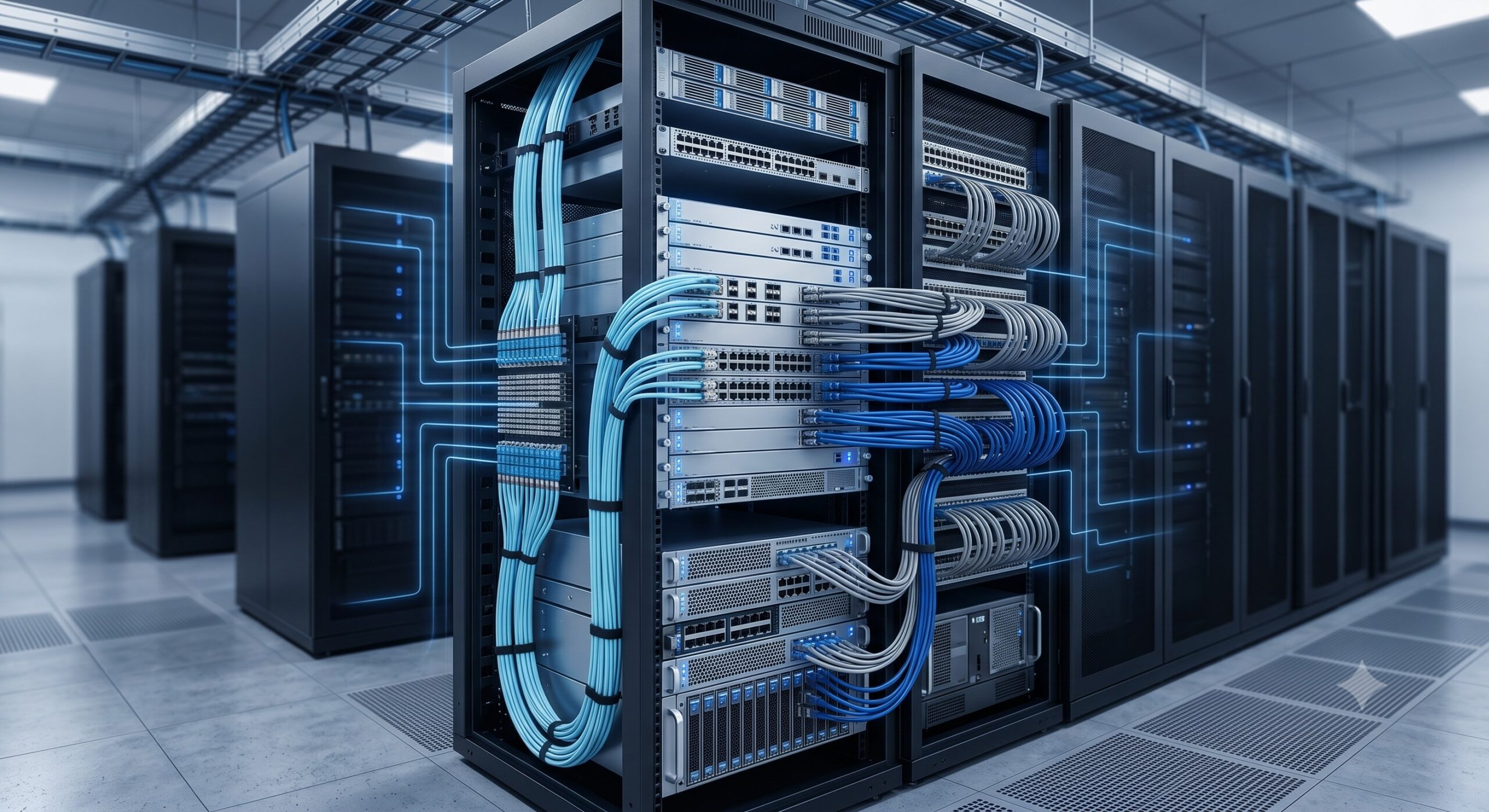
The data-driven evaluation is clear: For core network switching, where long distances, high bandwidth (40G+), and low power consumption are paramount, optical fiber significantly outperforms copper. Copper’s destiny is not extinction but specialization. It will remain the optimal choice for short-reach (sub-5m) server-to-switch connections (Top-of-Rack) and for Power over Ethernet (PoE) applications where power delivery is required .
The future of core network architecture is a hybrid one. It leverages the ultra-low latency and cost-efficiency of copper for intra-rack connectivity and deploys fiber for inter-rack, row-scale, and backbone connections . For systems integrators, the strategic imperative is to adopt a fiber-rich backbone with a modular structured cabling approach (using MPO/MTP trunks) to ensure the infrastructure is future-proofed for the impending 800G and 1.6T generations, where copper’s role will be further confined to the very edge of the network .

Leave a comment