

EXECUTIVE SUMMARY
This document serves as the definitive technical reference for the ZTE WDM Board Alarm Troubleshooting Guide, detailing the comprehensive alarm management, diagnostic, and recovery capabilities integrated within ZTE’s Wavelength Division Multiplexing (WDM) hardware portfolio. Designed for carrier-grade optical transport networks, this guide provides network operations teams, field engineers, and system integrators with a structured, hierarchical approach to fault isolation and service restoration. The guide covers all major WDM board types, including optical transponders, multiplexers, demultiplexers, optical amplifiers (OAs), and optical supervisory channel (OSC) units, ensuring end-to-end visibility across the optical layer.
The alarm troubleshooting framework is built upon a multi-tiered severity classification system (Critical, Major, Minor, Warning, and Indeterminate) that aligns with ITU-T Recommendation X.733 and Telcordia GR-253-CORE standards. Each alarm entry is meticulously documented with root cause analysis, impact assessment, and a step-by-step corrective action workflow, enabling rapid mean time to repair (MTTR) reduction. This guide is an indispensable asset for maintaining the high availability and performance integrity of ZTE WDM networks, directly contributing to Service Level Agreement (SLA) compliance and operational excellence.

ARCHITECTURE & CHASSIS DESIGN
The ZTE WDM board architecture is engineered for modular scalability and high-density optical transport. The chassis design supports a variety of form factors, from compact 1RU and 2RU shelf systems to high-capacity 8RU and 12RU subracks, accommodating up to 96 optical channels in a C-band or L-band configuration. The hardware is based on a fully redundant, hot-swappable board architecture, with dedicated slots for control, switching, and optical interface modules. Each board integrates a local processor unit that continuously monitors key operational parameters, including optical power levels, laser bias current, temperature, and voltage, feeding real-time status data to the central network management system (NMS) via the embedded control plane.
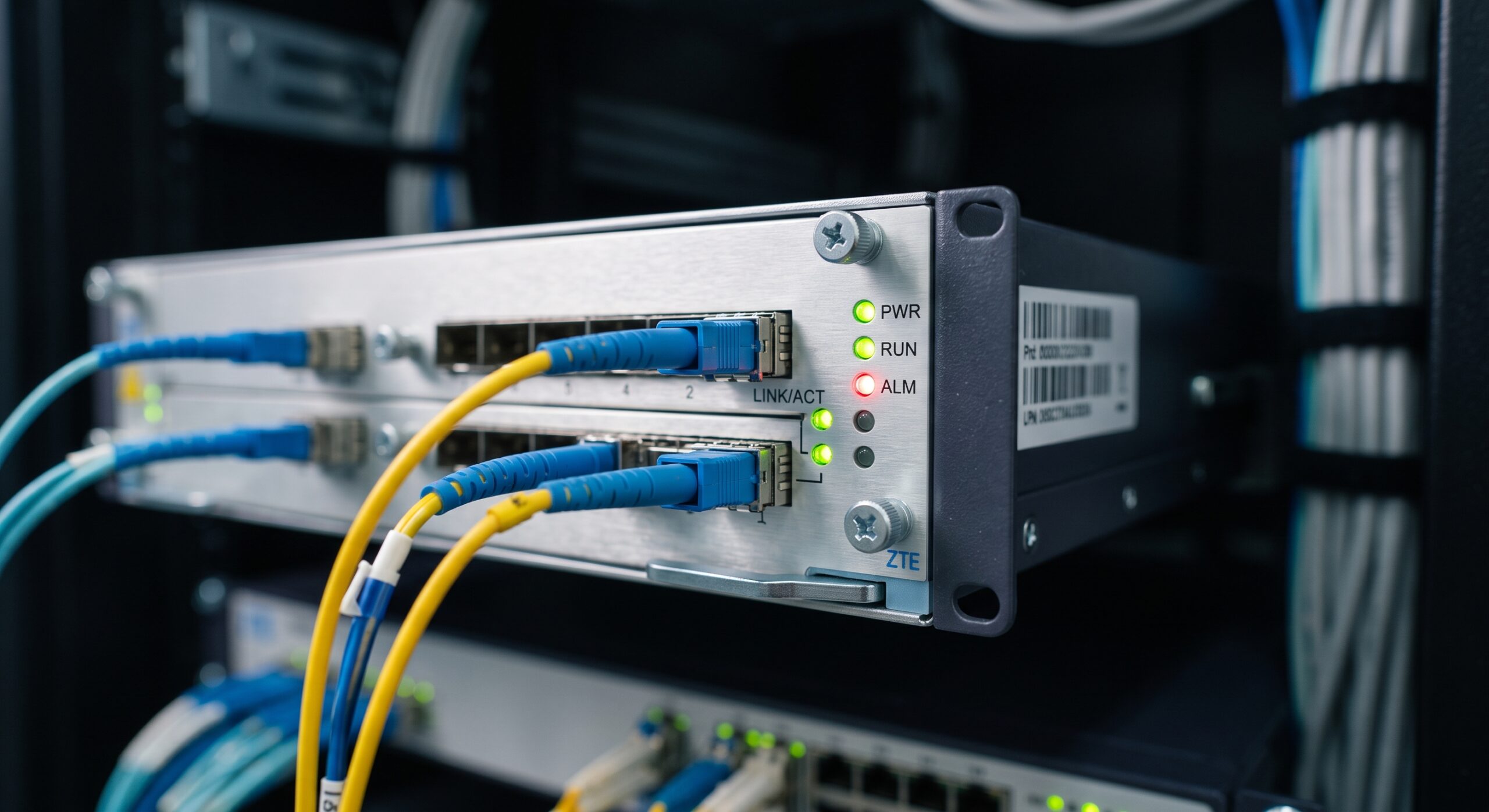
A pivotal aspect of the architecture is the intelligent alarm correlation engine, which employs a finite state machine (FSM) model to differentiate between primary faults and consequential alarms. This engine significantly reduces alarm floods, presenting operators with a clear, root-cause-focused alert list. The physical layer interface is enabled by a dense backplane that supports up to 1 Tbps of switching fabric capacity, with dedicated channels for both data and management traffic. The guide provides detailed schematics of board front panels, LED indicator meanings, and connector pinouts, ensuring accurate physical layer troubleshooting.
HARDWARE FEATURES
The ZTE WDM board family is equipped with a suite of advanced hardware-level diagnostic features that form the foundation of the alarm troubleshooting guide. Key hardware features include:
– Integrated Optical Channel Monitor (OCM): Provides real-time spectral analysis, enabling detection of channel drift, power imbalances, and optical signal-to-noise ratio (OSNR) degradation.
– Digital Diagnostic Monitoring (DDM): Embedded on all optical transceivers (e.g., SFP, SFP+, XFP, QSFP), DDM allows for precise monitoring of TX/RX power, bias current, temperature, and supply voltage, facilitating proactive failure prediction.
– Automatic Laser Shutdown (ALS): A safety mechanism that automatically disables laser output upon detection of a fiber cut or open circuit, preventing eye safety hazards and triggering specific alarms.
– Redundant Power and Cooling Modules: Boards are supported by 1+1 or N+1 redundant power supplies and fan trays, with alarm generation for any module failure or thermal overrun.
– Hardware Watchdog Timers: Each board features independent watchdog timers that reset the local processor in the event of a software hang, generating a ‘Board Reset’ alarm with diagnostic data.
COMPLIANCE & STANDARDS
The ZTE WDM board alarm and diagnostic features are fully compliant with a comprehensive set of international telecommunications standards, ensuring interoperability and operational reliability in multi-vendor environments. Key compliance frameworks include:
– ITU-T G.709 (Optical Transport Network – OTN): The guide aligns with G.709 alarm and performance monitoring (PM) parameters, including TTI (Trail Trace Identifier), BIP (Bit Interleaved Parity), and BEI (Backward Error Indication).
– Telcordia GR-253-CORE (SONET/SDH): The alarm severity and reporting formats are mapped to industry-standard SONET/SDH alarm hierarchies.
– ITU-T G.697 (Optical Monitoring): The guide details alarm thresholds in accordance with G.697 recommendations for optical parameter monitoring.
– IEEE 802.3 (Ethernet): For boards with Ethernet client interfaces, alarm handling is compliant with 802.3 link fault signaling (LFS).
– NEBS Level 3 (Network Equipment Building Standards): The board hardware is designed to meet NEBS environmental and safety compliance, with alarms generated for any environment-related deviations.
TECHNICAL SPECIFICATIONS
The following table provides a comprehensive parameter registry for the primary WDM board types referenced within the alarm troubleshooting guide. These specifications are critical for baseline comparisons and performance validation during troubleshooting events.
| Parameter | Specification |
|---|---|
| Form Factor | 1RU, 2RU, and 8RU Chassis Options |
| Switching Capacity | Up to 1.2 Tbps (per subrack) |
| Power Supply | 1+1 Redundant, -48V DC / 110-240V AC |
| Supported Board Types | Transponder, Mux/Demux, OA, OSC, ROADM |
| Alarm Severity Levels | Critical, Major, Minor, Warning, Indeterminate |
| Alarm Interface | DCN (Data Communication Network) via SNMP, TL1, NETCONF |
| Optical Connectors | LC/UPC, SC/UPC, MPO (depending on board type) |
| Operating Temperature | -5°C to +55°C (Standard Range) |
| MTBF | > 250,000 hours (per board) |
| Compliance Standards | ITU-T G.709, G.697, GR-253, NEBS Level 3 |
ORDERING OPTIONS
To facilitate accurate field replacement and system upgrades, the ZTE WDM Board Alarm Troubleshooting Guide includes detailed ordering information. Boards are identified by a specific product code that indicates the board type, function, interface variants, and software feature set. The ordering matrix distinguishes between standard boards, high-performance versions, and extended temperature range variants. All boards are factory-tested with the latest firmware to ensure compatibility and alarm handling consistency. Spare parts kits, including optical attenuators, cleaning tools, and loopback plugs, are also referenced to support efficient on-site diagnostics. For procurement, customers should reference the base product code followed by a suffix that denotes the transceiver type and software license level.
📥 Download Technical Specification
Click the button below to view or download the full official PDF datasheet.

Leave a comment