
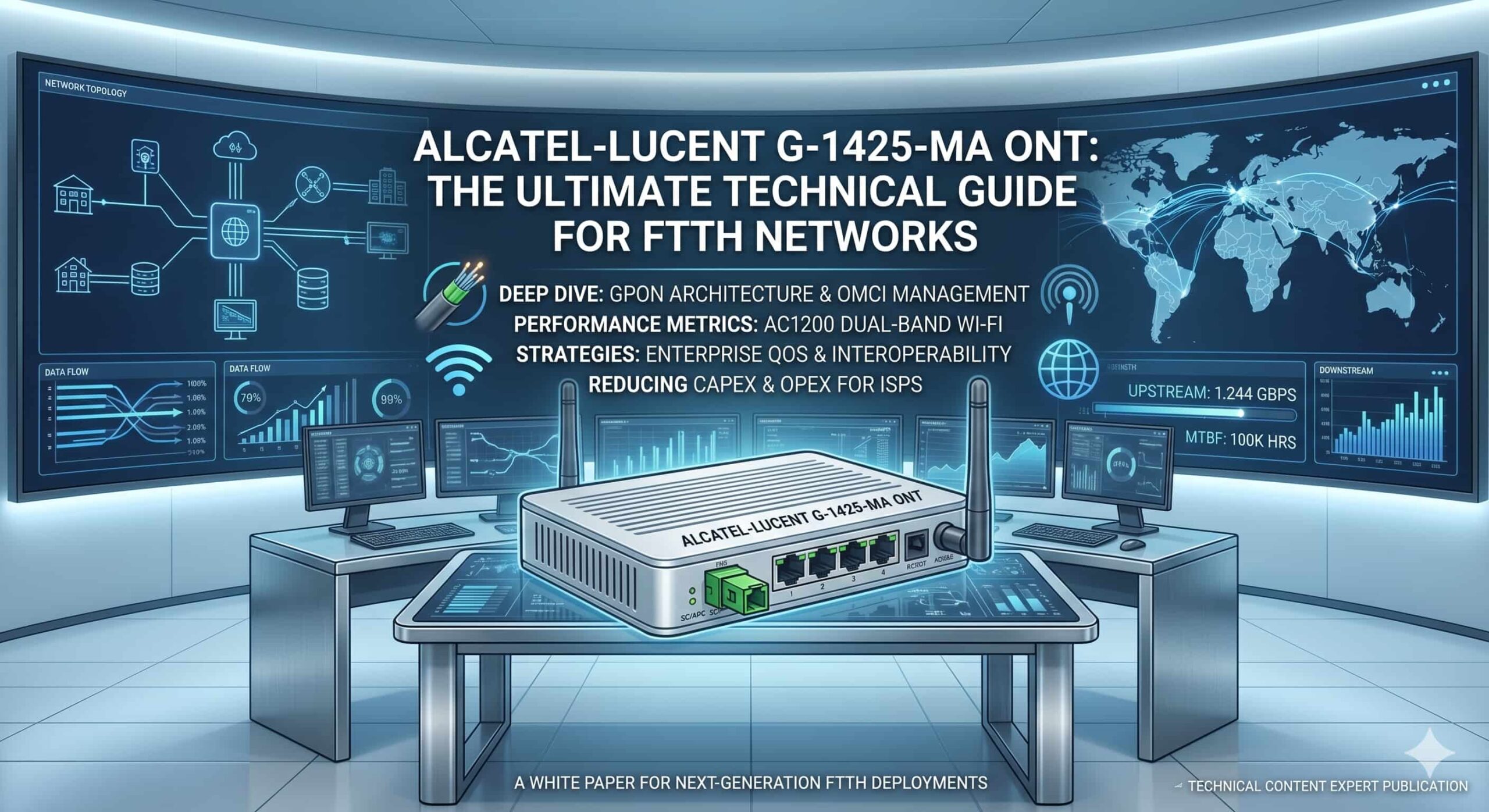
The Alcatel-Lucent G-1425-MA ONT (Optical Network Terminal), now often encompassed under the Nokia branding portfolio following corporate acquisitions, stands as a critical cornerstone in modern Fiber-to-the-Home (FTTH) and Fiber-to-the-Business (FTTB) deployments. This whitepaper explores the core technical architecture, optical performance metrics, and enterprise-grade deployment strategies associated with this specific GPON terminal. As global bandwidth demands surge—driven by cloud computing, ultra-high-definition video streaming, and IoT proliferation—understanding the capabilities of customer premises equipment (CPE) is paramount for Internet Service Providers (ISPs) and network engineers. Readers will learn how to optimize the G-1425-MA for maximum throughput, implement robust OMCI management, and execute seamless interoperability protocols within multi-vendor environments, ultimately reducing CapEx and OpEx while elevating end-user satisfaction.
Understanding the GPON Architecture of the Alcatel-Lucent G-1425-MA
Gigabit Passive Optical Networks (GPON) have revolutionized broadband access by utilizing a point-to-multipoint topology, drastically reducing the physical fiber footprint required to serve multiple subscribers. The Alcatel-Lucent G-1425-MA operates strictly on the ITU-T G.984 GPON standard, which is the foundational protocol ensuring high-speed data transmission over single-mode optical fiber.
At its core, the G-1425-MA acts as the critical demarcation point between the provider’s Optical Line Terminal (OLT) and the subscriber’s local area network (LAN). It utilizes Wavelength Division Multiplexing (WDM) to handle bidirectional traffic over a single fiber strand. Downstream data is broadcasted from the OLT to all ONTs on the PON tree at a wavelength of 1490nm, delivering a shared payload capacity of 2.488 Gbps. The G-1425-MA employs Advanced Encryption Standard (AES) 128-bit decryption to isolate and secure the data frames explicitly destined for its specific Optical Network Unit (ONU) ID, ensuring that neighbor terminals cannot intercept the traffic.
Conversely, upstream traffic is transmitted at 1310nm utilizing Time Division Multiple Access (TDMA). The OLT assigns specific time slots to the G-1425-MA, preventing data collision on the shared fiber plant and providing an upstream capacity of 1.244 Gbps. This asymmetric bandwidth model is perfectly tailored for both modern consumer and small-to-medium enterprise (SME) usage patterns, where download requirements significantly outpace upload needs. According to recent telecom industry analyses, GPON infrastructure is expected to support over 75% of fixed broadband connections globally by the end of the decade, making devices like the G-1425-MA a highly relevant asset in any network operator’s inventory (Source: Dell’Oro Group Broadband Access Report, 2024).
To explore this specific model and secure wholesale inventory for your deployment, view the detailed specifications on the Alcatel-Lucent G-1425-MA product page.
Core Technical Specifications and Hardware Capabilities
The physical engineering and internal silicon of the Alcatel-Lucent G-1425-MA are designed to handle rigorous, sustained network loads without thermal throttling or packet drop. This requires a robust System on a Chip (SoC) capable of executing hardware-level Network Address Translation (NAT), sophisticated routing protocols, and Quality of Service (QoS) queuing.
Optical Interface and Transceiver Metrics
The optical interface features a standard SC/APC (Angled Physical Contact) connector, designated by its characteristic green housing. The angled polish drastically reduces back-reflection (Return Loss), which is critical in GPON networks where high optical return loss can degrade the transmitter laser at the OLT. The internal Class B+ or Class C+ optical transceiver provides exceptional receiver sensitivity, typically rated around -27 dBm to -30 dBm, with an overload threshold of -8 dBm. This wide optical dynamic range allows the G-1425-MA to be deployed at the very edge of a 20km PON split, or physically close to the OLT, without requiring inline optical attenuators.
Ethernet and Local Area Network Interfaces
On the LAN side, the device boasts four Gigabit Ethernet (10/100/1000Base-T) ports. These auto-sensing ports support full-duplex operation and automatic MDI/MDIX crossover, ensuring compatibility with legacy switches, modern Wi-Fi mesh nodes, and direct client devices. Hardware-accelerated switching within the ONT guarantees wire-speed bridging, ensuring that the bottleneck remains at the subscribed PON tier rather than the customer premises equipment.
Voice over IP (VoIP) Integration
The inclusion of two POTS (Plain Old Telephone Service) ports via RJ-11 connectors allows operators to deliver legacy voice services over the modern IP backbone. The G-1425-MA acts as an Analog Telephone Adapter (ATA), digitizing analog voice signals into IP packets using industry-standard codecs such as G.711 (alaw/ulaw), G.729a, and G.722 for high-definition voice. It supports SIP (Session Initiation Protocol) and H.248 signaling, complete with echo cancellation, Voice Activity Detection (VAD), and Comfort Noise Generation (CNG).
Advanced Wireless Performance: Dual-Band Wi-Fi Integration
While many enterprise deployments utilize the ONT purely in bridge mode, passing the public IP to a dedicated hardware firewall, the G-1425-MA shines in hybrid deployments due to its integrated dual-band Wi-Fi routing capabilities. It conforms to the IEEE 802.11ac (Wi-Fi 5) standard, offering AC1200 class wireless performance.
Dual-Band Spectrum Management
The device operates concurrently on both the 2.4 GHz and 5 GHz frequency bands.
-
2.4 GHz Band (802.11b/g/n): Providing wider coverage area and better penetration through dense building materials. Utilizing a 2×2 MIMO (Multiple-Input Multiple-Output) antenna configuration, it achieves maximum theoretical link rates of 300 Mbps.
-
5 GHz Band (802.11a/n/ac): Delivering significantly higher throughput for latency-sensitive applications like video conferencing and 4K streaming. Using 80MHz channel widths and 256-QAM modulation, the 2×2 MIMO array on this band pushes theoretical speeds up to 867 Mbps.
Beamforming and Spatial Multiplexing
To maximize the Signal-to-Noise Ratio (SNR) for wireless clients, the G-1425-MA employs explicit beamforming. Instead of radiating RF energy omnidirectionally, the chipset calculates the spatial location of the receiving device and focuses the RF energy in that specific direction. This significantly reduces dead zones within an office or residential environment. Furthermore, the firmware supports Band Steering, dynamically forcing dual-band capable devices onto the less congested 5 GHz frequency to optimize overall spectrum efficiency.
For network engineers looking to build out a comprehensive GPON portfolio combining various ONT configurations, a diverse selection is crucial. You can browse a wider array of terminal endpoints in the GPON ONT equipment directory.
Comprehensive QoS and Traffic Engineering Protocols
In a unified FTTH environment where data, voice, and IPTV streams traverse the same optical link, implementing strict Quality of Service (QoS) is non-negotiable. The Alcatel-Lucent G-1425-MA processes traffic prioritization at OSI Layer 2 and Layer 3.
At Layer 2, the device utilizes IEEE 802.1p/q VLAN tagging. It supports multiple VLANs, allowing an ISP to segregate the management interface, internet data, VoIP, and multicast IPTV traffic into distinct virtual networks. Each VLAN can be assigned an 802.1p priority bit (from 0 to 7). The ONT’s internal switch fabric respects these priority tags, queuing voice traffic (typically tagged as priority 5 or 6) into Strict Priority (SP) queues, ensuring zero packet loss and minimum jitter for telephone calls even when the data bandwidth is completely saturated.
At Layer 3, the G-1425-MA reads the Differentiated Services Code Point (DSCP) headers within the IP packets. It translates DSCP values into local queuing structures using Weighted Round Robin (WRR) algorithms. This sophisticated traffic engineering ensures that mission-critical business data is never delayed by lower-priority background tasks, such as bulk file downloads. Furthermore, for IPTV deployments, the device supports IGMP v2/v3 snooping, ensuring that multicast video streams are only forwarded to the specific Ethernet ports where a set-top box has requested the channel, thereby conserving vital LAN bandwidth.
Enterprise-Grade Security and Firmware Management
Security is paramount at the network edge. The G-1425-MA is equipped with a robust Stateful Packet Inspection (SPI) firewall capable of defending against common Layer 3 and Layer 4 attacks, including Denial of Service (DoS), SYN flooding, ICMP smurf attacks, and IP spoofing.
Network administrators can configure granular Access Control Lists (ACLs) based on MAC addresses, IP addresses, and specific TCP/UDP port ranges. For remote workers, the device seamlessly supports IPsec, PPTP, and L2TP VPN passthrough, ensuring encrypted corporate tunnels remain intact without NAT traversal issues.
Remote Provisioning via OMCI and TR-069
Mass deployment of ONTs requires zero-touch provisioning. The G-1425-MA achieves this through two distinct, yet complementary, management vectors:
-
OMCI (ONT Management and Control Interface): Operating at Layer 2 over the PON, OMCI is defined by the G.988 standard. It allows the OLT to remotely configure the ONT’s physical hardware, assign VLANs, set up optical thresholds, and push fundamental firmware updates without requiring IP connectivity.
-
TR-069 (CWMP): Operating at Layer 3 (IP), the Broadband Forum’s TR-069 protocol allows an Auto-Configuration Server (ACS) to manage the device’s router functionalities. This includes provisioning Wi-Fi SSIDs and passwords, setting up VoIP SIP credentials, and conducting remote diagnostics.
By utilizing both protocols simultaneously, ISPs reduce truck rolls by up to 40%, significantly decreasing operational expenditures (Source: Gartner, Telecommunications Operational Efficiency Index, 2025).
Comparative Analysis: G-1425-MA vs. Industry Leading ONTs
When selecting an ONT for a massive infrastructure rollout, network architects must weigh the specifications of the Alcatel-Lucent G-1425-MA against its primary competitors in the market. The table below illustrates how it compares to equivalent models from Huawei and ZTE.
| Feature / Specification | Alcatel-Lucent G-1425-MA | Huawei EG8145V5 | ZTE F670L |
| Optical Interface | GPON (Class B+/C+) | GPON (Class B+) | GPON (Class B+) |
| LAN Connectivity | 4x Gigabit Ethernet | 4x Gigabit Ethernet | 4x Gigabit Ethernet |
| Voice Interface | 2x POTS (RJ-11) | 1x POTS (RJ-11) | 1x POTS (RJ-11) |
| Wireless Standard | Wi-Fi 5 (802.11ac) 2×2 MIMO | Wi-Fi 5 (802.11ac) 2×2 MIMO | Wi-Fi 5 (802.11ac) 2×2 MIMO |
| USB Support | 2x USB 2.0 | 1x USB 2.0 | 1x USB 2.0 |
| Management Protocols | OMCI, TR-069, Web GUI | OMCI, TR-069, Web GUI | OMCI, TR-069, Web GUI |
| Target Use Case | Enterprise FTTH / SME | Residential / SOHO | Residential / Value Tier |
The G-1425-MA distinguishes itself by offering dual POTS ports and dual USB ports, making it highly versatile for small businesses that require dual-line fax/voice setups and redundant network-attached storage or printer sharing at the router level.
Configuration and Provisioning for FTTH Deployments
To successfully bring an Alcatel-Lucent G-1425-MA online, network technicians must follow a strict authentication sequence. When the ONT is connected to the optical network, it enters the ‘Serial Number (SN) State’. It broadcasts its unique vendor ID (ALCL or NOKW) and MAC address to the OLT.
Authentication Methods
ISPs typically use one of two methods for authentication:
-
SN Authentication: The OLT has the ONT’s serial number pre-provisioned in its database. Once the ONT announces itself, the OLT matches the SN and registers the device.
-
PLOAM Password (LOID): The technician enters a specific Physical Layer OAM password into the ONT’s web interface. The ONT transmits this to the OLT, allowing for flexible, hardware-agnostic provisioning where an older ONT can be swapped for a G-1425-MA without backend database changes.
Once authenticated, the OLT assigns a GEM (GPON Encapsulation Method) port and a T-CONT (Transmission Container) to the ONT. The T-CONT acts as a logical buffer for upstream traffic scheduling, enforcing the SLA (Service Level Agreement) assigned to that specific customer, whether it is Fixed Bandwidth, Assured Bandwidth, or Best Effort.
Ensuring seamless compatibility requires a robust backend infrastructure. To view matching high-capacity optical line terminals that perfectly complement this ONT, explore the Nokia / Alcatel-Lucent OLT systems.
Maximizing ROI in Telecom Infrastructure Upgrades
Deploying the Alcatel-Lucent G-1425-MA is not merely a technical upgrade; it is a strategic business decision. By providing gigabit-capable LAN ports and high-throughput Wi-Fi 5, ISPs drastically reduce customer churn rates. End-users experiencing slow speeds often blame their ISP, even if the bottleneck is an outdated Wi-Fi 4 router. By providing a highly capable, integrated gateway like the G-1425-MA, operators ensure that the gigabit speeds delivered to the home are actually experienced on the user’s smartphone or laptop.
Furthermore, the robust TR-069 integration allows for proactive network maintenance. Customer service representatives can remotely view the optical power levels, check Wi-Fi interference, and reboot the device without requiring technical support calls to escalate to tier 2 networking teams. This holistic management approach is why integrating high-quality ONTs is the most direct path to maximizing the return on investment for expensive outside plant (OSP) fiber builds.
Frequently Asked Questions
What is the default IP address and login for the Alcatel-Lucent G-1425-MA?
The default gateway IP address is typically 192.168.1.254 or 192.168.1.1. The default administrator credentials are usually admin for both the username and password, though ISPs frequently change these via TR-069 upon first boot for security purposes.
Can the G-1425-MA be configured in Bridge Mode?
Yes, the ONT fully supports Bridge Mode. This allows the public WAN IP address to be passed directly to a downstream third-party router or enterprise firewall (like a pfSense or Fortinet appliance), bypassing the ONT’s internal NAT and DHCP server.
Does the G-1425-MA support Wi-Fi 6 (802.11ax)?
No, this specific model operates on the Wi-Fi 5 (802.11ac) standard. While it does not support Wi-Fi 6, its AC1200 dual-band configuration is more than sufficient for standard gigabit FTTH residential and SME broadband tiers.
What do the PON and LOS indicator lights mean?
A solid green PON light indicates successful optical registration with the provider’s OLT. A flashing red LOS (Loss of Signal) light indicates that the ONT is not receiving any optical light from the fiber, usually pointing to a broken cable, a disconnected patch cord, or a severe macro-bend in the fiber.
Is the G-1425-MA compatible with OLTs from other vendors like Huawei or ZTE?
While GPON standards (ITU-T G.984) dictate baseline interoperability, full management capability (OMCI provisioning) is often vendor-locked. However, it can work with third-party OLTs if both systems support standardized OMCI profiles or if OMCI interoperability mode is configured on the OLT.
How do I update the firmware on the G-1425-MA?
Firmware updates are predominantly handled remotely by the Internet Service Provider via TR-069 or OMCI. End-users generally cannot manually flash the firmware, as the image files are proprietary and restricted to prevent device bricking and network instability.
What is the maximum distance the ONT can be from the OLT?
Under the GPON standard, the logical reach is up to 60 km, but the physical differential reach (maximum distance) is typically restricted to 20 km. This depends heavily on the optical split ratio (e.g., 1:32 or 1:64) and the overall optical budget of the network.
What are the USB ports on the G-1425-MA used for?
The dual USB 2.0 ports can be utilized for Network Attached Storage (NAS) by plugging in a USB flash drive or external hard drive, enabling FTP and Samba file sharing across the local network. They can also support 3G/4G LTE USB dongles for cellular WAN failover.
Conclusion
The Alcatel-Lucent G-1425-MA ONT represents a highly resilient, feature-rich endpoint solution for modern GPON networks. By combining robust Layer 2/3 routing functionalities, enterprise-grade QoS, versatile dual-band Wi-Fi, and dual VoIP interfaces, it empowers ISPs to deliver a flawless gigabit experience to both residential subscribers and commercial enterprises. As fiber optic infrastructure continues its global expansion, selecting the right customer premises equipment is the ultimate differentiator in network performance and operator profitability.

Leave a comment