

EXECUTIVE SUMMARY
This document establishes authoritative power dissipation benchmarks for 800G optical transceivers in QSFP-DD and OSFP form factors. As hyperscale and AI-driven networks transition from 400G to 800G lane speeds, thermal management and power budgeting have emerged as primary architectural constraints. The data presented herein synthesizes vendor datasheets, MSA compliance specifications, and emerging architecture guidelines to provide network architects with actionable power envelopes for deployment planning.
800G optical modules typically consume between 12W and 18W for standard DSP-based implementations, with linear drive architectures reducing this figure to the 6W–9W range for short-reach applications. The OSFP form factor, benefiting from approximately 30% greater heat dissipation surface area, supports higher power envelopes suitable for coherent and long-reach optics, while QSFP-DD prioritizes port density and backward compatibility with existing 400G infrastructure.

ARCHITECTURE & CHASSIS DESIGN
FORM FACTOR THERMAL ENVELOPES
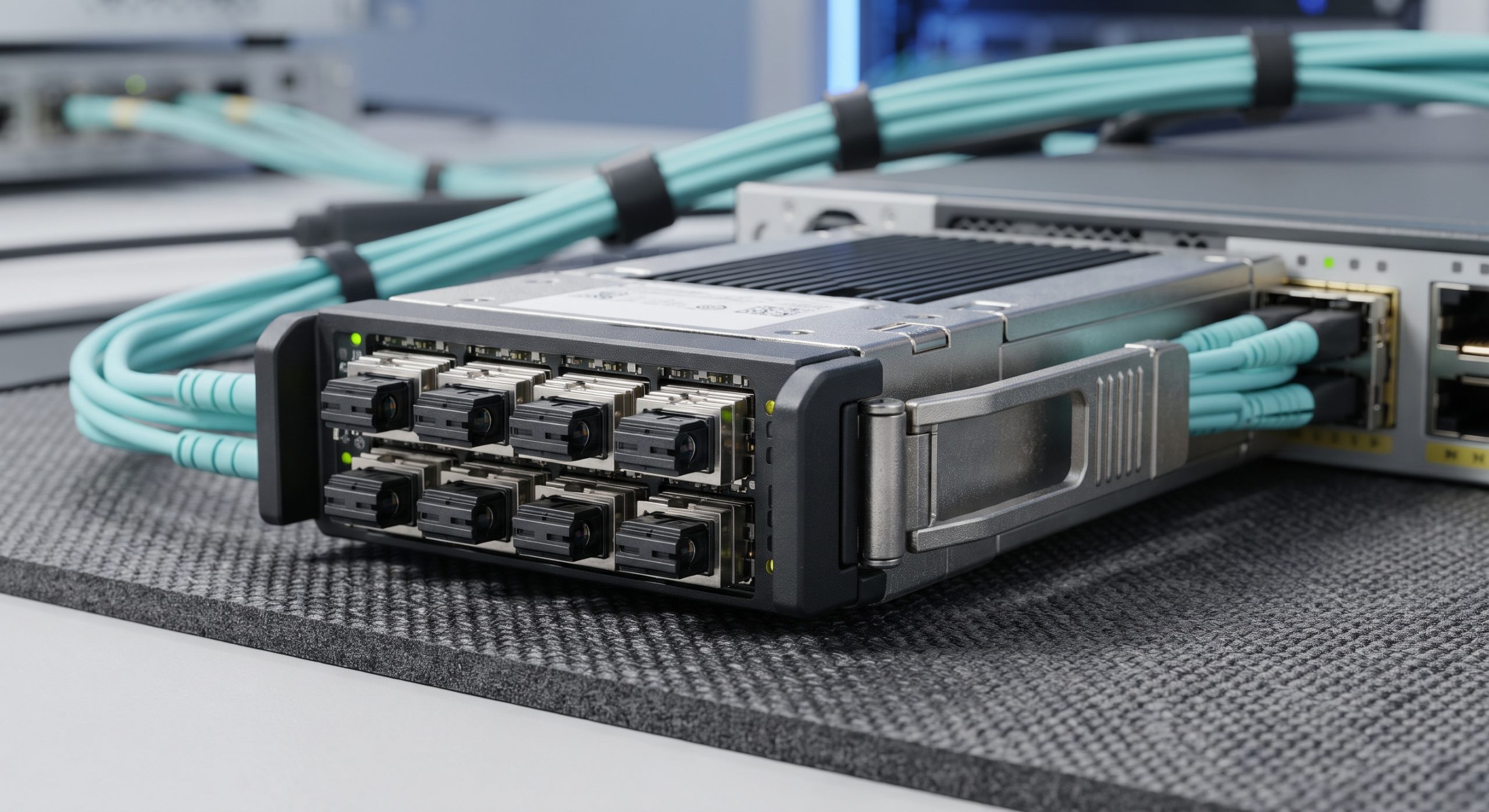
The fundamental power dissipation ceiling of an 800G transceiver is dictated by its physical form factor and the associated thermal pathway to the host chassis. QSFP-DD modules, with their compact 18.35mm width, rely primarily on chassis-level airflow for heat rejection, yielding a practical power envelope of approximately 12W to 16W for standard optics. OSFP modules occupy a larger 22.5mm footprint with integrated heat dissipation features, enabling sustained operation at 15W to 20W and supporting high-power coherent variants up to approximately 24W.
DSP ARCHITECTURE IMPACT
The digital signal processor remains the dominant power consumer within standard pluggable modules. Conventional fully-retimed 800G modules incorporate DSPs that contribute significantly to the 14W–18W typical range. Emerging Linear Pluggable Optics (LPO) architectures remove the onboard DSP entirely, delegating signal processing to the host ASIC and reducing module power to 6W–9W at the cost of stricter link engineering requirements. Linear Receive Optics (LRO) offers an intermediate path at 9W–12W, retaining a reduced-function DSP on the transmit side while employing linear receive techniques.
HARDWARE FEATURES
POWER DISSIPATION BY OPTICAL INTERFACE TYPE
Standard 800G Ethernet optics exhibit distinct power signatures correlated with reach and modulation complexity. SR8 modules utilizing VCSEL-based multimode transmission typically dissipate below 16W, with many implementations targeting the 12W–14W typical range. DR8 single-mode modules operating at 500m reach consume approximately 14W–16W typical, with maximum ratings capped at 16W–18W across vendor datasheets. Longer-reach 2xFR4 and 2xLR4 variants increase to 15W–18W typical as CWDM and additional optical components add dissipation. Coherent 800G ZR modules represent the upper bound at 20W–25W typical and approaching 30W maximum.
COMPLIANCE & STANDARDS
All benchmarked power figures reference modules compliant with QSFP-DD MSA or OSFP MSA specifications, IEEE 802.3ck electrical interfaces, and CMIS management standards. Thermal specifications assume commercial case temperature operation from 0°C to 70°C. Power measurements are conducted per MSA-defined test conditions unless otherwise noted.
TECHNICAL SPECIFICATIONS
The following table consolidates benchmark power dissipation values across the 800G transceiver portfolio. Figures represent typical and maximum values as reported in vendor datasheets and industry reference architectures. Network architects should apply appropriate derating factors for elevated ambient temperatures or restricted airflow conditions.
| Module Type | Form Factor | Typical Power | Maximum Power | Architecture | Target Reach |
|---|---|---|---|---|---|
| 800G SR8 | QSFP-DD / OSFP | 12–14W | 16W | VCSEL MMF | 50–100m |
| 800G DR8 | QSFP-DD / OSFP | 14–16W | 16–18W | PAM4 Direct Detect | 500m |
| 800G 2xFR4 | OSFP | 14–16W | 18W | Dual FR4 | 2km |
| 800G 2xLR4 | OSFP | 15–18W | 20W | CWDM SMF | 10km |
| 800G ZR | OSFP | 20–25W | 30W | Coherent DSP | 80km |
| 800G LPO | QSFP-DD / OSFP | 6–9W | 9W | Linear (No DSP) | 500m |
| 800G LRO | QSFP-DD / OSFP | 9–12W | 14W | Reduced DSP | 2km |
ORDERING OPTIONS
Power-optimized 800G transceiver variants are available across both form factors. For QSFP-DD deployments prioritizing backward compatibility and port density, standard DR8 and SR8 modules provide 16W maximum envelopes. For OSFP platforms supporting AI fabric and spine applications, LPO variants at sub-9W and standard DR8 modules at 15W maximum are recommended. Coherent ZR applications require OSFP form factor with thermal provisioning for 25W–30W per port.
📥 Download Technical Specification
Click the button below to view or download the full official PDF datasheet.

Leave a comment