

The SLA Imperative: Why CGNAT Reliability Dictates Subscriber Trust
Carrier-Grade NAT (CGNAT) is no longer a transitional compromise; it is the foundational IPv4 address preservation mechanism for service providers operating under chronic address scarcity. However, the term “carrier-grade” implies a standard of availability that exceeds enterprise expectations—typically 99.999% service uptime. When a CGNAT cluster fails, the impact is not merely degraded performance; it is a total loss of broadband, voice, and enterprise VPN connectivity for tens of thousands of subscribers simultaneously. The architectural decision to centralize stateful translation creates a single point of failure that must be mitigated through rigorous hardware redundancy, deterministic failover logic, and empirical reliability metrics. This analysis dissects the redundancy models and Mean Time Between Failures (MTBF) characteristics essential for CGNAT deployments scaling beyond 100 Gbps.

Dual-Engine Failover Architecture: Beyond Simple Active-Standby
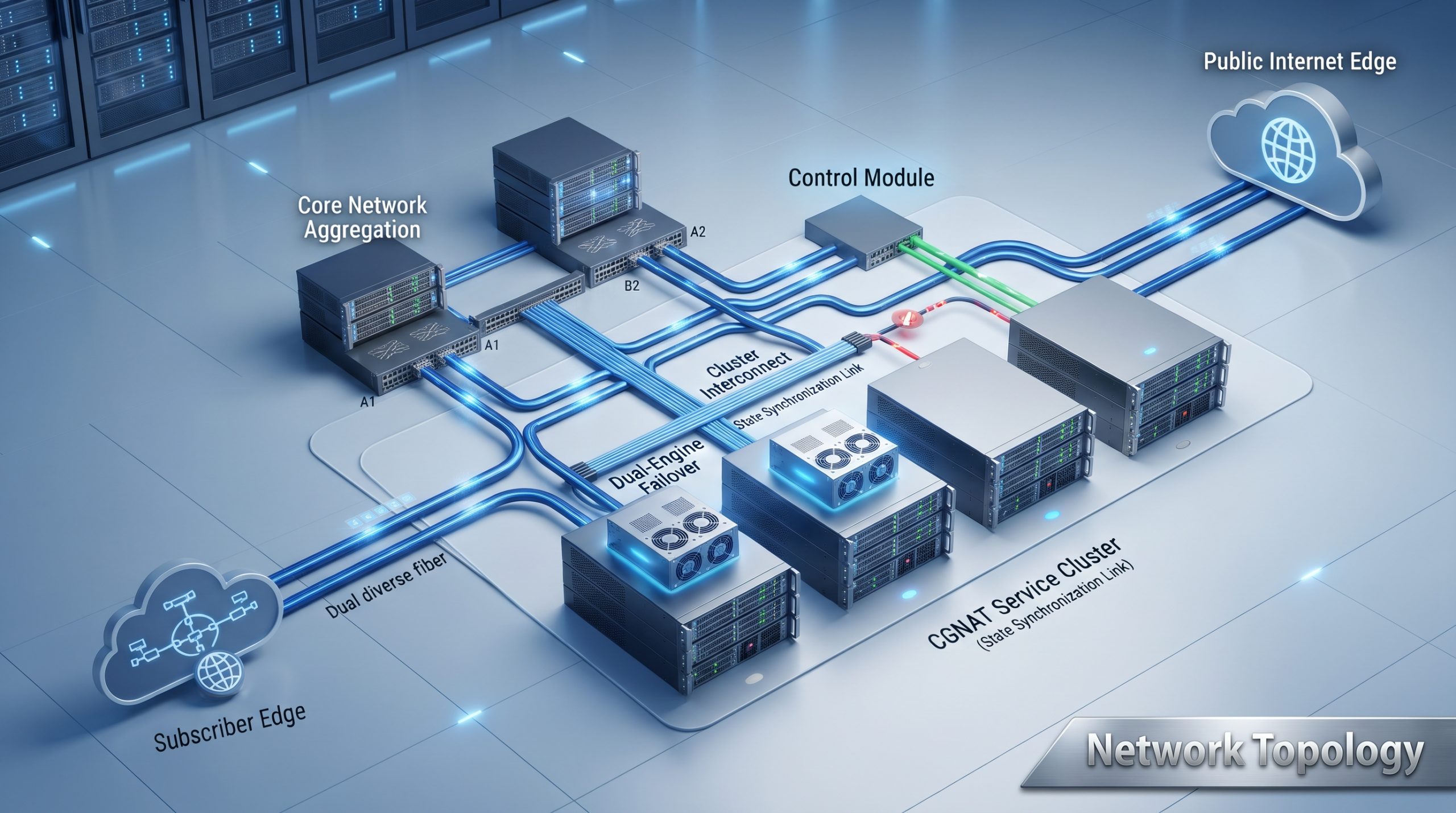
Legacy high-availability designs relied on VRRP with stateful session synchronization, a model that introduces unacceptable convergence latency for real-time traffic under CGNAT loads. Modern carrier-grade platforms employ dual-engine failover with deterministic session replication. In this architecture, the control plane maintains synchronized subscriber port-block allocations across both active and standby engines, while the data plane utilizes hardware-accelerated session mirroring.
Session Synchronization Latency and Its Impact on SLA
The critical metric here is failover convergence time. For TCP-based services, a sub-second failover (typically sub-10 ms failover for established flows, though new session establishment experiences a brief spike in translation latency during the transition window.
N+1 Clustering and Geographic Redundancy
Single-chassis redundancy is insufficient for carrier-grade reliability at scale. The reference architecture mandates N+1 clustering across physically disparate data centers. When a node failure occurs, the cluster manager redistributes the affected subscriber port-blocks to surviving nodes. This redistribution must be deterministic to preserve lawful intercept logging integrity—a non-negotiable requirement under regulations such as the FCC’s CALEA and the EU’s Data Retention Directive. Platforms supporting up to 16-node clusters enable horizontal scaling while maintaining a unified management plane .
Quantifying Reliability: MTBF, MTTR, and the Real Cost of Downtime
Vendor datasheets often cite impressive MTBF figures, but these numbers demand contextual interpretation. An MTBF of 200,000 hours at the component level translates to a significantly lower system-level reliability when factoring in power supplies, fans, and optical transceivers. The system MTBF for a fully populated CGNAT chassis with redundant components typically ranges from 50,000 to 80,000 hours. However, MTBF alone is misleading without considering MTTR (Mean Time To Repair). A hot-swappable fan tray with a 5-minute MTTR contributes negligibly to service impact; a failed supervisor engine requiring chassis replacement introduces hours of risk.
The financial calculus is stark. For a Tier-1 ISP serving 1 million subscribers, a one-hour total CGNAT outage can trigger SLA credits exceeding $250,000, excluding churn and reputational damage. This justifies the premium for true carrier-grade hardware over enterprise-grade alternatives: the cost of downtime dwarfs the CapEx delta.
| Key Parameter | Technical Specification |
|---|---|
| Chassis Throughput (Full Redundancy) | 400 Gbps – 800 Gbps per cluster |
| Session Failover Convergence | |
| System MTBF (Redundant Configuration) | > 75,000 hours |
| Cluster Node Scalability | Up to 16 nodes (N+1 survivability) |
| Session Capacity (Per Cluster) | Up to 1.5 Billion concurrent sessions |
| Port-Block Allocation Determinism | Reversible per-subscriber logging (RFC 6908 compliant) |
| Compliance Standards | ITU-T Y.1564 (service activation), IEEE 802.3 (physical layer), RoHS (environmental) |
Mission-Critical Deployment Scenarios: Redundancy in Practice
Scenario A: Tier-1 Broadband Aggregation
A national ISP deploying CGNAT for 1.2 million subscribers across three regional hubs requires more than raw throughput. The design must survive the loss of an entire hub without exceeding 0.01% session drop rate. This is achieved through a two-layer redundancy model: intra-hub 1+1 chassis redundancy with sub-50 ms failover, and inter-hub anycast-based traffic steering that redirects new sessions to surviving hubs within 200 ms. The critical constraint is preserving existing sessions during hub failure—a challenge that demands synchronous state replication across metro distances (
Scenario B: Mobile Network Operator (MNO) Gi-LAN
For MNOs, CGNAT sits between the mobile core and the public internet. Reliability requirements are compounded by 3GPP specifications for session continuity. A failed CGNAT node must not tear down GTP-U tunnels or trigger PDP context deactivation. The solution involves deep integration with the mobile core’s N3 interface and graceful session draining during planned maintenance. Platforms that support hitless software upgrades—where the control plane transitions to the standby engine without dropping active sessions—are mandatory for maintaining five-nines availability during patch cycles.
Final Assessment: Redundancy as a Design Principle, Not a Feature
The evaluation of CGNAT scaling for IPv4 address preservation must prioritize reliability engineering over headline throughput figures. A platform capable of 800 Gbps but lacking deterministic session replication is, in operational terms, a liability. The convergence of dual-engine failover, N+1 clustering, and sub-10 ms state synchronization transforms CGNAT from a necessary compromise into a reliable, transparent service delivery function. As IPv4 address scarcity persists indefinitely, the carriers that invest in robust, MTBF-validated CGNAT infrastructure will differentiate themselves not through raw capacity, but through the invisible reliability that subscribers expect and regulators demand.
Leave a comment