

Carrier-Grade Reliability: Evaluating MTBF and Redundancy in State-Synchronization Protocols for Stateful Router Failover
In carrier-grade IP/MPLS backbones and data center edge fabrics, a routing engine failure that causes session state loss translates directly into dropped subscriber traffic, BGP flap storms, and SLA violations. The distinction between stateful failover and mere hardware redundancy lies entirely in the fidelity and velocity of state-synchronization protocols. While a standby Route Processor (RP) may be physically present and powered, it remains operationally useless without a continuous, ordered, and acknowledged replication of control-plane state—including BGP RIB entries, MPLS label bindings, and subscriber session contexts. This analysis examines the architectural mechanisms, synchronization cadence, and reliability metrics that determine whether a failover event is invisible to the forwarding plane or catastrophic.

Dual-Engine Failover Architecture and State Chain Synchronization
Push-Based State Replication vs. Polling Architectures
The fundamental design choice in stateful router failover is whether the standby RP polls the active RP for state updates or whether the active kernel pushes updates asynchronously. Modern carrier-grade routers employ push-based state chain synchronization, where the active primary kernel replicates state changes to the standby kernel via a dedicated inter-process communication daemon (often termed ksync or async daemon) . This approach eliminates the polling latency and control-plane overhead associated with legacy synchronization, reducing convergence time during failover to sub-second thresholds.
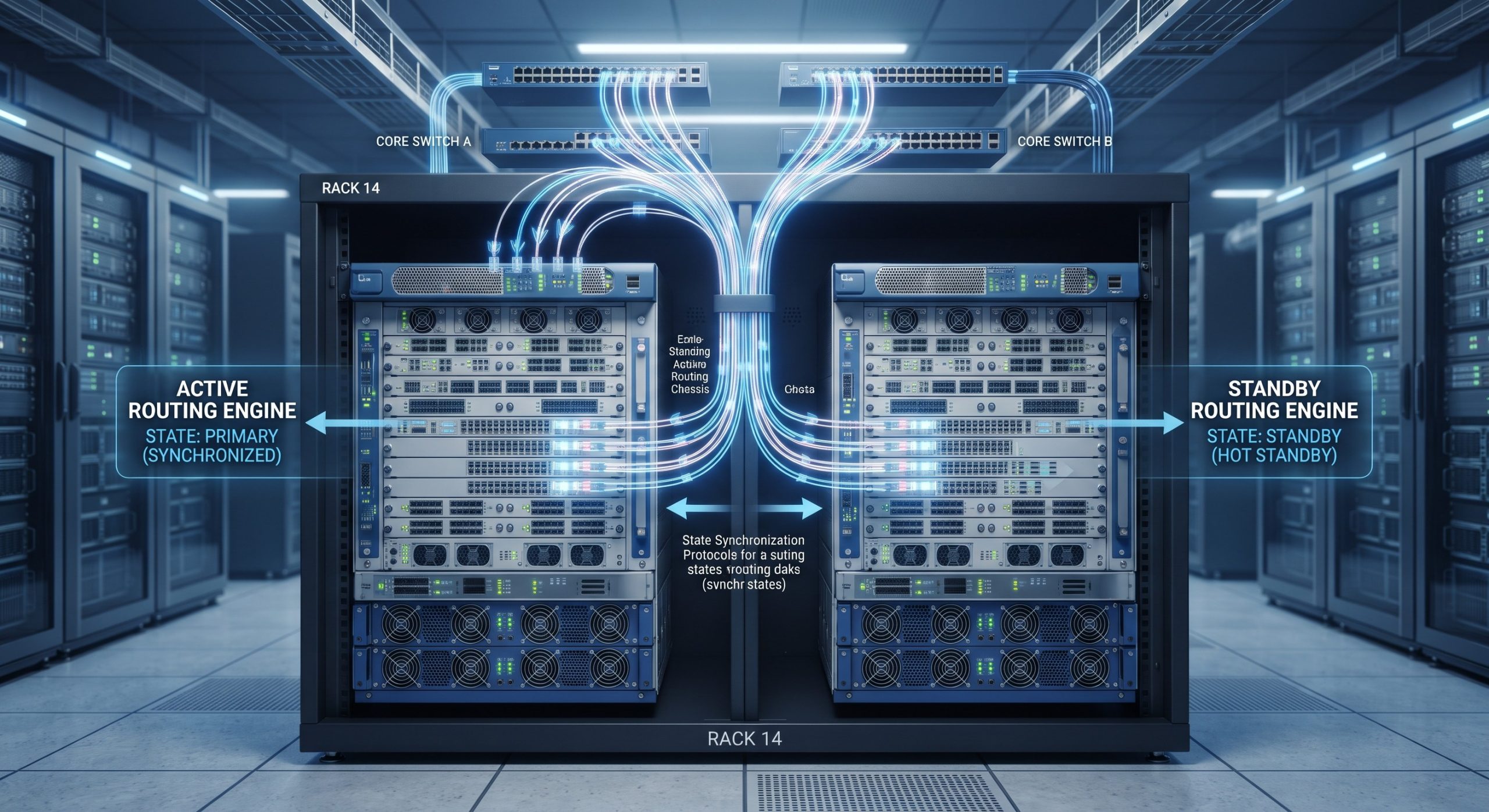
In a multi-chassis or high-availability cluster deployment, the synchronization granularity extends beyond the route processor to line card Forwarding Engines (PFEs). Each state update object is appended to a temporally ordered state chain, with commit markers and commit proposals inserted to track which objects have been acknowledged by downstream consumers—including standby RPs, PFEs, and chassis daemons . The active RP will not release a state update for forwarding until the standby RP and all relevant PFEs have acknowledged receipt, ensuring that the standby is capable of immediate packet forwarding upon role transition.
Session-Level State Granularity
For stateful services beyond pure routing—such as NAT, firewall sessions, and subscriber management—the synchronization protocol must capture session bindings rather than just routing table entries. In load-sharing NAT redundancy deployments, routers exchange newly generated session bindings immediately upon creation via a direct synchronization link or intermediate network, allowing the peer router to maintain a combined, complete set of bindings . Upon failure of the active router, the standby can assume all active sessions without re-establishing TCP handshakes or re-generating NAT translations, achieving true hot-switchover semantics.
Protocol Compliance and Operational Parameter Limits
The synchronization control channel itself must be hardened against failure to prevent split-brain scenarios. Carrier-grade implementations leverage Bidirectional Forwarding Detection (BFD) for rapid peer liveness detection, combined with a control interface protocol that enforces authentication (MD5) and configurable hello/hold timers . The synchronization link should be physically diverse from the data forwarding path to prevent correlated failures.
| Key Parameter | Technical Specification |
|---|---|
| Synchronization Model | Push-based state chain with commit markers and acknowledgment tracking |
| Failover Detection | BFD (Bidirectional Forwarding Detection) with sub-second hello intervals |
| State Granularity | RIB entries, MPLS label bindings, NAT/session bindings, interface state |
| Control Channel Auth | MD5 authentication on inter-chassis redundancy control link |
| Standby Acknowledgment | Per-object commit proposal acknowledgment before active forwarding release |
| Target Availability | 99.999% (carrier-grade, per Telcordia SR-332 prediction methodology) |
| Failover Latency Target |
Mission-Critical Deployment Scenarios and Reliability Validation
In a tier-1 ISP core routing cluster supporting 100 Gbps line-rate interfaces and 10+ million BGP prefixes, the synchronization protocol must sustain state update throughput without introducing control-plane CPU saturation. Telcordia SR-332 reliability prediction procedures provide the framework for calculating expected failure rates (in FITs) and validating that the redundancy architecture achieves the required availability targets—typically 99.999% or better for carrier-grade nodes . A properly synchronized standby RP with acknowledged state chain replication effectively reduces the control-plane MTTR to the failover detection and switchover latency, often under 200 ms with BFD-driven triggers.
Field validation should include forced failover testing under full state load, verifying that the standby RP assumes control with zero packet loss for established sessions and that BGP adjacencies remain stable without requiring session resets. The synchronization protocol’s acknowledgment mechanism provides a deterministic audit trail: if the standby has acknowledged a state object, it possesses the information required to forward traffic for that state upon promotion.
Final Assessment
State-synchronization protocols are the invisible backbone of carrier-grade router redundancy. Without rigorous, acknowledged, and ordered state replication, a standby Route Processor is merely a cold spare—capable of booting, but incapable of forwarding. The architectural distinction between push-based state chain synchronization with commit markers and legacy polling mechanisms determines whether a failover event is a transparent blip or a service-affecting outage. For network architects specifying core routing platforms, the synchronization protocol’s acknowledgment semantics, BFD integration, and session-binding granularity should be treated as first-class evaluation criteria alongside switching capacity and port density.

Leave a comment