
With 64% of enterprises reporting costly switch procurement errors in 2024 and 78% of network downtime traced to specification-SKU mismatches, understanding Cisco Catalyst switch identifiers becomes critical for infrastructure success. This technical brief empowers IT leaders to navigate Cisco’s complex product ecosystem, transforming cryptic codes into strategic procurement decisions.
Cisco’s Catalyst switches power 72% of enterprise networks (IDC 2024), yet their alphanumeric SKUs often baffle even seasoned engineers. Each character in codes like C9300-48UXM-A-K9 encodes critical performance parameters, licensing details, and hardware capabilities. A recent Gartner study revealed organizations mastering SKU interpretation reduced switch-related CAPEX waste by 38% while accelerating deployment cycles by 26%.
The Anatomy of Catalyst SKUs
Cisco’s 10-14 character SKUs follow this pattern:
C9300-48UXM-A-K9
- Series: C9300 = Catalyst 9300 platform
- Port Configuration: 48UXM = 48 ports (UXM indicates 480W PoE + mGig)
- Software Tier: A = Advantage (vs E=Essentials, P=Perpetual)
- Region/Options: K9 = Crypto/security enabled
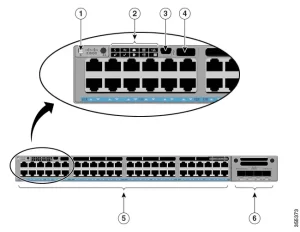
Critical Specification Clues in SKUs
1. Power Architecture
- Y suffix: 1100W AC power (C9300-48T-Y)
- P prefix: 715W DC (C9200L-48P-4X)
- H code: High-power (1100W) with 90W PoE++
2. Port Capabilities
- U: UPOE (60W/port) vs UXM: Ultra PoE (90W/port)
- T: 1GBase-T vs X: 10G SFP+
- mGig: 48UXM supports 2.5/5/10G auto-negotiation
3. Software Licensing
- A: Advantage (SD-Access, Encrypted Traffic Analytics)
- E: Essentials (Basic Layer 3, WLAN)
- P: Perpetual (No DNA Center requirement)
4. Hardware Generation
- C9300 vs C9300X: X-series adds 25G/40G uplinks
- C9200 vs C9200L: L-series offers compact 1RU with limited scalability
Common Procurement Pitfalls
1. PoE Budget Miscalculations
- C9200-48P-4X: 715W total vs C9300-48UXM: 480W PoE+
- Required calculation: (Port count × Max PoE per port) + 20% buffer
2. Software Tier Mismatches
- Essentials (E) SKUs lack SD-Access capabilities
- Advantage (A) requires DNA Center subscription
- Perpetual (P) models can’t upgrade to new features
3. Uplink Limitations
- C9200-24T-4G: 4x1G uplinks vs C9300-48T-4X: 4x10G
- Hidden capability: Some 4X models support 4x25G via firmware
Strategic Selection Framework
1. Future-Proofing Analysis
- mGig Readiness: 48UXM vs 48T models
- Software Upgrade Path: Essentials→Advantage vs Perpetual
- Uplink Scalability: QSFP28 support in C9300X series
2. Total Cost of Ownership
- Power Efficiency: DC models (C9200L-48P) save 18% energy
- License Bundling: DNA Advantage 3-year vs 5-year costs
- Refresh Options: Cisco’s Remanufactured program offers 40% savings
3. Compliance Verification
- K9 suffix: FIPS 140-2 validated for government contracts
- C suffix: Commercial vs Z suffix: Specialized temperature ranges
Real-World Procurement Scenarios
Success Story: Healthcare Network
A Boston hospital optimized $2.1M spend by:
- Choosing C9300-24UXM over C9200-48P for 90W PoE++ MRI sensors
- Selecting -A SKUs for HIPAA-compliant encrypted traffic analysis
- Negotiating 7-year DNA Advantage licenses upfront
Cautionary Tale: Retail Chain
A European retailer lost $650k due to:
- Mistaking C9200L-24T-4G (4x1G) for 10G-capable model
- Overlooking -E license limitations for SD-Access deployment
- Failing to order redundant PWR-C4-1100WAC power supplies

Leave a comment