

Introduction: The Clock is Ticking on Legacy SDH Networks
For over two decades, the Synchronous Digital Hierarchy (SDH) has been the bedrock of telecom transport networks, providing the deterministic latency and physical layer security that mission-critical applications demand. However, the digital landscape has shifted. With the exponential growth of data driven by cloud computing, 4K/8K video, and AI, the limitations of SDH have become glaringly apparent. The last major update to the SDH standard was finalized in 2007, and vendors have long ceased investing in new equipment development . The industry has reached a critical inflection point, making SDH to OTN Migration not just a technical upgrade but a strategic imperative for survival and growth.
This guide serves as a comprehensive blueprint for network architects and systems integrators navigating this complex transition. We will dissect the technical drivers, explore the architectural nuances of Optical Transport Network (OTN) and its new fine-grain variants, and provide data-driven insights from real-world carrier deployments to ensure your migration is seamless, cost-effective, and future-proof.

The Business & Technical Drivers for SDH to OTN Migration
The case for migrating from SDH to OTN is overwhelming, driven by a confluence of operational pain points and evolving market demands.
1. The Capacity Crunch and Bandwidth Explosion
SDH technology simply cannot meet the expected bandwidth requirements of new technologies. Individual SDH containers have a maximum size of 155Mbit/s, and there is a fundamental limit of 10Gbit/s in any single fiber within an SDH network . In contrast, modern OTN standards support 100G, 200G, and even 400G per wavelength, offering a bandwidth increase of up to 100x or more, as demonstrated in carrier deployments where capacity leaped from 100M to 10G . This scalability is critical for supporting high-bandwidth video surveillance, real-time digital twins, and massive IoT data aggregation.
2. End-of-Life (EOL) and Operational Inefficiencies
A vast majority of SDH equipment currently in operation is well past its expected 10-15 year lifespan. Many devices are in an End-of-Sale (EOS) or End-of-Life (EOL) state, making spare parts procurement difficult and expensive . This aging infrastructure is also an energy and space hog. Real-world data from recent large-scale migrations reveals the significant operational cost savings:
- Energy Consumption: The removal of legacy SDH gear yields dramatic energy savings. For example, China Telecom’s migration in Chizhou saved over 600,000 kWh annually , while other operators report savings ranging from 400,000 to over 1.1 million kWh per year .
- Space Optimization: SDH networks require vast amounts of physical real estate. Migrations have liberated hundreds of square meters of valuable datacenter floor space—for instance, clearing over 350 racks and 110 sqm in one deployment and 178 standard racks in another .
3. The Rise of Fine-Grain OTN (fgOTN) and VC-OTN
A key historical barrier to migration was the inefficiency of mapping low-speed legacy SDH services (E1/T1, 2M/4M) into standard OTN containers. The minimum OTN container (ODU0) is 1.25Gbit/s, which leads to significant bandwidth wastage . This challenge has been decisively solved by the ITU-T’s standardization of fine-grain OTN (fgOTN), finalized in late 2023. The fgOTN standards introduce flexible containers (fgODUflex) with a minimum granularity of approximately 10Mbit/s, enabling efficient and deterministic transport of sub-1G services while retaining the hard-pipe isolation of SDH .
Similarly, Virtual Concatenated OTN (VC-OTN) has been widely deployed to aggregate and migrate SDH services, offering a robust, highly reliable migration path that balances capacity and cost .
Core Architecture & Hardware Topology of the Target OTN Network
Modern OTN networks are engineered for high-density, carrier-grade performance, representing a complete overhaul of the legacy SDH architecture. The transition shifts the network from a rigid, TDM-centric topology to a flexible, multi-service transport fabric.
1. Hardware Modernization: From Legacy to High-Density Platforms
New-generation OTN platforms, such as Huawei’s OSN 9800 series or ZTE’s M-OTN solutions, are designed to replace racks of outdated SDH equipment. For instance, in the Shandong Mobile migration, a single pair of OSN 1800V devices replaced multiple legacy SDH shelves, achieving a significant 30% improvement in migration efficiency . These new chassis are characterized by:
- High-Density Line Cards: Supporting 100G/200G/400G interfaces.
- Flexible Tributary Slots: Supporting a mix of legacy interfaces (E1, STM-1/4/16) and modern Ethernet (GE, 10GE).
- Integrated ASIC Processing: Dedicated silicon for FEC, grooming, and OAM with zero impact on forwarding performance.
2. The ASIC Packet Forwarding Pipeline
Unlike SDH’s rigid time-slot switching, OTN leverages high-performance ASICs for efficient packet and frame processing. The pipeline typically involves:
- Ingress Processing: Mapping client signals (Ethernet, SDH, etc.) into OTN frames (OPU/ODU).
- Cross-Connect Grooming: Performing complex ODUk/fgODUflex cross-connect switching at sub-50ms protection speeds.
- Egress Processing: Adding Forward Error Correction (FEC) and transmitting the optical signal. The use of FEC is a major advantage, improving optical signal-to-noise ratio (OSNR) and enabling longer transmission distances without regeneration .
| Parameter | Legacy SDH Network | Modern OTN Target Network | Quantified Gain |
|---|---|---|---|
| Max Capacity per Fiber | 10 Gbps | 100G / 200G / 400G+ | > 10x – 40x increase |
| Min. Service Granularity | 155 Mbps (VC-4) | ~10 Mbps (fgODUflex) | Efficient low-speed service transport |
| Power Consumption per Node | High (e.g., 100+ Amps) | Reduced by up to 60-70% | Significant OpEx and carbon footprint reduction |
| Rack Space per Node | Large (Multiple Racks) | High-Density (1-2 Racks) | Frees up to 400+ sqm of floor space |
| Network Latency (Typical) | Variable / Multi-Hop | Deterministic Sub-ms (e.g., 1ms city) | Enhanced SLA for latency-sensitive apps |
| Service Provisioning | Days / Weeks (Manual) | Minutes (AI/Intent-Based) | >80% reduction in delivery time |
| Protection Switching | Sub-50ms (Linear/MSP) | Sub-50ms (Enhanced with fgOTN) | Carrier-grade reliability and resilience |
The Migration Strategy: A Phased Approach for Zero-Disruption
Migrating from a live SDH network to OTN is a high-stakes operation requiring meticulous planning and execution. The industry has converged on a proven, phased strategy to mitigate risks and ensure service continuity.
Phase 1: Audit, Planning, and Tooling
This initial phase is the most critical. Carriers like Anhui Telecom and Shandong Mobile have leveraged specialized digital tools to conduct an exhaustive audit of the existing SDH network . This involves:
- Inventory & Services Audit: Identifying every piece of active equipment, its port utilization, and the specific services running through it. This often includes using cloud-based platforms to analyze ineffective services and traffic flows.
- Customer Segmentation: Developing a ‘one-customer, one-plan’ migration strategy, prioritizing services based on business impact and SLAs . High-value government or financial circuits may require a more conservative, parallel approach.
Phase 2: Building the OTN Target Network
A parallel OTN overlay network is established. The goal is to create a robust, intelligent base network with broad coverage. For example, the ‘One-Fiber’ strategy deployed in various regions ensures the new OTN network covers all high-value nodes and datacenter resources, laying the groundwork for the migration . This network features:
- Core Layer: High-speed OXC/OTN backbones.
- Aggregation Layer: VC-OTN/PeOTN nodes that serve as the primary collection points for SDH traffic.
- Intelligent Network Cloud Engine (NCE): A unified management system for end-to-end service provisioning, path computation, and health monitoring.
Phase 3: Execution – From Bottom-up to End-to-End Cutover
The actual service migration is executed methodically, often utilizing a bottom-up approach—moving services off the access and aggregation layers first, before tackling the core . Two primary models are employed:
- Point-to-Point/Incremental Migration: Legacy circuits are individually or in small batches re-provisioned onto the new OTN network. This method is lower risk but slower.
- Ring/Node Modernization: This is the more efficient, radical approach used in successful projects like the ‘Global First’ project in Shaoguan . It involves building a new OTN infrastructure for a specific geographic ring and then performing a cutover of the entire ring’s traffic in one operation, drastically shortening the migration timeline by up to 80% .
Key to this phase is the use of automated tools to generate cutover scripts and verification plans, reducing human error and ensuring a smooth, lossless migration .
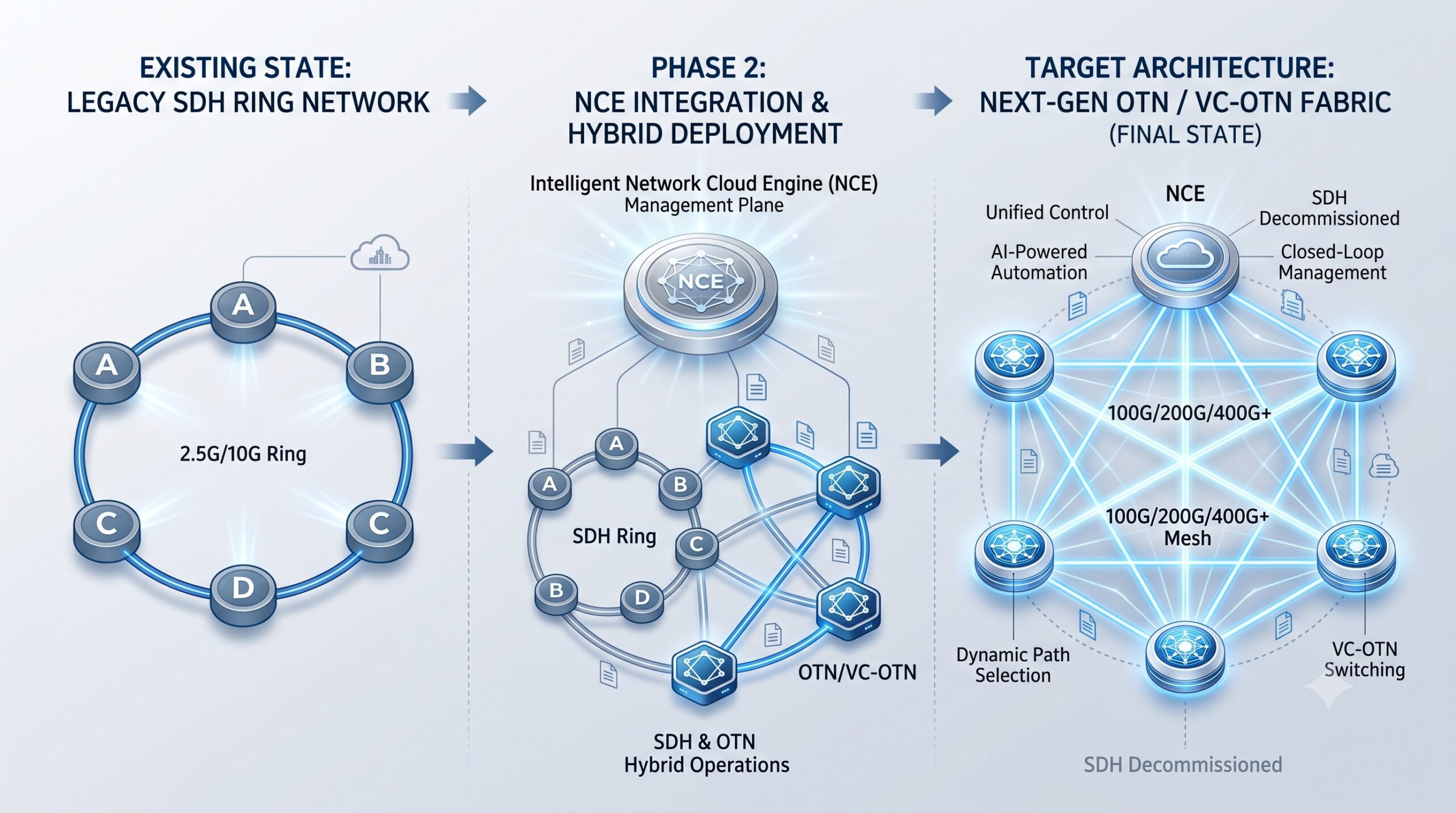
Measurable Gains: Quantified Operational Gains from Real-World Deployments
The benefits of a completed SDH to OTN migration are tangible and immediate. By analyzing recent carrier-grade rollouts, we can quantify the return on investment across several key metrics.
1. Operational Expenditure (OpEx) Reduction
- Energy Efficiency: The migration eliminates power-hungry legacy gear. Annual energy savings reported range from 400,000 kWh to over 1.1 million kWh, correlating to significant cost reductions and a drastic decrease in carbon footprint (equivalent to planting thousands of trees annually) .
- Space & Maintenance: The high-density nature of modern OTN equipment frees up precious floor space (hundreds of square feet/racks) and simplifies network complexity, directly reducing rental, cooling, and maintenance costs .
2. Performance and Service Delivery Gains
- Bandwidth Scaling: The new infrastructure provides a 100-fold increase in bandwidth capacity, eliminating the 10Gbps fiber limit of SDH and allowing for future growth without costly fiber overbuilds .
- Ultra-Low Latency: Architecture optimizations and new ASIC designs enable the creation of ‘1ms city’ or ‘2ms provincial’ latency rings, critical for high-frequency trading and real-time industrial control .
- Service Agility: Intelligent O&M systems (e.g., NCE) enable ‘one-click’ service provisioning and real-time network health visibility, reducing service delivery times from days or weeks to minutes .
3. Enhanced Reliability and Security
OTN inherits SDH’s robust, deterministic characteristics while enhancing them with advanced features:
- Hard-Pipe Isolation: Guarantees physical layer security, crucial for government and financial clients.
- Carrier-Grade Resilience: Sub-50ms protection switching ensures SLAs are consistently met. New fgOTN standards further enhance this with hop-by-hop clock transmission for CBR services .
- Line-Rate Encryption: The ability to encrypt the entire payload at Layer 1 provides 100% link efficiency and ensures data integrity across the WAN .
Conclusion: The Strategic Imperative for SDH to OTN Migration
As the telecom industry accelerates towards the AI-driven era, the SDH to OTN migration is not merely an option but a fundamental requirement for long-term viability. The technical and operational evidence is unequivocal: legacy SDH networks are a bottleneck on growth, consuming excessive power and space while failing to meet the bandwidth and agility demands of modern digital services.
Conversely, the new generation of OTN, bolstered by recent ITU-T standards (fgOTN, G.709 Amd3), offers a future-proofed, high-efficiency architecture that seamlessly integrates legacy services with cutting-edge performance . The successful, large-scale carrier deployments across China—from Chizhou and Xinyang to Shandong and Shaoguan—demonstrate that a strategic, phased migration can deliver immediate OpEx savings, a 100x bandwidth upgrade, sub-ms latency, and intelligent, automated operations, all while supporting national carbon reduction goals.
For network architects and systems integrators, the message is clear: the time to plan and execute your SDH to OTN migration strategy is now. By adopting the proven methodologies outlined in this guide, you can transform your network into a high-quality, sustainable, and competitive asset ready to support the next wave of digital innovation.

Leave a comment