
Huawei CloudEngine 16800 is the data center switch built for the AI era. It uses innovative iLossless algorithm to learn and train network-wide traffic, implement zero packet loss and E2E μs-level latency, achieve the maximum throughput and enables more efficient NVMe and fully unleashes the value of all-flash storage. In addition, they support NOF+ technology to implement plug-
and-play of the storage system and fast fault detection. CloudEngine 16800 series switches provide stable, reliable, and secure high-performance Layer 2/Layer 3 switching capabilities to help build an elastic, virtualized, and high-quality network. CloudEngine 16800 series switches use an advanced hardware architecture design. The CloudEngine 16800 series provide up to 576 x 400GE, 768 x 100GE, 768 x 40GE, 792 x 25GE or 792 x 10GE line-rate ports and use an industry-leading backplane-free Clos architecture and provide industrial- grade reliability. The switches support comprehensive data center service features. Their front-to-back airflow design suits data center equipment rooms, and the innovative energy conservation technologies
greatly reduce power consumption.
The CloudEngine 16800 series switches are available in three models: CloudEngine 16804, CloudEngine 16808, and CloudEngine 16816.
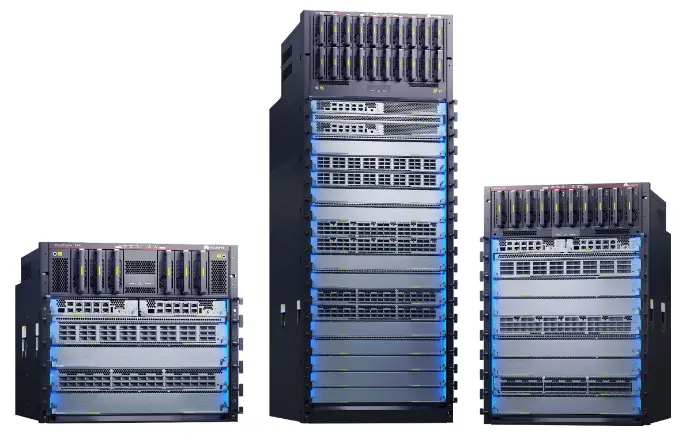
CloudEngine 16800 Series Data Center Switches Comparison
| Parameters | CE16804 | CE16808 | CE16816 |
| Switching Capacity | 45Tbps | 89Tbps | 178Tbps |
| Service Slots | 4 | 8 | 16 |
| Switching Fabric Module Slots | 9 | 9 | 9 |
| Fabric Architecture | Clos architecture, cell switching, VoQ | Clos architecture, cell switching, VoQ | Clos architecture, cell switching, VoQ |
| Airflow Design | Strict front-to-back airflow design | Strict front-to-back airflow design | Strict front-to-back airflow design |
| Virtualization | M-LAG VS (1:16 virtualization) Cluster Switch System (CSS) VXLAN and VXLAN bridging QinQ access VXLAN |
M-LAG VS (1:16 virtualization) Cluster Switch System (CSS) VXLAN and VXLAN bridging QinQ access VXLAN |
M-LAG VS (1:16 virtualization) Cluster Switch System (CSS) VXLAN and VXLAN bridging QinQ access VXLAN |
| L2/L3 | VLAN, STP, LACP Static route, IPv4/IPv6 dynamic route protocol IP packet fragmentation and reassembly |
VLAN, STP, LACP Static route, IPv4/IPv6 dynamic route protocol IP packet fragmentation and reassembly |
VLAN, STP, LACP Static route, IPv4/IPv6 dynamic route protocol IP packet fragmentation and reassembly |
| Reliability | Microsegmentation Hardware-based Bidirectional Forwarding Detection (BFD) |
Microsegmentation Hardware-based Bidirectional Forwarding Detection (BFD) |
Microsegmentation Hardware-based Bidirectional Forwarding Detection (BFD) |
| O&M | Telemetry ERSPAN+ iPCA |
Telemetry ERSPAN+ iPCA |
Telemetry ERSPAN+ iPCA |
| Programmability | Standard NETCONF interface Ansible-based automatic configuration and open-source module release |
Standard NETCONF interface Ansible-based automatic configuration and open-source module release |
Standard NETCONF interface Ansible-based automatic configuration and open-source module release |
Networking and Application
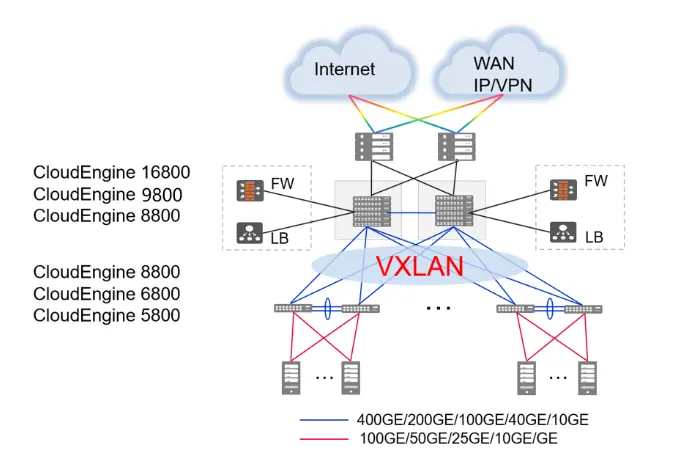
On a typical data center network, CloudEngine 16800 switches work as core switches, whereas CloudEngine 8800/CloudEngine6800/CloudEngine 5800 switches work as TOR switches and connect to the core switches using 400GE/200GE/100GE/40GE/10GE ports. The core and TOR switches use fabric technologies such as VXLAN to build a non-blocking large Layer 2 network, which allows for large-scale VM migration and flexible service deployment.
Note: VXLAN can also be used on campus networks to support flexible service deployment in different service areas.
If you have any questions, please feel free to contact: sales@telecomate.com.

Leave a comment