

Carrier-Grade SLA Demands in the Terabit Era
The migration to terabit-per-fiber transmission is no longer a roadmap item; it is a deployment reality driven by AI compute clusters, 800G/1.6T line cards, and the insatiable bandwidth appetite of hyperscale data center interconnects (DCIs). Extending the optical spectrum from the conventional C-band into the L-band doubles the available channel count within the same fiber pair, enabling 12 THz of usable bandwidth without new outside plant construction . However, for Tier-1 carriers and wholesale ISPs, raw capacity is only half the equation. The operational mandate remains absolute: carrier-grade availability (99.999% or higher), predictable mean time between failures (MTBF), and deterministic failover behavior under ITU-T G.709 framing and G.798 management hierarchies.
The shift from discrete C-band-only architectures to integrated C+L systems introduces nuanced reliability variables. While integrated designs eliminate discrete C/L multiplexing hardware—reducing insertion loss and footprint—they concentrate thermal density and complicate in-service maintenance . This analysis evaluates the redundancy architectures and reliability metrics that determine whether a C+L expansion meets SLA thresholds or becomes a liability in the backbone.

Dual-Engine Failover Architecture in Integrated C+L Line Systems
Optical Layer Protection Schemes
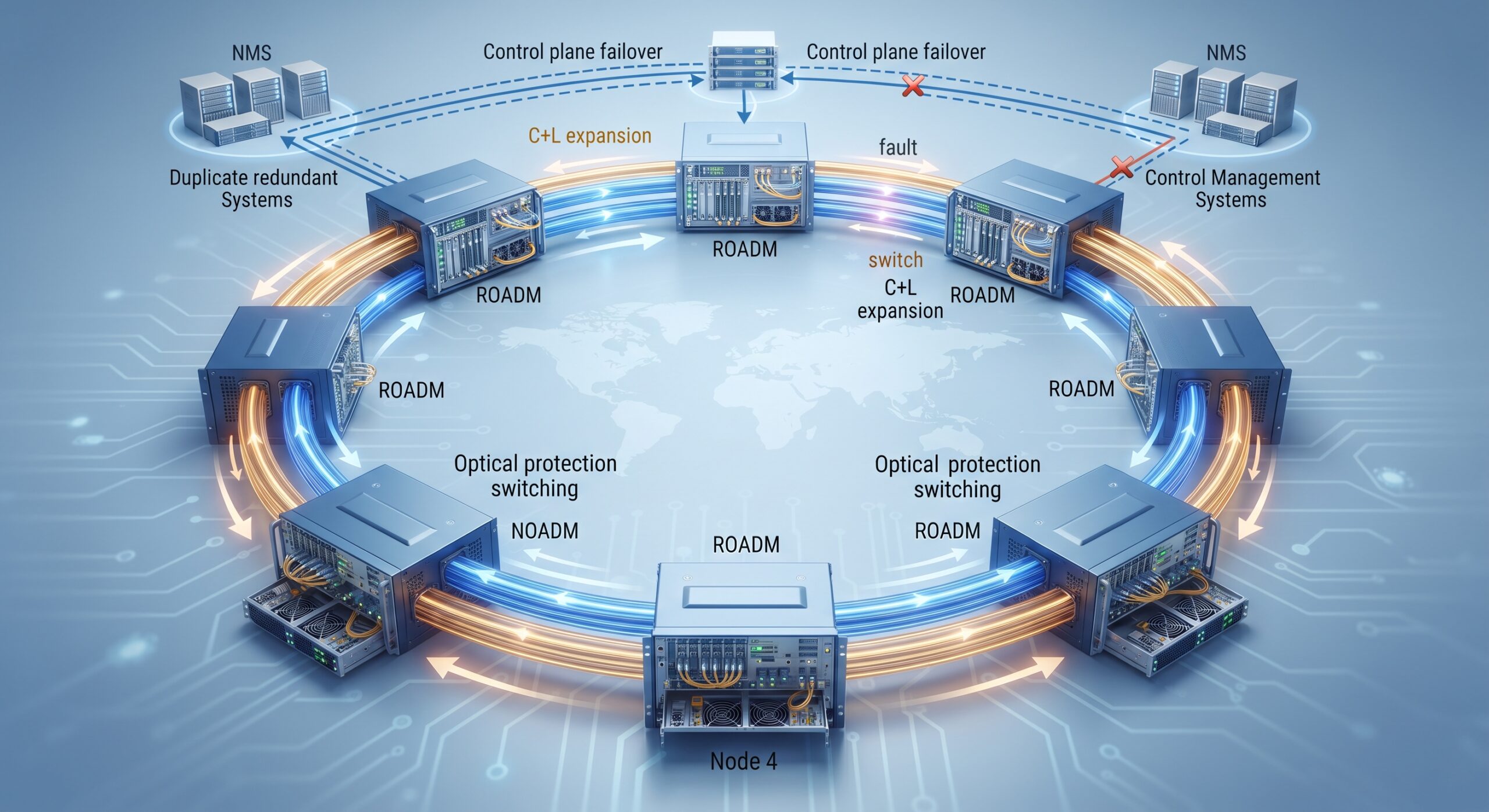
Carrier-grade C+L systems must support optical-layer ASON recovery with restoration times below 10 seconds for fiber cuts, and electrical-layer protection below 200 ms for equipment failures . The integrated architecture complicates this because a single EDFA or WSS failure can affect both bands simultaneously if not properly partitioned.
Leading implementations address this through split-band amplification chains with independent C-band and L-band EDFA modules feeding a common integrated WSS. In the event of a C-band pump laser failure, the L-band remains operational, preserving partial capacity and enabling graceful degradation rather than total span loss. The WSS itself must support 1+1 redundancy with hitless switchover, as it represents the single most critical optical component in a ROADM node.
Power and Thermal Redundancy
Integrated C+L line cards dissipate significantly more heat than C-band-only equivalents. The MTBF of an EDFA pump laser degrades exponentially with junction temperature; a 10°C rise can halve expected lifetime. Carrier-grade chassis therefore employ N+1 fan redundancy with tachometer feedback and thermal throttling thresholds tied to Telcordia GR-63-CORE operating ranges. Front-to-back airflow must be maintained across the full 12 THz spectrum card set, with per-slot airflow impedance matched to prevent hot spots in high-density shelves.
Control Plane Resilience
The WSON control plane must maintain state synchronization across C and L band resources. In integrated systems where OTU and WSS are co-managed, a control card failure can orphan wavelength resources. Dual control cards with sub-50 ms stateful failover are mandatory for SLA compliance. The G.709 OTN layer provides TCM (tandem connection monitoring) sublayer visibility, enabling rapid fault isolation across multi-vendor spans without dispatching field technicians.
| Key Reliability Parameter | Carrier-Grade Specification |
|---|---|
| System-Level MTBF (10-span link, protected) | ≥ 400,000 hours |
| Optical Layer Restoration (ASON) | |
| Electrical Layer Protection Switch | |
| Control Plane Failover | |
| EDFA Pump Laser Derating Threshold | ≤ 45°C junction temperature |
| WSS Hitless Switchover | 1+1 redundancy, zero traffic loss |
| Operating Temperature Range | -5°C to +55°C (Telcordia GR-63-CORE) |
| Compliance Standards | ITU-T G.709, G.798, RoHS 3, IEEE 802.3 |
MTBF Metrics and Field Reliability Data
Component-Level Failure Rates
Published field data for C+L integrated line systems indicates MTBF figures exceeding 400,000 hours for the optical amplifier subsystem when operating within RoHS-compliant thermal envelopes. The dominant failure modes are:
- Pump laser diode degradation: gradual output power decline triggering automatic shutdown at 80% threshold.
- WSS LCoS panel aging: insertion loss creep over 10+ years of continuous operation.
- Thermoelectric cooler (TEC) failure in ITLA modules: causes wavelength drift beyond ±2.5 GHz tolerance.
Integrated C+L designs reduce total component count by approximately 30% versus discrete C/L architectures, which theoretically improves system-level MTBF by eliminating inter-card connectors and redundant multiplexing optics . However, the concentrated thermal load in integrated WSS modules requires derating analysis to ensure that the theoretical MTBF gain is not negated by elevated operating temperatures.
System Availability Calculation
For a representative 10-span C+L link with integrated OLA sites, the calculated availability using Telcordia SR-332 methods yields 99.9992% (approximately 4.2 minutes of unplanned downtime annually) when protected with optical-layer ASON and dual control planes. This assumes a mean time to repair (MTTR) of 4 hours for line card replacement, achievable only with hot-swappable, front-accessible C+L cards and pre-staged spares inventory.
Mission-Critical Deployment Scenarios
Submarine and Long-Haul Backbone
In unrepeatered and long-haul submarine segments, the reliability calculation shifts dramatically. The stimulated Raman scattering (SRS) tilt inherent in C+L transmission requires careful power pre-emphasis at the transmit end; a transponder failure that drops power on the short-wavelength C-band edge can cascade into L-band OSNR degradation across the entire span . Redundancy here focuses on transponder pool protection with pre-provisioned spare wavelengths and automated power re-optimization scripts triggered by OTU failure alarms.
Metro-Core DCI Interconnects
For 400G/800G DCI links spanning 80-120 km, the reliability calculus favors integrated C+L pluggable optics with 60% smaller footprint and 68% lower power per Gbit compared to discrete solutions . The reduced component count directly improves MTBF at the module level. However, operators must validate that the pluggable housing thermal design sustains the rated junction temperature under sustained 800G line-rate operation, particularly in high-ambient-temperature outside plant cabinets.
Final Assessment: When C+L Reliability Justifies the Migration
The reliability case for C+L optical band expansion is compelling but conditional. Integrated architectures deliver measurable MTBF improvements through component reduction and eliminate the failure-prone C/L multiplexing interface. The 12 THz spectrum enables terabit-per-fiber capacity with a hardware footprint that supports N+1 redundancy within standard 600mm racks .
However, the thermal density of integrated WSS and broadband EDFA modules demands rigorous derating verification. Operators should insist on field MTBF data exceeding 300,000 hours for integrated line cards and validate ASON restoration performance across the full C+L spectrum, not just the C-band slice. With these safeguards in place, C+L expansion meets the carrier-grade bar: 99.999% availability, sub-10-second optical restoration, and a predictable five-to-seven-year maintenance cycle under RoHS and ITU-T compliance regimes.

Leave a comment