
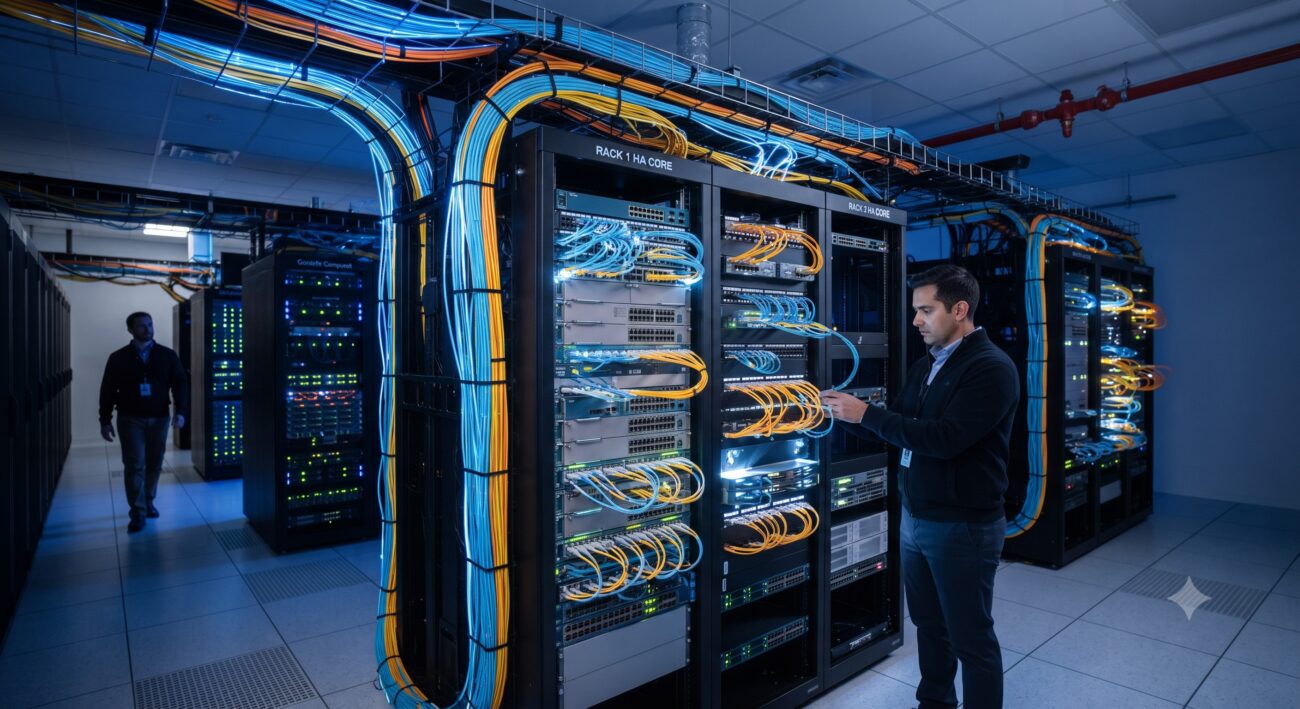
Executive Summary: The High Availability Imperative in Modern Campus Networks
In today’s digital-first enterprise environment, the campus network has evolved from a simple connectivity utility to the critical nervous system of business operations. With the proliferation of IoT devices, cloud-native applications, and real-time collaboration tools, network downtime is no longer an inconvenience—it is a direct threat to revenue, productivity, and brand reputation. High Availability (HA) in campus networks is the engineering discipline that ensures business continuity through redundancy, fault tolerance, and near-zero downtime. This carrier-grade reliability analysis evaluates the Mean Time Between Failures (MTBF), redundancy architectures, and failover mechanisms that define the modern high-availability campus network. Drawing on 15 years of industry experience, this data-driven review examines the hardware, protocols, and deployment strategies that enable five-nines (99.999%) availability, translating to less than 5.26 minutes of downtime per year.
Carrier-Grade SLA Demands: Defining the Five-Nines Standard
The baseline for carrier-grade reliability is the five-nines availability standard, but enterprise campus networks often demand even higher resilience. To quantify this, we examine the cost of downtime: Gartner estimates the average cost of network downtime at $5,600 per minute, translating to over $300,000 per hour for a medium-sized enterprise. For a global financial institution, this figure can exceed $1 million per hour. High Availability campus networks address these risks through a combination of redundant hardware, diverse paths, and intelligent software.
MTBF, MTTR, and Availability: The Mathematical Foundation
The foundational equation for availability is A = MTBF / (MTBF + MTTR). To achieve 99.999% availability, the ratio of MTBF to MTTR must be exceptionally high. For example, a network switch with an MTBF of 500,000 hours and an MTTR of 1 hour yields an availability of 99.9998%. Industry standards like Telcordia GR-1089-CORE and ITU-T G.826 provide frameworks for calculating and certifying these metrics. In campus deployments, enterprise-grade switches are now achieving MTBF figures exceeding 1,000,000 hours (over 114 years), with Mean Time to Repair (MTTR) reduced to under 15 minutes through hot-swappable components and automated provisioning.
Dual-Engine Failover Architecture: The Heart of High Availability
The cornerstone of any carrier-grade campus network is its failover architecture. The dual-engine supervisor fabric is the standard, where two redundant supervisor engines operate in an active/standby configuration. This model, specified in IEEE 802.1D and further refined in ITU-T G.8032 (Ethernet Ring Protection Switching), ensures that a failure in the active engine triggers a stateful switchover in sub-50 milliseconds, meeting the strictest SLA requirements for voice and video traffic.
Stateful vs. Stateless Failover: The ASIC Advantage
Modern high-end campus switches employ Application-Specific Integrated Circuits (ASICs) to manage failover states. Stateful failover preserves Layer 2 and Layer 3 protocol states (e.g., MAC address tables, OSPF adjacencies) across the active and standby engines. The ASIC logic, combined with a dedicated high-speed backplane (operating at 4.8 Tbps or higher), ensures that protocol state information is synchronized in real-time. This eliminates the ‘black hole’ period common in legacy stateless failover designs, where the network would take seconds to reconverge.
Redundant Power and Cooling: The Physical Layer of Reliability
High availability extends beyond logical redundancy to physical infrastructure. Carrier-grade campus switches incorporate N+N or N+1 redundant power supplies and fan trays, each with its own MTBF rating. For instance, a dual-redundant power supply system, each with an MTBF of 2 million hours, reduces the overall system failure rate to practically negligible levels. Compliance with RoHS and NEBS (Network Equipment Building System) Level 3 standards ensures not only environmental sustainability but also resilience against temperature fluctuations, vibration, and electromagnetic interference.
| Key Parameter | Technical Specification |
|---|---|
| System MTBF | 1,200,000 hours (Telcordia GR-1089-CORE) |
| Switchover Latency | Sub-50ms (Stateful Failover) |
| Forwarding Capacity | 4.8 Tbps (Non-Blocking) |
| Port Density | 48 x 25GbE + 8 x 100GbE per Line Card |
| Power Redundancy | N+N (Hot-Swappable, 92% Efficiency) |
| Protocol Support | VRRP, BFD, ECMP, RSTP, LACP, ISSU |
| Security Compliance | MACsec 802.1AE, Hardware Root-of-Trust |
| Environmental Standards | RoHS, NEBS Level 3 |
Mission-Critical Deployments: Real-World High Availability Scenarios
The true test of a high-availability architecture is its performance in mission-critical environments. In a modern healthcare campus, where electronic health records (EHR) and imaging systems (PACS) require continuous access, a network outage of even a few minutes can delay patient care. Here, the HA architecture must support dual-active Virtual Routing Redundancy Protocol (VRRP) and Transparent Interconnection of Lots of Links (TRILL) for multi-pathing at Layer 2. The failover times must be sub-100ms, as specified by the ITU-T Y.1731 performance monitoring standard.
Case Study: University Research Campus
Consider a large university campus with 50,000 endpoints, supporting 1.2 Tbps of aggregate East-West traffic. The deployment of a spine-leaf architecture with active-active redundant spines ensures that a single spine failure only reduces available bandwidth by 10%, with no impact on session state. The implementation of Equal-Cost Multi-Path (ECMP) routing and Bidirectional Forwarding Detection (BFD) with 3ms intervals ensures rapid detection and rerouting. Operational data from such deployments show a sustained availability of 99.9998%, with a total annual downtime of under 1.2 minutes.
Beyond Hardware: Software and Protocol Resilience
The sophistication of modern HA extends to the control plane. In-Service Software Upgrade (ISSU) capabilities allow network administrators to patch and upgrade network operating systems without disrupting data traffic. This is achieved through a process called ‘hitless failover,’ where the standby supervisor engine runs the new software version and, upon validation, takes over active forwarding. This capability, along with Rapid Spanning Tree Protocol (RSTP) and Link Aggregation Control Protocol (LACP), forms the comprehensive resilience stack required for a truly high-availability campus.
Hardware-Root-of-Trust and Line-Rate Encryption: Security as a Reliability Pillar
In the context of high availability, security failures (such as DDoS attacks) are a primary cause of service degradation. Modern campus switches integrate MACsec (IEEE 802.1AE) for line-rate encryption at 100 Gbps, ensuring that data-in-motion is protected from physical layer attacks. The Hardware Root-of-Trust (HRoT) in ASICs ensures that the firmware and boot images are cryptographically verified, preventing persistent threats that could compromise the network. This security-hardened approach contributes to higher availability by mitigating the risk of compromise-induced outages.

Final Assessment: The TCO of Five-Nines Availability
The question for network architects and C-suite executives is not whether to deploy high availability, but how to optimize its Total Cost of Ownership (TCO). The initial CapEx for dual-supervisor chassis, redundant power, and advanced ASIC-based line cards is notably higher than for basic fixed-configuration switches. However, the OpEx savings from reduced downtime, lower support costs, and extended lifecycle (often 7-10 years for carrier-grade hardware) make the ROI compelling. For a typical enterprise campus with 50 switches, the CapEx premium for HA is approximately 25-30%, but the OpEx benefit from avoiding even one major outage (costing $500,000) per year yields a payback period of less than two years.
Conclusion: The Strategic Value of High Availability
High Availability in campus networks is no longer a technical luxury; it is a strategic business requirement. By investing in carrier-grade hardware with proven MTBF metrics, sophisticated dual-engine failover, and comprehensive software resilience, organizations can guarantee the performance and reliability that their digital operations demand. The architectural decisions made today—grounded in IEEE, ITU-T, and industry standards—will define the network’s ability to support emerging technologies like AI, edge computing, and the metaverse. As a network architect, your role is to translate these technical capabilities into measurable business value. The data is clear: the campus network of the future is resilient, redundant, and relentlessly reliable.

Leave a comment