

Introduction: The Non-Negotiable Demand for Carrier-Grade Uptime
In the realm of telecommunications and enterprise WAN edge, network downtime is not merely an inconvenience—it directly correlates with lost revenue, diminished customer trust, and SLA penalties. For network architects and systems integrators, evaluating hardware reliability is paramount. The ZTE ZSR Router Series, encompassing the ZXR10 ZSR V2 family, is engineered to meet the rigorous demands of mission-critical environments. This analysis provides a data-driven examination of the ZTE ZSR Router specifications, focusing on the core architectural principles, MTBF metrics, and redundancy mechanisms that underpin its carrier-grade status. We move beyond theoretical marketing claims to dissect the hardware and software capabilities that ensure continuous operation, referencing industry standards like IEEE 802.3ah and the ITU-T specifications that govern modern networking .

Hardware Architecture: The Foundation of Reliability
The reliability of any routing platform begins at the silicon level. The ZTE ZSR series utilizes a modular hardware philosophy, designed to decouple control and data planes. High-end models like the ZSR3882 and ZSR3842 integrate high-performance RISC processors and dedicated ASICs for packet forwarding, ensuring that control plane processes (like routing table calculations) do not impede data plane throughput . This architecture is complemented by a high-speed internal switching bus, which facilitates seamless integration with Ethernet switching fabrics and provides the backplane capacity necessary for high-density configurations . The physical specifications across the series, such as the 19-inch rack-mountable chassis (442mm width) and operating temperature range (-5°C to 45°C), are designed to meet NEBS (Network Equipment Building Standards) expectations for telecom environments .
Port Density and Interface Flexibility
Flexibility is a key tenet of the ZSR design. The ZTE ZSR Router specifications reveal a broad spectrum of interface types to accommodate diverse WAN and LAN topologies. From the compact ZXR10 1800-2S supporting GE/FE and E1/CE1 interfaces, to the enterprise-grade ZXR10 2800-4 and 3800-8 models that boast 10GE, OC-3/STM-1 POS, and OC-48/STM-16 POS interfaces, the platform scales to meet branch and regional hub requirements . The modular slot architecture—ranging from 2 slots on the ZSR1822 to 8 slots on the ZSR3882—allows for custom configurations that avoid port wastage, a critical factor in CapEx optimization . All chassis support AC (110V/220V) and DC (-48V/-60V) power inputs, including HVDC (240V) options for data center deployments .
Quantifying Reliability: MTBF and the 200,000-Hour Benchmark
To evaluate carrier-grade hardware, we must examine the Mean Time Between Failures (MTBF). Across the ZSR family, including models like the ZSR3882 and ZSR1842, ZTE specifies an MTBF of 200,000 hours . This metric is not an arbitrary figure; it is a statistical prediction of reliability derived from component stress analysis and accelerated life testing. A 200,000-hour MTBF translates to a theoretical failure rate of approximately 1 failure per 22.8 years of continuous operation. To contextualize this, consider the Mean Time To Repair (MTTR) which is specified as 0.5 hours . This 30-minute MTTR is enabled by the hot-swappable modular design and redundancy features, ensuring that when a component does fail, operational impact is minimized.
| Specification Parameter | Metric / Value | Relevance |
|---|---|---|
| Mean Time Between Failures (MTBF) | 200,000 Hours | Carrier-Grade Reliability |
| Mean Time To Repair (MTTR) | 0.5 Hours (30 Minutes) | Serviceability |
| Operating Temperature Range | -5°C to 45°C | NEBS Compliance |
| Power Supply Redundancy | 1+1 (AC/DC/HVDC) | Fault Tolerance |
| Packet Forwarding (ZSR3882) | 600 kpps | Performance Benchmark |
Compliance and Standards
Hardware reliability is validated through adherence to rigorous international standards. The ZSR series meets stringent safety and electromagnetic compatibility (EMC) requirements, including UL1950, CSA C22.2 NO.950, EN60950, and IEC950 . On the environmental and EMC front, the platform complies with FCC Part 1.5, CSA C108.8, EN55022, and VCCI standards . This level of certification ensures that the hardware integrates seamlessly into existing infrastructure without introducing electromagnetic interference, a critical consideration in dense data centers .
Redundancy Architecture: N+N Power and Engine Failover
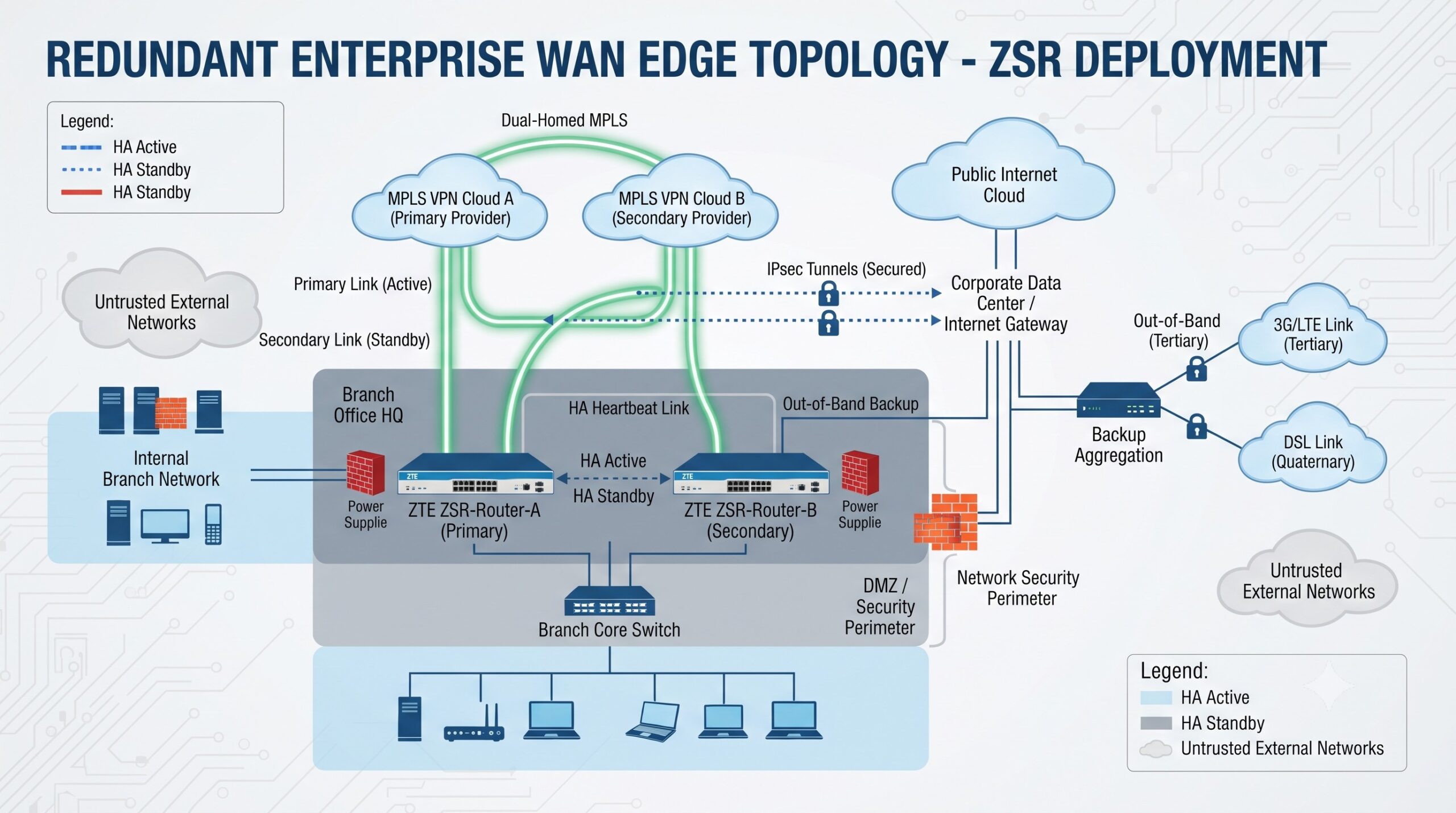
While a high MTBF is essential, true carrier-grade reliability is defined by fault tolerance. The ZTE ZSR routers employ a comprehensive redundancy strategy. Most importantly, the platforms support 1+1 power supply redundancy . This feature allows for dual AC or DC power feeds, or a mix of both, ensuring that a single power supply failure does not bring down the router. The ZTE ZSR Router specifications highlight a modular ROS (Routing Operating System) software platform that supports stateful failover. In configurations with redundant route processors or service modules, the system can maintain routing adjacencies and forwarding states during a failover event, ensuring sub-second convergence. Additionally, the system integrates features like uRPF (Unicast Reverse Path Forwarding) and support for diverse VPN link backups (DSL, 3G), which provide layer 3 and layer 2 redundancy paths for WAN connectivity . This holistic approach to redundancy ensures that the network edge remains operational even during hardware maintenance or unexpected failures.
Security and Integrity: Hardening the Edge
Network security is an integral component of reliability. The ZSR series acts as a router and security appliance in one, incorporating a built-in firewall and a proprietary intelligent security protection system known as AMAT (Automatic Malware Analysis and Defense) . This hardware-backed security framework offers protection against DDoS attacks, application-layer filtering, and access control lists (ACLs) that operate at line rate . The integration of IPsec, GRE, and L2TP VPNs alongside MPLS L2/L3 VPN capabilities ensures that data integrity and confidentiality are maintained across the WAN . The ZTE AMAT system is particularly noteworthy; it automatically identifies network attack patterns and generates proactive defense policies, adding an intelligent layer of security without manual intervention .
Conclusion: The Verdict on ZSR Reliability
Analyzing the ZTE ZSR Router specifications through the lens of carrier-grade reliability reveals a platform designed for persistence. The combination of a 200,000-hour MTBF, sub-30-minute MTTR, dual power supplies, and modular hardware architecture provides a robust foundation for network infrastructure. The commitment to industry standards (IEEE, ITU-T, and international safety norms) underscores its suitability for deployment in environments where downtime is unacceptable. While the specific configuration details vary across the product line, from the entry-level ZSR1809 to the high-density ZSR3882, the common thread is an engineering focus on redundancy and resilience. For systems integrators and network architects, the ZSR series offers a compelling proposition for WAN edge and enterprise branch connectivity, providing the operational gains necessary to support the bandwidth explosion of next-generation networks .

Leave a comment