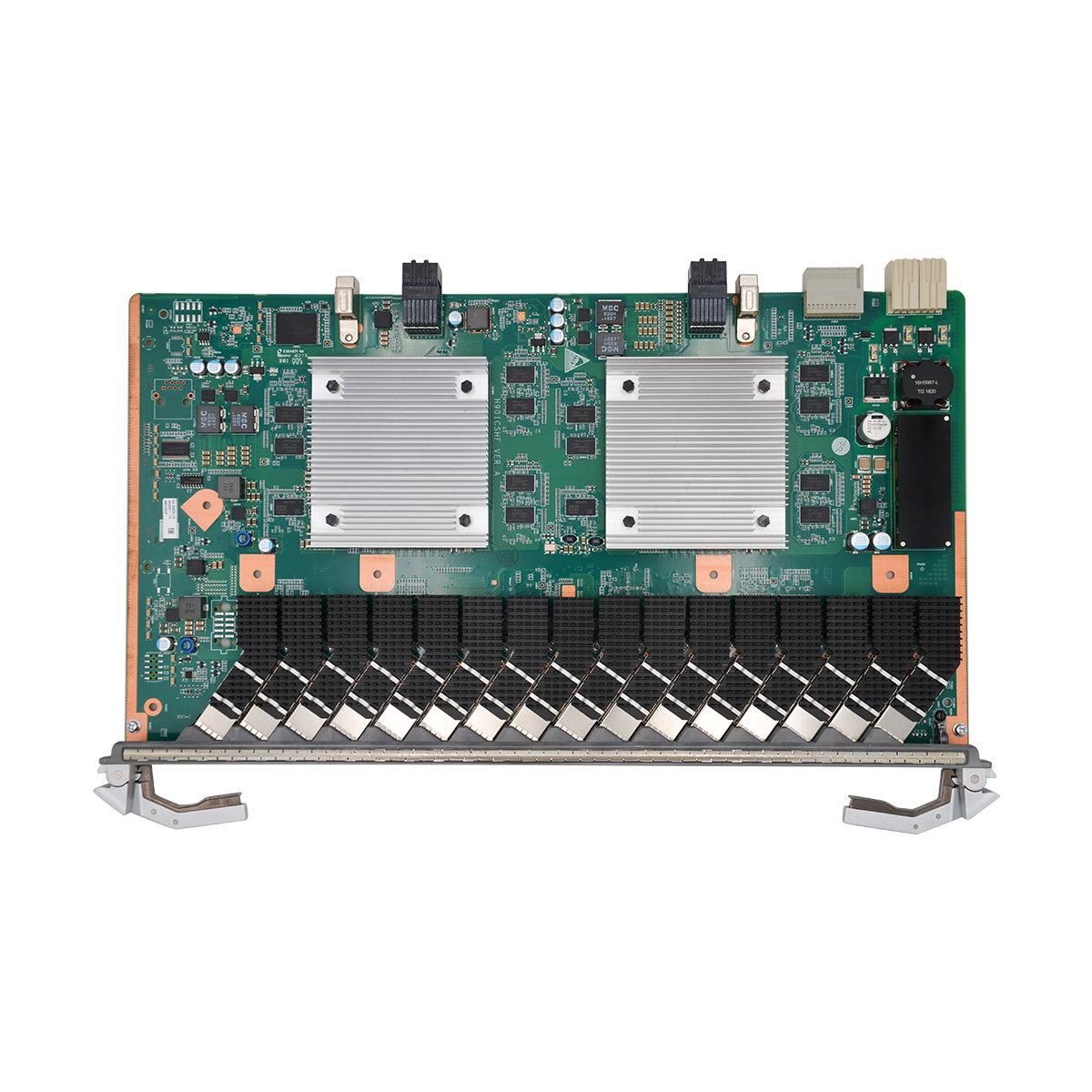



H901CSHF

10 Reviews Write a review
PN03025AJA
AvailabilityIn Stock
huawei-ma5800 Combo PON Board
WarrantyUp to 36 months i
×
Warranty Policy
We provide a comprehensive warranty policy.
Refer to the table for more details.

Original price was: $0.00.Current price is: $0.00.

Huawei H901CSHF MA5800 series 16-port XGS-PON and GPON combo OLT interface board with XGS-PON & GPON B+/C+ optical module, apply to MA5800 series

Description

Huawei H901CSHF is a 16-port XGS-PON and GPON Combo OLT interface board with XGS-PON & GPON C+ optical module. It works together with optical network unit(ONU) to provide XG(S)-PON and GPON access services.

Forwarding Capability: 200 Gbit/s

Max split radio: 1:256


Maximum Frame Size:
2052 bytes
9216 bytes (jumbo frame enabled)
T-CONTs per PON port:
GPON: 1024
XG-PON: 2048
Maximum number of MAC addresses: 131072
Service flows per PON board: 16352
Maximum distance difference between two ONUS under the same pon port: 40 km
GPON channel:
Tx: 2.488 Gbit/s
Rx: 1.244 Gbit/s
XGS-PON channel:
Tx: 9.953 Gbit/s
Rx: 9.953/2.488 Gbit/s

Front Panel

H901CSHF

H901CSHF Datasheet
Item H901CSHF
Service ports
Port 16
Forwarding capability 200 Gbit/s
Rate mode Asymmetric rate Symmetric rate
T-CONTs per PON port GPON:1024 XG(S)-PON:2048
Service flows per PON board 16352
Maximum frame size 2052 bytes 9216 bytes(jumbo frame enabled)
Maximum number of MAC addresses 131072
Maximum distance difference between two ONUS under the same pon port 40km
FEC Bidirection
CAR group Supported
Variable-length OMCI Supported
HQoS Supported
ONU-based shaping or queue-based shaping Supported
Type B protection(dual-homing) Supported
Type B protection(single-homing) Supported
Type C protection(dual-homing) Supported(applicable to GPON channels)
Type C protection(single-homing) Supported(applicable to GPON channels)
1588v2 Not supported
Rogue ONT detection and isolation Supported
Automatic shutdown at high temperature Supported
Energy saving for service boards Supported
D-CCAP Not supported
GPON SFP Module Specification
Type B+ Module: One-fiber bidirectional optical module, class B+ C+ Module: One-fiber bidirectional optical module, class C+
Operating Wavelength B+/C+ Module: GPON channel: Tx: 1490 nm Rx: 1310 nm XGS-PON channel: Tx: 1577 nm Rx: 1270 nm
Encapsulation Type SFP+
Port Rate B+/C+ Module: GPON channel: Tx: 2.488 Gbit/s Rx: 1.244 Gbit/s XGS-PON channel: Tx: 9.953 Gbit/s Rx: 9.953/2.488 Gbit/s
Minimun Output Optical Power B+ Module: GPON channel: 1.5 dBm XGS-PON channel: 1 dBm C+ Module: GPON channel: 3 dBm XGS-PON channel: 5 dBm
Maximum Output Optical Power B+ Module: GPON channel: 5 dBm XGS-PON channel: 4 dBm C+ Module: GPON channel: 7 dBm XGS-PON channel: 8 dBm
Maximum Receiver Sensitivity B+ Module: GPON channel: -28 dBm XG-PON channel: -26.5 dBm XGS-PON channel: -25 dBm C+ Module: GPON channel: -32 dBm XG-PON channel: -30.5 dBm XGS-PON channel: -29 dBm
Optical Connector Type SC
Optical Fiber Type Single-mode
Overload Optical Power B+ Module: GPON channel: -8 dBm XG-PON channel: -6 dBm XGS-PON channel: -4 dBm C+ Module: GPON channel: -12 dBm XG-PON channel: -10 dBm XGS-PON channel: -8 dBm
Extinction Ratio 8.2 dB
Device Specifications
Dimensions (W x D x H) 23.3 mm x 257.90 mm x 399.20 mm
Power Consumption Static: 51 W Maximum: 99 W
Operating temperature -40°C to +55°C

How to add local digitmap for Huwei ONT?

Because the specific ONT model is unknown, you can refer to the general ONT configuration method for configuring the ONT digitmap.
1. Log in to the WebUI of the Huawei ONT.
2. In the navigation tree on the left, choose Advanced Configuration > Voice > VoIP Basic Configuration. In the pane on the right, parameters of a VoIP interface can be configured, including the IP addresses of the primary server and secondary server, and digitmap.

I have MA5800 with CSHF card. If I use XG-PON and XGS-PON ONTs mixed on a port. How can they share the download/upload bandwith?

When XG-PON and XGS-PON ONTs are mixed on the same PON port of an MA5800 with a CSHF card, they share the same optical wavelength for downstream but use different upstream channels.
In the downstream direction, both XG-PON and XGS-PON ONTs receive data from the same 10 Gbps wavelength. So if the XG-PON ONTs are using 5 Gbps, the remaining 5 Gbps can still be used by the XGS-PON ONTs. The total downstream capacity is shared dynamically among all ONTs connected to that port, depending on traffic demand and DBA (Dynamic Bandwidth Allocation) scheduling.
In the upstream direction, it’s different:
XG-PON uses a 2.5 Gbps upstream channel.
XGS-PON uses a 10 Gbps upstream channel.

What L2VPN and L3VPN services are available?

Supports:
*VPLS
*VPWS
*QinQ VLAN tunneling
*MPLS-based L2VPN
*L3VPN for enterprise connections

What QoS features are supported?

The QoS model implemented on the MA5800 is the differentiated service (DiffServ) model.
This model is based on priorities. In this model, the network identifies each data stream and provides corresponding QoS guarantees for the data streams. Traffic classification and priority marking are the prerequisites for using this model.
This model involves simple packet processing and is highly extendible. It is used for the following services:
*VoD
*Streaming media
*VoIP
*Video conferencing
*Private-line services

What is the main architectural advantage of the MA5800?

MA5800 adopts a distributed architecture, meaning each service board has independent forwarding capability. This ensures higher performance, enhances reliability, and supports large-scale 10G PON deployments compared with MA5600T’s centralized architecture.

Differences between PON Combo interface boards

Board Specifications

H901CGID

H901CGHF/H902CGHF

H901CSHF/H902CSHF

H902CGHD/H903CGHD

H902CSHD/H903CSHD

Port quantity

8

16

16

8

8

Forwarding capability

80 Gbit/s

200 Gbit/s

200 Gbit/s

100 Gbit/s

100 Gbit/s

Rate mode

Asymmetric rate

Asymmetric rate

Supports two modes:

  • Asymmetric
  • Symmetric

Asymmetric rate

Supports two modes:

  • Asymmetric
  • Symmetric

Port rates

  • GPON upstream: 1.244 Gbit/s
  • GPON downstream: 2.488 Gbit/s
  • XG-PON upstream: 2.488 Gbit/s
  • XG-PON downstream: 9.953 Gbit/s
  • GPON upstream: 1.244 Gbit/s
  • GPON downstream: 2.488 Gbit/s
  • XG-PON upstream: 2.488 Gbit/s
  • XG-PON downstream: 9.953 Gbit/s
  • GPON upstream: 1.244 Gbit/s
  • GPON downstream: 2.488 Gbit/s
  • XG-PON upstream: 2.488 Gbit/s
  • XG-PON downstream: 9.953 Gbit/s
  • XGS-PON upstream: 9.953 Gbit/s
  • XGS-PON downstream: 9.953 Gbit/s
  • GPON upstream: 1.244 Gbit/s
  • GPON downstream: 2.488 Gbit/s
  • XG-PON upstream: 2.488 Gbit/s
  • XG-PON downstream: 9.953 Gbit/s
  • GPON upstream: 1.244 Gbit/s
  • GPON downstream: 2.488 Gbit/s
  • XG-PON upstream: 2.488 Gbit/s
  • XG-PON downstream: 9.953 Gbit/s
  • XGS-PON upstream: 9.953 Gbit/s
  • XGS-PON downstream: 9.953 Gbit/s

Maximum split ratio

  • GPON: 1:128
  • XG-PON: 1:256
  • GPON: 1:128
  • XG-PON: 1:256
  • GPON: 1:128
  • XG(S)-PON: 1:256
  • GPON: 1:128
  • XG-PON: 1:256
  • GPON: 1:128
  • XG(S)-PON: 1:256

T-CONTs per PON port

  • GPON/auto type ONU: 1024
  • XG-PON: 2048
  • GPON/auto type ONU: 1024
  • XG-PON: 2048
  • GPON/auto type ONU: 1024
  • XG(S)-PON: 2048
  • GPON/auto type ONU: 1024
  • XG-PON: 2048
  • GPON/auto type ONU: 1024
  • XG(S)-PON: 2048

Service flows per PON board

16368

16352

16352

16368

16368

Maximum number of MAC addresses

131072

131072

131072

131072

131072

Maximum distance difference between two ONUs under the same PON port

(board capability)

40 km

40 km

40 km

40 km

40 km

Supported ONU rates

  • GPON: 2.5G/1.25G (downstream rate/upstream rate)

  • XG-PON: 10G/2.5G (downstream rate/upstream rate)

  • GPON: 2.5G/1.25G (downstream rate/upstream rate)

  • XG-PON: 10G/2.5G (downstream rate/upstream rate)

  • GPON: 2.5G/1.25G (downstream rate/upstream rate)

  • XG-PON: 10G/2.5G (downstream rate/upstream rate)

  • XGS-PON: 10G/10G (downstream rate/upstream rate)

  • GPON: 2.5G/1.25G (downstream rate/upstream rate)

  • XG-PON: 10G/2.5G (downstream rate/upstream rate)

  • GPON: 2.5G/1.25G (downstream rate/upstream rate)

  • XG-PON: 10G/2.5G (downstream rate/upstream rate)

  • XGS-PON: 10G/10G (downstream rate/upstream rate)

FEC

Bidirection

Bidirection

Bidirection

Bidirection

Bidirection

CAR group

Yes

Yes

Yes

Yes

Yes

HQoS

Yes

Yes

Yes

Yes

Yes

PON ISSU

Yes

Yes

Yes

Yes

Yes

Variable-length OMCI

Yes

Yes

Yes

Yes

Yes

ONU-based shaping or queue-based shaping

Yes

Yes

Yes

Yes

Yes

Type B protection (single-homing)

Yes

Yes

Yes

Yes

Yes

Type B protection (dual-homing)

Yes

Yes

Yes

Yes

Yes

Type C protection (single-homing)

Yes (applicable to GPON channels)

Yes (applicable to GPON channels)

Yes (applicable to GPON channels)

Yes (applicable to GPON channels)

Yes (applicable to GPON channels)

Type C protection (dual-homing)

Yes (applicable to GPON channels)

Yes (applicable to GPON channels)

Yes (applicable to GPON channels)

Yes (applicable to GPON channels)

Yes (applicable to GPON channels)

1588v2

Yes

Yes

Yes

Yes

Yes

9216-byte jumbo frames

Yes

Yes

Yes

Yes

Yes

Rogue ONT detection and isolation

Yes

Yes

Yes

Yes

Yes

Automatic shutdown at high temperature

Yes

Yes

Yes

Yes

Yes

Energy conservation for service boards

Yes

Yes

Yes

Yes

Yes

Additional information

Weight 3.0000 kg
Dimensions 49.0000 × 33.0000 × 8.0000 cm
MA5800

Lead Time

3-5 days

Ship From

Shenzhen Warehouse

Reviews

  1. Nicholas

    XGS-PON board hasn’t been used in large quantities in the market, price is a little expensive, so i bought 1pcs of sample to test firstly.

  2. Cesar

    Very good! 100% recomended. perfect!

  3. Karl

    Try the board, I’m satisfied, but the price is a little high at the moment.

  4. Daniel

    Buy one CSHF board for testing, stock sale. It only took 4 days to Canada.

  5. Laurra

    CSHF price is quite high, considering 10GPON development , we have to test firstly.

  6. Oliver

    Due to the lack of stock in the CSHF market, the price has risen a lot.

  7. Bastida

    CSHF is expensive, and the market supply is scarce, XG-PON is still mainsteam in China.

  8. Daniel

    CSHF resources are very shortage in the market, Telecomate.com just got one for me, hope I switch to CGHF.

  9. Mikhail

    The price of CSHF is too high. At present, I still choose CGHF to deploy services.

  10. Aaron

    Easy to configure, even for our junior engineers.

Add a review

Your email address will not be published. Required fields are marked *

3  +  6  =  

Back to Top

Search For Products

Product has been added to your cart