
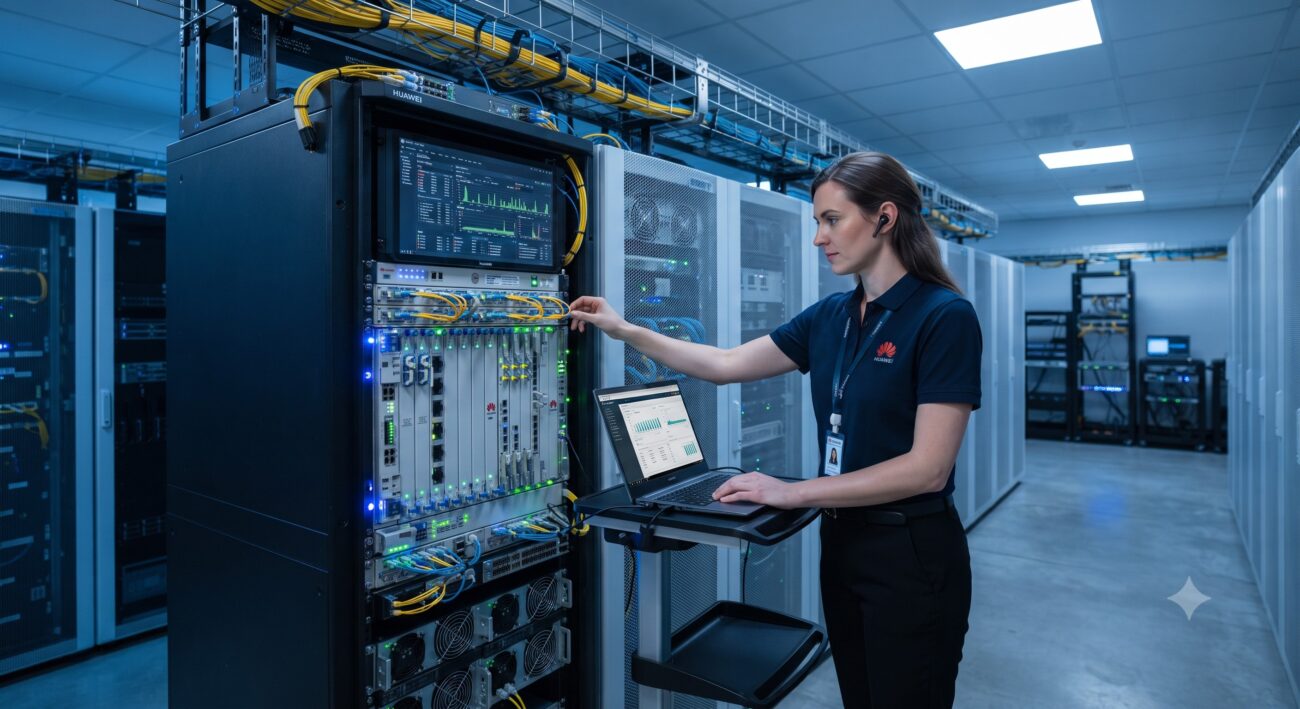
Overview: Power and Thermal Management for the OptiX OSN 8800
Understanding the precise power supply requirements for the Huawei OptiX OSN 8800 is critical for network engineers and data center planners to ensure system stability and efficient cooling. The power consumption varies significantly based on the specific subrack model—T16, T32, or T64—as well as the installed service boards and configuration . This FAQ covers the key technical specifications, from maximum wattage draw to redundancy architecture, helping you accurately budget for power and thermal loads in your deployment.
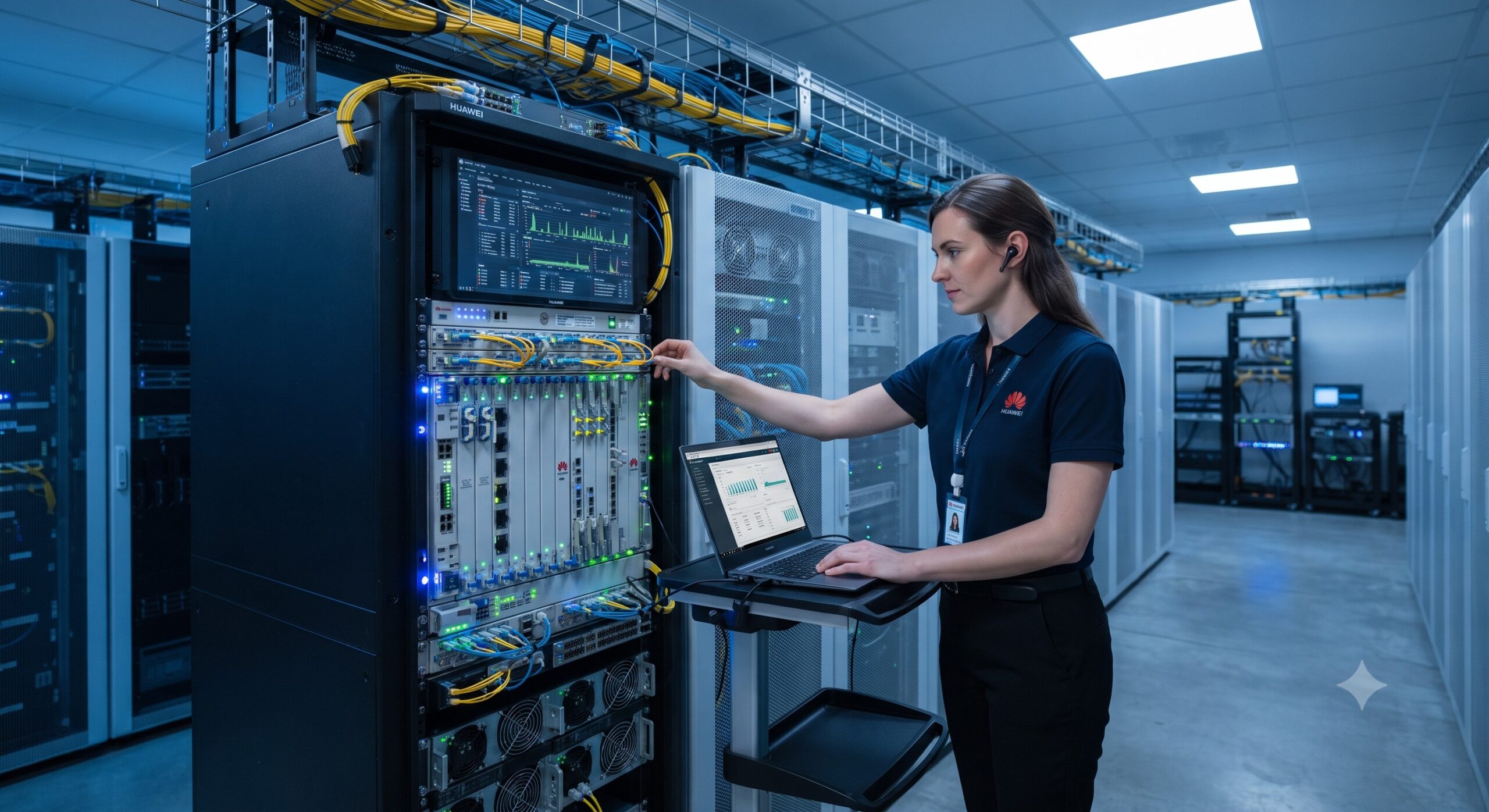
Frequently Asked Questions
- What is the maximum power consumption of a fully configured Huawei OptiX OSN 8800 T64 subrack?
- The maximum power consumption for a Huawei OptiX OSN 8800 T64 subrack can be as high as 6,400 W depending on the specific configuration and boards installed. For example, an enhanced T64 subrack with a typical configuration draws 4,739 W, while a full OCS configuration can draw up to 5,681 W . For a complete N66B cabinet with a fully populated T64 system, the maximum power consumption is 9,600 W, requiring 16 power supplies to support this load .
- What are the typical and maximum power consumption figures for the OSN 8800 T32 subrack?
- The OptiX OSN 8800 T32 subrack has a maximum power consumption threshold of 4,800 W, although typical operational consumption is around 2,000 W for general configurations and 3,300 W for enhanced configurations . It is important to note that the U2000 management system’s default power consumption threshold is set to 4,800 W; if you are using a 30 A power supply, this threshold must be manually adjusted to 2,400 W to avoid alarms . The typical power consumption for an OADM configuration is 1,731 W, while an OTM subrack 2 is rated at 2,088 W .
- How does the power consumption of the OSN 8800 T16 subrack compare to other models?
- The OptiX OSN 8800 T16 is the most power-efficient model, with a typical power consumption around 821 W for a standard configuration and up to 1,109 W for a full service configuration . This lower power draw makes the T16 an ideal choice for edge deployments or smaller network nodes where space and power are limited, contrasting sharply with the 2,828 W typical consumption of an OTU subrack 1 on the larger T64 platform .
- What are the DC input voltage and current requirements for the OSN 8800 power interface units?
- The Huawei OptiX OSN 8800 relies on Power Interface Units (PIUs), such as the TN18PIU, which accept a DC input voltage range of -40 V to -72 V. This range supports both common telecommunication standards, including -48 V DC (-40 V to -57.6 V) and -60 V DC (-48 V to -72 V). Each PIU can draw a maximum current of up to 60 A .
- How does power redundancy work on the OSN 8800 T64 subrack?
- The OptiX OSN 8800 T64 subrack utilizes a 1+1 hot backup architecture for power redundancy to ensure high availability. Two PIU boards operate simultaneously to supply power to the subrack. Should one PIU fail, the other automatically continues to supply power without service interruption. The specific redundancy pairing depends on the subrack type—for the T64 Enhanced subrack, PIUs are installed back-to-back, while for the T64 General subrack, they are paired on the left and right sides .
- What is the power consumption of individual components like the TN18PIU or the TN5S000SW111 software package?
- While the chassis consumes significant power, specific components have minimal impact on the overall budget. A power interface board like the TN18PIU has a typical power consumption of just 7.5 W and a maximum of 8 W . Similarly, software packages such as the TN5S000SW111 T32-Basic Software Package draw only 30 W (typical) . These figures are useful for calculating the exact power draw of granular configurations.
- What are the operating temperature and cooling requirements for the OSN 8800?
- The Huawei OptiX OSN 8800 is designed to operate within an ambient temperature range of -5°C to +45°C (23°F to 113°F) . Effective thermal management is ensured via a forced-air cooling system using integrated fan trays. As heat consumption is nearly equivalent to power consumption, the high power draw of models like the T64 necessitates a robust cooling strategy to maintain stable operating temperatures and system reliability .

Leave a comment