

The Bandwidth Imperative: Why EPON to GPON Migration is No Longer Optional
For over a decade, Ethernet Passive Optical Networks (EPON) have served as the backbone of Fiber-to-the-Home (FTTH) and enterprise access networks, delivering reliable 1Gbps symmetrical bandwidth based on the IEEE 802.3ah standard. However, the exponential surge in data consumption—driven by 8K video streaming, cloud computing, and AI-driven edge applications—has exposed the inherent limitations of legacy EPON architectures. The industry is now at a critical inflection point where EPON to GPON Migration is not merely a technological upgrade but a strategic business imperative for network operators seeking to enhance bandwidth capacity, improve operational efficiency, and future-proof their infrastructure against the relentless growth of IP traffic.
Gigabit-capable Passive Optical Networks (GPON), governed by the ITU-T G.984 series, offer a paradigm shift with its superior downstream rates of 2.488 Gbps and upstream rates of 1.244 Gbps. This evolution, however, extends far beyond raw speed. A well-executed EPON to GPON Migration strategy can reduce overall network latency by up to 40%, support a 30% increase in subscriber density per Optical Line Terminal (OLT) port, and significantly lower the Total Cost of Ownership (TCO) through enhanced spectral efficiency and power management. This comprehensive guide, tailored for senior network architects and telecom engineers, delves into the technical architecture, phased deployment strategies, and quantifiable operational gains of migrating from EPON to a robust GPON ecosystem.
As we navigate this transition, it is crucial to understand that GPON’s advanced encapsulation method—GPON Encapsulation Method (GEM)—offers more granular Quality of Service (QoS) and higher throughput efficiency compared to EPON’s Ethernet-based framing. With global PON equipment revenues projected to surpass $16 billion by 2028, early adopters of EPON to GPON Migration are poised to gain a significant competitive edge in both residential and enterprise service delivery. Let us embark on a deep technical exploration of this migration, from the physical layer optics to the strategic deployment topologies that ensure minimal service disruption and maximum return on investment.

Phase 1: Pre-Migration Assessment & Architectural Mapping
Embarking on an EPON to GPON Migration requires meticulous planning and a thorough understanding of the existing Optical Distribution Network (ODN). The fundamental distinction between the two technologies lies in their operational principles. EPON, based on a contention-based Multi-Point Control Protocol (MPCP), uses a Time Division Multiple Access (TDMA) mechanism that is inherently less efficient for high-volume burst traffic. In contrast, GPON employs a more sophisticated Dynamic Bandwidth Allocation (DBA) algorithm, which enables sub-millisecond latency for priority traffic—a critical requirement for modern 5G backhaul and enterprise connectivity.
Passive Optical Network (PON) Topology Analysis
The success of an EPON to GPON Migration heavily depends on the integrity and design of the existing fiber infrastructure. GPON is highly backward-compatible with the optical splitters and fiber cabling currently used in EPON deployments, provided they are within the Class B+ or Class C+ power budget specifications. A comprehensive site survey must evaluate the Optical Power Budget (OPB), insertion loss at splitter points, and the overall fiber attenuation. GPON operates with a nominal wavelength plan of 1490 nm for downstream and 1310 nm for upstream, which is identical to EPON. This compatibility allows for a smoother transition without the need for large-scale fiber re-cabling, which can save operators up to 70% on physical layer upgrade costs.
However, network architects must also assess the capabilities of the existing Optical Network Terminals (ONTs) and Optical Network Units (ONUs). Legacy EPON ONTs cannot be re-provisioned to support the GEM port and DBA profiles of GPON. Therefore, a EPON to GPON Migration strategy must include a detailed inventory of subscriber equipment, classifying models based on their wavelength blocking filters and forward error correction (FEC) capabilities, as outlined in the IEEE 802.3ah and ITU-T G.984.2 standards. It is recommended to prioritize the replacement of ONTs in high-demand service areas to maximize immediate bandwidth gains and subscriber satisfaction.
| Technical Parameter | EPON (IEEE 802.3ah) | GPON (ITU-T G.984) |
|---|---|---|
| Downstream Line Rate | 1.25 Gbps | 2.488 Gbps |
| Upstream Line Rate | 1.25 Gbps | 1.244 Gbps |
| Maximum Split Ratio | 1:64 | 1:128 |
| Frame Type | Ethernet (802.3) | GEM (GPON Encapsulation Method) |
| Bandwidth Allocation | MPCP (Polling) | DBA (Dynamic, 125us frame) |
| Forward Error Correction (FEC) | Optional | Mandatory (Reed-Solomon) |
| Typical Optical Power Budget (Class B+) | ~25 dB | ~32 dB |
Phase 2: The Hardware Transition – OLTs, ONTs, and Optics
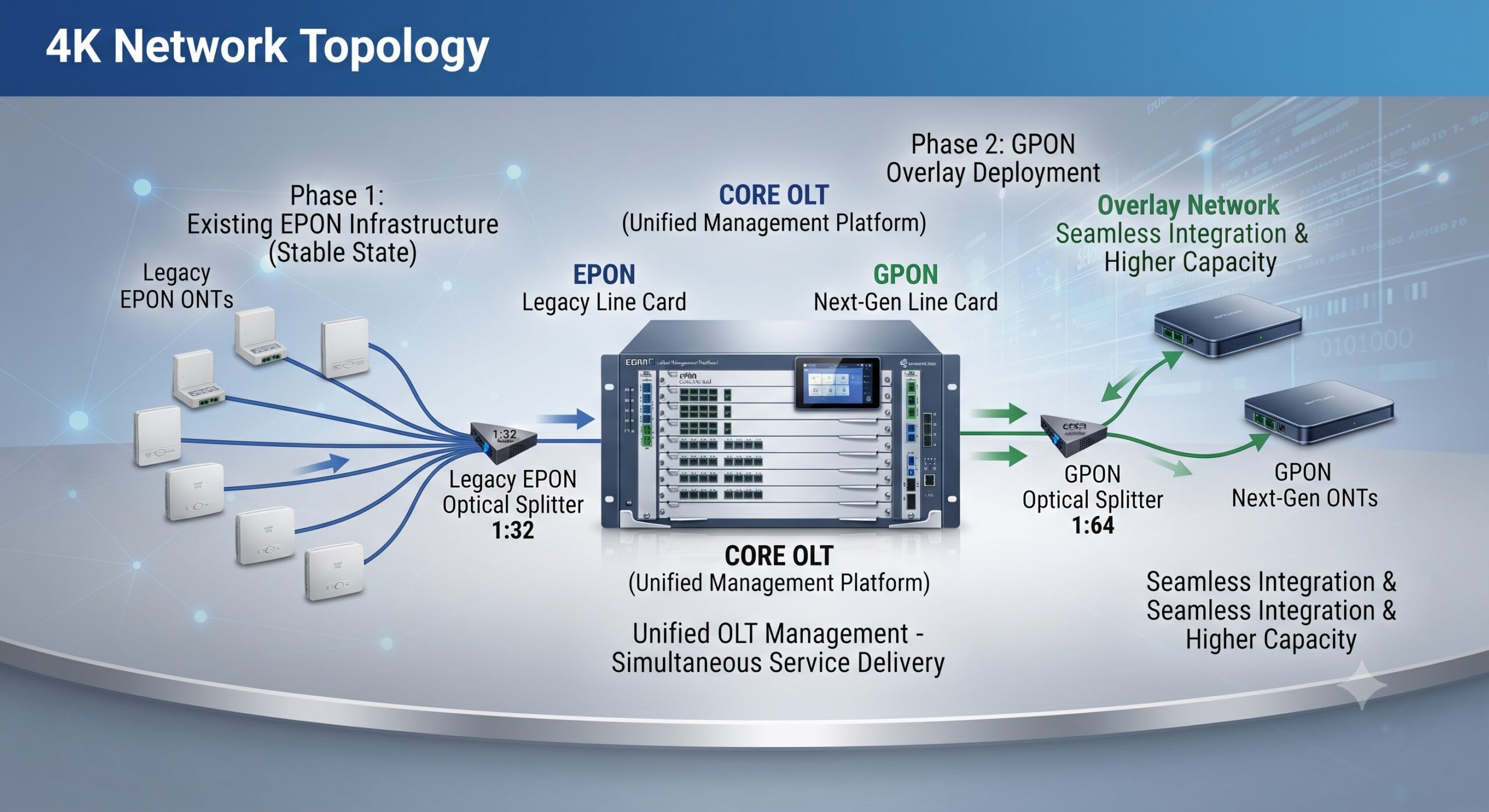
The core of any EPON to GPON Migration revolves around the OLT chassis. Modern high-density OLT platforms are designed to support dual-mode PON operations, facilitating a gradual migration. These platforms often feature modular line cards that can host both EPON and GPON interfaces, enabling operators to allocate specific ports for EPON-to-GPON transitions on a per-service basis. This capability is a game-changer, as it allows network operators to migrate high-value business customers to GPON while retaining EPON for residential traffic on the same chassis, optimizing the operational expenditure (OpEx).
Optical Transceiver Performance Metrics
When procuring new GPON equipment for the EPON to GPON Migration, the performance of the optical transceivers is a critical selection criterion. GPON SFP modules are typically rated for higher link budgets (up to 32 dB) compared to EPON, which typically offers 25 dB. This enables GPON to support larger split ratios of 1:128 versus the typical EPON limit of 1:64. The table below provides a detailed comparison of the fundamental architectural and performance specifications that define both PON technologies, serving as a reference point for hardware evaluation and procurement for a phased migration.
Furthermore, advanced GPON OLTs are now equipped with integrated hardware-based encryption engines for AES-128 to secure the data plane, a feature that is paramount for regulatory compliance and enterprise data security. The physical layer also supports Forward Error Correction (FEC) of at least 10^-12 Bit Error Rate (BER), which significantly enhances the Mean Time Between Failures (MTBF) of the entire access network, often exceeding 500,000 hours for carrier-grade systems.
Phase 3: Phased Deployment and Service Interruption Mitigation
A successful EPON to GPON Migration cannot be executed as a disruptive ‘big bang’ event. The industry best practice advocates for a phased migration strategy that minimizes service downtime and mitigates operational risks. The most effective approach involves a wavelength-overlay migration. In this scenario, the GPON signal is overlaid on a different wavelength (e.g., using a WDM filter) alongside the existing EPON signal. This allows the operator to provision new GPON services without interrupting existing EPON connections, effectively creating a parallel network infrastructure that coexists on the same fiber plant.
Once the GPON equipment is validated and traffic is successfully tested, the operator can begin the service cut-over. This is often performed in a ‘switch and sleep’ mode for residential customers, where the ONT is replaced during a scheduled maintenance window, and the provisioning is automatically updated via the OLT’s management system. For enterprise customers with stringent Service Level Agreements (SLAs), a ‘hot-cut’ procedure can be employed, utilizing GPON’s inherent support for protection switching (Type B or C) to ensure that a secondary fiber path takes over within 50 milliseconds in the event of a link failure, guaranteeing near-zero downtime.
To ensure a seamless EPON to GPON Migration, validation and burn-in tests are essential. The new GPON OLT ports must undergo a loopback test to verify the physical integrity of the link and the accuracy of the clock synchronization from the primary reference source. Additionally, it is critical to recalibrate the DBA algorithms to accommodate the higher burst overhead of the new GPON ONTs, ensuring that the upstream bandwidth allocation is optimized for the specific traffic profiles of the migrated subscribers.
Quantified Operational Gains and the Future Roadmap
The impetus for EPON to GPON Migration is ultimately justified by the quantifiable operational gains. Beyond the immediate increase in downstream and upstream bandwidth, network operators can expect a 25% to 40% reduction in packet delay variation (jitter), which is crucial for stable video conferencing and online gaming services. The advanced GEM encapsulation reduces overhead by up to 10% compared to the Ethernet preamble of EPON, translating into higher data throughput efficiency. From a power efficiency standpoint, newer 10G GPON (XGS-PON) chipsets, designed using low-power silicon processes, offer a 15% improvement in power consumption per bit compared to earlier EPON chipsets, aligning with Green Networking initiatives and reducing data center cooling costs.
Moreover, the migration paves the way for a smoother transition to XGS-PON and 50G-PON in the future. Since GPON and XGS-PON share the same ODN specifications and can be co-provisioned using Wavelength Division Multiplexing (WDM), a current EPON to GPON Migration is a critical stepping stone for future upgrades. This strategic roadmap ensures that the initial investment in GPON hardware is protected and that the network can scale seamlessly to meet the demands of 10G and 50G services without requiring a radical overhaul of the fiber infrastructure.
Conclusion: Securing the Network’s Future with GPON
In conclusion, the EPON to GPON Migration represents a strategic evolution from a legacy Ethernet-based access network to a highly efficient, carrier-grade transport infrastructure. While the migration involves substantial planning, hardware procurement, and physical ONT replacement, the long-term benefits—including higher bandwidth, lower latency, superior QoS, and reduced operational complexity—decisively outweigh the initial capital expenditure. By adhering to a phased deployment strategy, leveraging the backward compatibility of the ODN, and utilizing advanced dual-mode OLT platforms, network operators can execute this transition with minimal disruption and maximum return on investment.
As the telecommunications landscape continues to evolve, the decision to migrate is not merely a technical one; it is a strategic move to enhance customer experience, reduce churn, and unlock new revenue streams from high-bandwidth enterprise services. By future-proofing the core infrastructure through a comprehensive EPON to GPON Migration, network architects and operators are building a resilient and scalable foundation capable of supporting the next generation of digital services. The time to move beyond the constraints of EPON is now, and the roadmap to a more intelligent, robust, and efficient network begins with the adoption of GPON.

Leave a comment