

The Bandwidth Imperative: Why an XGS-PON Strategy is No Longer Optional
The digital ecosystem has reached a critical inflection point. The proliferation of 4K/8K video streaming, cloud-based collaboration, AI-driven workloads, and the burgeoning demand for 5G xHaul transport has rendered traditional GPON (Gigabit Passive Optical Network) architectures insufficient for modern service providers. Legacy GPON, defined by ITU-T G.984, offers a maximum downstream capacity of 2.5 Gbps and an upstream bottleneck of just 1.25 Gbps. This asymmetry is fundamentally misaligned with the symmetrical demands of today’s enterprise and high-end residential services . Consequently, the industry is accelerating its transition toward XGS-PON (10-Gigabit-capable Symmetric Passive Optical Network), standardized under ITU-T G.9807.1. This technology delivers a full 10 Gbps symmetrical bandwidth, providing a future-proof platform that protects existing fiber investments while enabling new revenue streams .

Architectural Foundations: Understanding XGS-PON and Coexistence Dynamics
To design a robust upgrade strategy, network architects must first appreciate the physical layer mechanics that make XGS-PON distinct. Unlike its predecessor, XG-PON (which maxed out at 10 Gbps down and 2.5 Gbps up), XGS-PON leverages specific optical wavelengths—1577 nm for downstream and 1270 nm for upstream . This shift is not arbitrary; it is specifically engineered for coexistence. The 1577 nm wavelength is isolated from GPON’s 1490 nm downstream and 1310 nm upstream wavelengths, allowing both technologies to operate concurrently on the same Optical Distribution Network (ODN) .
The Combo PON Advantage
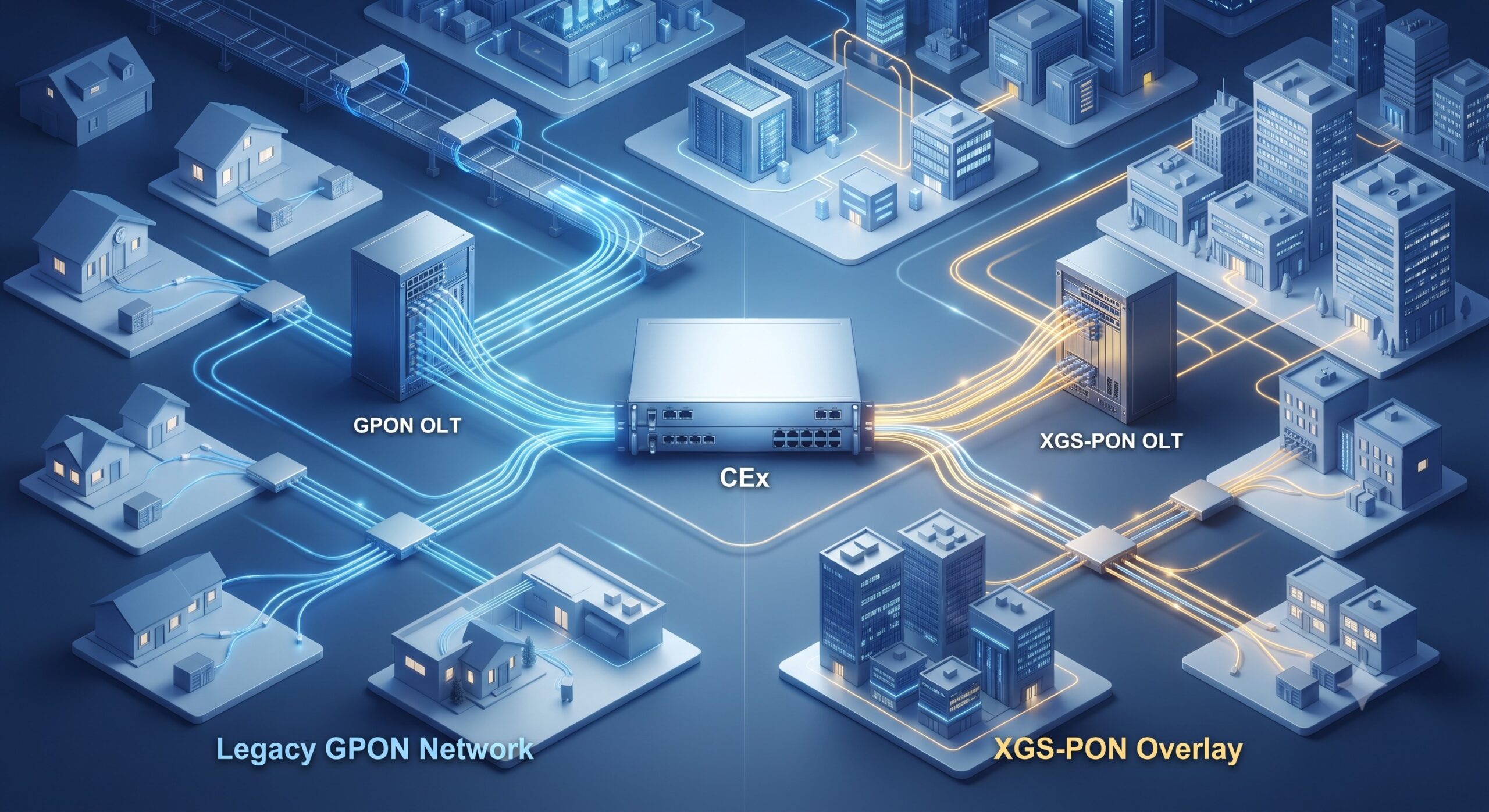
This coexistence is commercially enabled by Combo PON technology. A Combo PON port integrates a GPON OLT, an XGS-PON OLT, and a WDM multiplexer into a single transceiver or line card. This innovation is the cornerstone of any low-disruption migration strategy, allowing operators to serve legacy GPON ONUs while simultaneously provisioning symmetrical 10 Gbps services to XGS-PON ONUs over the same physical fiber . This effectively eliminates the need for costly and disruptive re-cabling of the outside plant.
Strategic Migration Paths: Phasing Out Legacy GPON
A successful migration from GPON to XGS-PON is characterized by strategic phasing rather than a sudden rip-and-replace. Search results and industry best practices highlight a clear multi-step process designed to minimize CapEx and preserve the integrity of existing network assets .
1. Comprehensive Network Audit
Before any hardware investment, operators must audit the existing infrastructure. Key parameters include optical loss budgets and splitter ratios. XGS-PON is more sensitive to signal loss; per ITU-T G.9807.1, the network must meet specific power budget classes such as N1 (29 dB) and N2 (31 dB). Operators must verify that their current splitter ratios (e.g., 1:32 or 1:64) comply with these tighter optical constraints to ensure viability at 10 Gbps .
2. Selecting the OLT Upgrade Path
Operators typically choose between three primary hardware strategies:
- Dual-Mode Chassis: Utilizing a modular OLT chassis (e.g., VSOL V5600X series) that allows for mixed installations of GPON and XGS-PON line cards.
- Combo PON Overlay: Deploying XGS-PON OLTs with Combo PON ports alongside the existing GPON OLTs, using passive coexistence modules to merge the signals.
- Modular Migration: Upgrading specific PON ports to Combo PON to target high-density or high-revenue areas first .
3. Phased ONT Upgrade and Remote Provisioning
The user premise equipment is upgraded in phases, prioritizing enterprise customers and “power users.” For standard users, the transition can be delayed until they upgrade their service tier. XGS-PON is backward compatible in the sense that it allows the simultaneous provisioning of 1G, 2.5G, 5G, or 10G profiles per customer . Leveraging management protocols such as TR-069 and the newer TR-369 (USP), or the standard OMCI, allows for zero-touch provisioning and remote firmware management, significantly reducing operational expenditure (OpEx) .
As a specific example of this phased ecosystem, the Cisco 10G Routed PON ONT family offers multiple variants to cover various use cases. These include the ENC-10G-ONT-10 (a high-speed, single-port 10G RJ-45 ONT for SMB environments), the multiport ENC-10G-ONT-14A (which adds 1G ports and an FXS voice port), and the hardened ENC-10G-ONT-01PR (designed for outdoor deployments with a -40° to 65°C operating range and PoE powering) .
| Parameter | Legacy GPON (ITU-T G.984) | XGS-PON (ITU-T G.9807.1) |
|---|---|---|
| Downstream Speed | 2.5 Gbps | 10 Gbps (Symmetrical) |
| Upstream Speed | 1.25 Gbps | 10 Gbps (Symmetrical) |
| Downstream Wavelength | 1490 nm | 1577 nm |
| Upstream Wavelength | 1310 nm | 1270 nm |
| Typical Split Ratio | 1:64 | 1:64 / 1:128 (with improved optics) |
| Max Link Budget (Class) | ~28 dB (Class B+) | 31 dB (Class N2) |
Financial Analysis and Operational Gains
The financial argument for XGS-PON extends beyond mere speed upgrades; it fundamentally rests on Total Cost of Ownership (TCO) optimization and Return on Investment (ROI).
CapEx Considerations
While XGS-PON ONUs are currently more expensive than legacy GPON units—with some sources noting ONU price premiums exceeding 50%—the CapEx for the OLT line cards is significantly more competitive, often only around 20% higher than GPON cards . However, the ability to reuse the existing ODN (fiber and splitters) means that the core infrastructure cost remains amortized over the existing network. Furthermore, as adoption scales, the price differential is projected to shrink rapidly.
OpEx and Revenue Streams
On the operational side, XGS-PON enables significant efficiencies. The symmetrical bandwidth capacity allows ISPs to offer premium service tiers to high-value enterprise customers—such as data centers needing high-speed disaster recovery connectivity or small-cell backhaul for 5G—thereby increasing Average Revenue Per User (ARPU) . Additionally, modern management platforms (like VSOL INCE or Calix Cloud) provide 360-degree visibility and automated diagnostics, reducing manual trouble-ticket resolution and costly truck rolls . In a real-world deployment, Chariton Valley Communications successfully migrated oversaturated GPON PONs to XGS-PON, resulting in a significant reduction in trouble calls and video streaming complaints during peak times .
Hardware Security and Protocol Compliance
As telecom infrastructure evolves, security and compliance remain paramount. For hardware-level security, modern XGS-PON systems incorporate features that go beyond simple encryption. The standard employs robust AES (Advanced Encryption Standard) encryption for the physical layer to ensure data privacy. Cisco’s routed PON ONTs, for example, are fully compliant with IEEE and RoHS standards and integrate secure boot and hardware-root-of-trust mechanisms to prevent unauthorized firmware execution .
For network stability and capacity planning, a critical parameter is latency. In a Combo PON scenario, the Round Trip Time (RTT) and dynamic bandwidth allocation (DBA) algorithms are optimized to maintain sub-millisecond latency targets, even when mix GPON and XGS-PON traffic coexist on the same ODN. This is essential for supporting mission-critical applications and meeting stringent carrier-grade SLAs .
Conclusion: Building the Roadmap to 50G PON
Upgrading to XGS-PON is less of a “project” and more of a strategic cornerstone for building a flexible and scalable network. The technology provides a clear, economically viable path to satisfy immediate bandwidth demands while simultaneously laying the groundwork for the next generation of PON standards, such as 25G-PON and 50G-PON . By adopting modular Combo PON OLTs and implementing a phased, data-driven migration strategy, network operators can secure their fiber assets, increase revenue potential, and ensure their infrastructure remains competitive for the next decade.

Leave a comment