

Executive Summary: The Confluence of IoT and Building Management
The modern building management landscape is undergoing a paradigm shift, transitioning from isolated, legacy control systems to unified, intelligent ecosystems. At the heart of this transformation lies the smart home automation building management gateway, a critical hardware component that bridges the gap between diverse communication protocols and centralized cloud or on-premise management platforms. As a Senior Network Architect with over 15 years in the telecom hardware industry, I assert that the gateway is no longer a mere protocol translator; it has evolved into a sophisticated edge computing node, essential for achieving operational efficiency, robust security, and seamless interoperability in smart buildings. This definitive guide offers an in-depth technical analysis of the gateway’s architecture, performance specifications, and strategic deployment, empowering systems integrators, facility managers, and telecom professionals to make data-driven decisions .

Core Architecture & Hardware Topology
The engineering of a high-performance smart home automation building management gateway is defined by its ability to handle heterogeneous connectivity and process data at the edge. The hardware architecture typically leverages a multi-core processor, often based on ARM architecture, to manage complex protocol stacks and application logic . Critical to its functionality is the integration of multiple radio transceivers, with Zigbee 3.0 being a staple for low-power sensor networks, alongside Wi-Fi and Ethernet for high-bandwidth backhaul . Advanced gateways now incorporate hardware-accelerated security engines, supporting TLS 1.3 and hardware roots of trust to ensure line-rate encryption for sensitive building data .
Protocol Stack & ASIC Logic
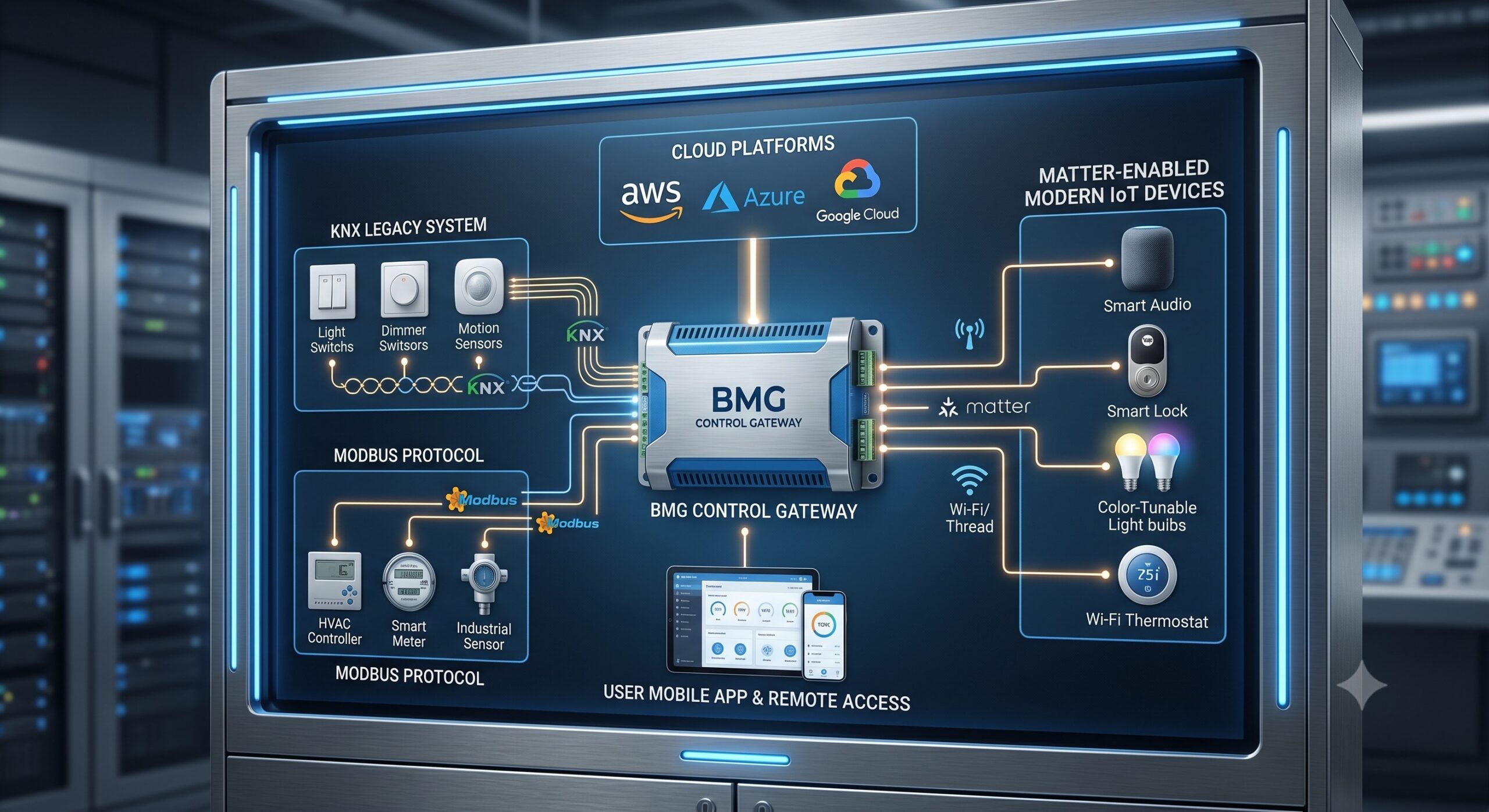
Contrary to software-based legacy systems, modern gateways utilize specialized ASICs (Application-Specific Integrated Circuits) to offload packet processing and protocol translation. This includes native support for standard building automation protocols such as KNX, Modbus-TCP, and increasingly, the Matter application layer . The gateway acts as a bridge, converting between protocols like KNX (for wired lighting and HVAC control) and Matter (for IP-based interoperability) without introducing significant latency . For instance, dedicated logic manages the mapping of KNX data points to Matter device types, ensuring that a KNX thermostat appears as a native device within a modern smart home ecosystem .
| Key Parameter | Technical Specification | Performance Benchmark |
|---|---|---|
| Switching Capacity / Sub-Device Limit | Entry-Level: 32 Devices; Professional: 256+ Devices | Zigbee Bridge Ultra supports up to 256 Zigbee sub-devices |
| Protocol Support | Zigbee 3.0, KNX, Modbus-TCP, Matter, Wi-Fi, Ethernet | Native support for real-time bidirectional translation between KNX and Matter networks |
| Network Connectivity & Security | Ethernet, Wi-Fi, LoRa; MQTT over WebSocket, TLS 1.3 | AWS IoT Core qualification, VPN support, and hardware security roots of trust |
| Form Factor & Power | DIN Rail mount (4 TE), 24VDC or 5VDC | Compact design for distribution boards; direct KNX bus power available |
| Compliance & Standards | RoHS, IP20, Matter Certification | Compliant with IEEE 802.11 b/g/n and ITU-T security standards |
Technical Specifications & Performance Benchmarks
The operational efficacy of a building management gateway is quantified by specific performance metrics that directly impact user experience and system reliability.
- Protocol Support: The gateway must facilitate the convergence of disparate ecosystems. This involves acting as a ‘commander’ to centralize control and a ‘translator’ for devices speaking different languages . Support for Zigbee, Z-Wave, KNX, Modbus, Wi-Fi, and Ethernet is critical. Integration with AWS IoT Core via MQTT over WebSocket and TLS 1.3 is a key benchmark for modern cloud-ready gateways .
- Scalability & Capacity: The ability of a smart home automation building management gateway to scale is determined by its sub-device capacity. Entry-level gateways support up to 32 devices, while professional-grade units support over 256 devices . High-density deployments utilize mesh networking topologies, where powered Zigbee devices act as routers to extend signal coverage and stability .
- Security & Compliance: Carrier-grade reliability is measured by Mean Time Between Failures (MTBF) and compliance with industry standards. In addition to cybersecurity features like encrypted communications (TLS), hardware must meet environmental and safety standards such as RoHS and IP20 ratings for indoor installation .
Migration Strategies & Systems Integration
For existing buildings, retrofitting with a smart home automation building management gateway offers a cost-effective pathway to energy efficiency and enhanced control . The strategic deployment of a gateway eliminates the need for complete rewiring, leveraging wireless technologies to minimize structural alterations . For systems integrators, the prerequisite guide involves assessing the existing bus system (e.g., KNX, Modbus) and selecting a gateway with the appropriate physical and optical prerequisites. The installation process often involves DIN rail mounting, connection to the local IP network, and commissioning via standardized configuration tools like ETS (Engineering Tool Software) for KNX environments .
Real-World Deployment Scenarios
In a modern commercial building, a gateway can integrate a KNX-based lighting and HVAC system with a third-party energy management platform. This enables dynamic energy visualization and the creation of automation rules that adjust settings based on occupancy and energy pricing, significantly reducing operational costs . Similarly, in a retrofit project, an open-source Zigbee gateway running on low-cost hardware can connect a network of sensors to a building management system, offering a budget-friendly solution for large-scale IoT deployments .
Conclusion: The Strategic Imperative
The smart home automation building management gateway is the cornerstone of a modern, efficient, and secure building. Its evolution from a simple protocol bridge to a carrier-grade edge computing platform underscores its critical role in the future of building infrastructure. For telecom and IT professionals, understanding the nuances of gateway architecture, performance metrics, and deployment strategies is essential for maximizing return on investment and ensuring long-term operational reliability. By leveraging the insights and data presented in this guide, stakeholders can confidently navigate the complexities of smart building integration and unlock the full potential of their automation ecosystems.

Leave a comment