

APPLICATION CONTEXT
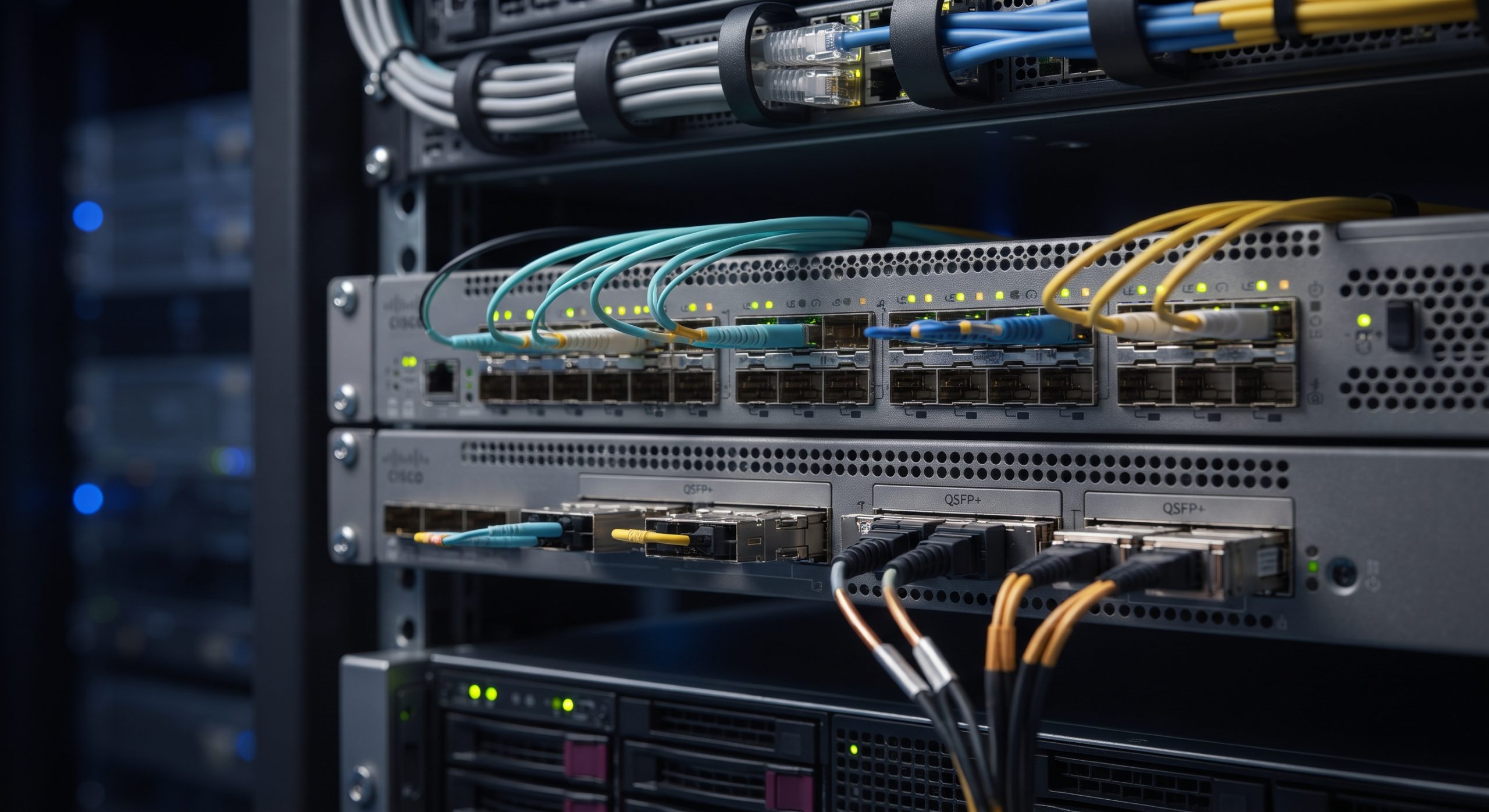
The Cisco Nexus 3000 Series represents a purpose-built class of fixed-form-factor switches engineered specifically to address the deterministic forwarding requirements of latency-sensitive financial trading environments, high-performance computing clusters, and carrier-grade edge aggregation points. Unlike general-purpose data center switches that prioritize feature depth over forwarding determinism, the Nexus 3000 family employs a cut-through switching architecture that minimizes packet dwell time within the chassis. The platform is optimized for deployments where microseconds of variance translate directly into competitive or operational disadvantage. The Cisco Nexus 3064, a representative member of this family, delivers ultra-low nominal latency suitable for high-frequency trading workloads while maintaining wire-rate Layer 2 and Layer 3 switching across all 64 10 Gigabit Ethernet ports. This reference design examines the forwarding pipeline characteristics and benchmarked latency figures that define the platform’s operational envelope.

FORWARDING PIPELINE DESIGN
The architectural foundation of the Nexus 3000 Series latency advantage lies in its streamlined ingress-to-egress data path. The switching ASIC employs cut-through forwarding, initiating frame transmission toward the egress port before the entire packet has been received, provided the destination port is available and the frame length is within configured thresholds. This contrasts with store-and-forward architectures that buffer complete frames before forwarding decisions are rendered. The Cisco Nexus 3524 notably contains no PHY chips in its data path, a design decision that eliminates an entire stage of serialization and deserialization delay, contributing to both lower latency and reduced power consumption. For the Nexus 3064, nominal latency is specified at less than one microsecond under ideal line-rate conditions, with the platform supporting full Layer 3 unicast and multicast routing protocol suites including BGP, OSPF, EIGRP, and PIM-SM without introducing additional forwarding overhead. The Nexus 3048, a copper-based variant, exhibits switch latency in the range of 2.7 to 7.2 microseconds, reflecting the trade-off between media type and forwarding determinism.
HARDWARE SPECS SUMMARY
| Parameter | Specification |
|———–|—————|
| Form Factor | 1RU fixed chassis |
| Switching Capacity | Up to 1.2 Tbps (Nexus 3064) |
| Forwarding Rate | Over 950 mpps (Nexus 3064) |
| Latency (Nominal) | Sub-microsecond class (Nexus 3064); 2.7–7.2 µs (Nexus 3048) |
| Interface Options | 48× SFP+ + 4× QSFP+ (3064); 48× RJ-45 + 4× SFP+ (3048) |
| Power | Dual redundant, hot-swappable AC/DC |
| Airflow | Front-to-back and back-to-front options |
| Parameter | Specification |
|---|---|
| Form Factor | 1RU fixed chassis |
| Switching Capacity | Up to 1.2 Tbps (Nexus 3064); 176 Gbps (Nexus 3048) |
| Forwarding Rate | Over 950 mpps (Nexus 3064) |
| Latency | Sub-microsecond nominal (Nexus 3064); 2.7–7.2 µs (Nexus 3048) |
| Interface Types | SFP+ 10GbE, QSFP+ 40GbE, 10GBase-T, RJ-45 |
| Power Supply | Dual redundant, hot-swappable AC or DC |
| Airflow Options | Front-to-back and back-to-front |
| Operating System | Cisco NX-OS |
| Layer 3 Protocols | BGP, OSPF, EIGRP, RIPv2, PIM-SM, MSDP |
| Warranty | 1-year limited hardware warranty |
QUALITY OF SERVICE PROTOCOLS
Latency-sensitive deployments require deterministic treatment of time-critical traffic even under congestion conditions. The Nexus 3000 Series implements a comprehensive QoS feature set including classification, marking, queuing, and scheduling capabilities. The platform supports up to eight hardware queues per port with configurable scheduling algorithms that include strict priority queuing for latency-critical flows and weighted deficit round-robin for best-effort classes. Explicit Congestion Notification is available for lossless Ethernet deployments, enabling the switch to signal congestion before buffer exhaustion occurs. For financial trading co-location scenarios, the platform supports Precision Time Protocol per IEEE 1588, allowing sub-microsecond clock synchronization across the switching fabric—a prerequisite for accurate timestamping and regulatory compliance in trading audit trails. The combination of cut-through forwarding with hardware-accelerated QoS ensures that latency bounds are maintained even when the switch is operating at sustained line-rate utilization.
COMPLIANCE VERIFICATION
The Cisco Nexus 3000 Series has been validated against the regulatory and interoperability standards expected of carrier-grade and enterprise data center infrastructure. The platform runs Cisco NX-OS, an operating system that interoperates with any networking OS conforming to the standards referenced in Cisco’s published datasheets, including Cisco IOS Software. Safety and emissions compliance spans the standard international regimes applicable to data center equipment. The switch family carries a one-year limited hardware warranty as standard, with optional service agreements extending coverage through Cisco’s global support infrastructure. For deployments requiring verified scalability figures, Cisco publishes platform-specific limits covering MAC table sizes, IPv4 and IPv6 host route capacities, multicast route scaling, and VXLAN tunnel endpoint counts, allowing network architects to validate designs against documented, tested limits rather than theoretical maxima.
SCENARIO VIEW
📥 Download Technical Specification
Click the button below to view or download the full official PDF datasheet.
Leave a comment