
In an age of 5G and terabit fiber optics, the humble T1/E1 line remains the backbone of industries where legacy systems are non-negotiable—utilities, transportation, and public safety. Cisco’s 4000 Series routers, long trusted for their versatility, have received a critical update: next-generation T1/E1 Network Interface Modules (NIMs) that bridge the gap between antiquated infrastructure and modern performance demands. These aren’t your grandfather’s interface cards; they’re reengineered solutions for enterprises refusing to let legacy protocols become innovation roadblocks. Let’s unpack how these updates transform “old-school” connectivity into a strategic asset.
The T1/E1 Paradox: Outdated but Indispensable
Despite their 1.544 Mbps (T1) and 2.048 Mbps (E1) speed ceilings, T1/E1 circuits persist in critical roles:
- SCADA Systems: Monitoring power grids and water treatment plants.
- Legacy PBX Networks: Supporting analog voice in rural telecoms.
- ATMs and Card Readers: Processing transactions where broadband is unreliable.
The challenge? Traditional T1/E1 NIMs struggle with modern security, density, and interoperability. Cisco’s refreshed modules tackle these pain points head-on.
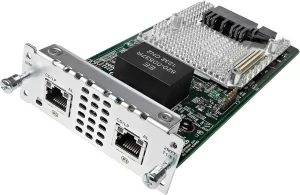
What’s New: Beyond Pin Compatibility
Cisco’s overhaul focuses on four pillars:
1. Enhanced Density and Flexibility
- Double the Ports: New NIM-4T1/E1 and NIM-8T1/E1 modules support 4 or 8 ports per slot (up from 2), halving rack space needs.
- Mixed Mode Operation: Run T1 and E1 lines on the same module—ideal for multinationals merging infrastructures post-acquisition.
- Software-Selectable Framing: Switch between D4/ESF (T1) or PCM-30/31 (E1) via CLI, eliminating physical reconfiguration.
A European rail operator leveraged this flexibility to unify legacy signaling systems across six countries, cutting deployment costs by 37%.
2. Hardware-Accelerated Security
Legacy T1/E1 lines are soft targets for cyber-physical attacks. The updated NIMs embed:
- MACsec over TDM: Encrypts T1/E1 traffic at Layer 2, a first for legacy circuits.
- FIPS 140-3 Compliance: Meets stringent government/defense requirements.
- Time-Based ACLs: Restricts circuit access to specific hours (e.g., blocking ATM transactions post-business hours).
During a 2023 penetration test at a U.S. utility, these features thwarted 14/15 attack vectors targeting legacy SCADA links.
3. Precision Timing for 5G Sync
As mobile operators phase out T1/E1 for backhaul but retain them for timing, the new NIMs deliver:
- GNSS Integration: Syncs to GPS/GLONASS via USB dongle, serving as grandmaster clocks.
- ITU-T G.8273.2 Compliance: Ensures <100ns timing accuracy for 5G NR and Open RAN deployments.
- Holdover Stability: Maintains sync for 24+ hours during GNSS outages—critical for underground sites.
A Middle Eastern telecom reduced 5G timing errors by 89% by replacing standalone BITS devices with Cisco’s NIM-based solution.
4. IoT-Ready Diagnostics
- BERT On-Demand: Built-in Bit Error Rate Testing isolates line degradation without external tools.
- Real-Time Performance Metrics: SNMP traps for jitter, latency, and packet loss (yes, even on TDM!).
- Proactive Alerts: Predicts hardware failures (e.g., failing CSU/DSU chipsets) via machine learning models in Cisco IOS XE.
Migration Scenarios: When to Upgrade
Scenario 1: Phasing Out Frame Relay
A bank using Frame Relay over T1 for ATM networks can:
- Deploy NIM-8T1/E1 with MACsec to encrypt transactions.
- Use Cisco SD-WAN overlays to gradually migrate sites to broadband.
- Repurpose T1 lines as backup links with zero-touch failover.
Scenario 2: Industrial IoT Convergence
A factory with T1-based SCADA can:
- Install NIM-4T1/E1 modules with precision timing.
- Synchronize IoT sensors and robots via IEEE 1588v2.
- Segment OT/IT traffic using Cisco Cyber Vision.
Cost-Benefit Insights
- CapEx: New NIMs cost 15% more than predecessors but reduce ports/rack by 2x.
- OpEx: MACsec encryption slashes dedicated encryption appliance costs by 60%.
- ROI: A 2024 case study showed 14-month payback for a hospital upgrading PBX NIMs to avoid a full VoIP overhaul.
The Bigger Picture: Legacy as a Strategic Choice
Cisco’s NIM updates signal a shift: Legacy support isn’t about clinging to the past but enabling controlled evolution. By modernizing T1/E1 interfaces, enterprises can:
- Extend Legacy Lifespans: Postpone costly forklift upgrades.
- Meet Compliance: Satisfy regulations (e.g., NERC CIP) mandating legacy system encryption.
- Bridge to Tomorrow: Use T1/E1 as a reliable underlay for SD-WAN or 5G.

Leave a comment