
In the labyrinth of enterprise networking, selecting the right Cisco switch or router isn’t merely a technical decision—it’s a strategic investment that shapes your organization’s agility, security, and growth trajectory. With over 20 product families and countless configurations, Cisco’s portfolio offers solutions for every conceivable use case, from hyper-scale data centers to minimalist branch offices. Yet, this abundance often paralyzes decision-makers, leading to overprovisioned budgets or underperforming networks. Whether you’re modernizing legacy infrastructure or building from scratch, this guide cuts through the complexity to align hardware choices with tangible business outcomes.
The Foundation: Understanding Workload DNA
Every hardware decision begins with a forensic analysis of your network’s workload profile:
- Data Velocity: A video production studio moving 8K raw footage requires 25G/100G switches, while a retail POS system thrives on 1G.
- Protocol Diversity: Manufacturing plants with Modbus TCP/IP demand routers supporting industrial protocols, unlike SaaS-centric offices.
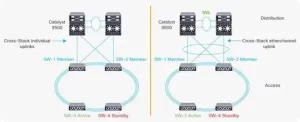
- Failure Tolerance: A stock trading floor needs sub-second failover (achieved with Cisco’s StackWise Virtual), while a school network may tolerate brief outages.
A healthcare provider, for instance, upgraded from Catalyst 2960 to Catalyst 9300 switches after realizing their legacy hardware couldn’t handle encrypted medical imaging (DICOM) traffic, reducing MRI transfer times by 92%.
Switch Selection: Matching Architecture to Application
1. Access Layer: Where Users Meet the Network
- Catalyst 1000 Series: Budget-friendly for small offices (8-48 ports, 1G).
- Example: A law firm with 20 employees uses Catalyst 1000 for VoIP phones and basic file sharing.
- Catalyst 9200/9300: For IoT-heavy environments (smart buildings, hospitals).
- Key Feature: Cisco’s Embedded Event Manager (EEM) automates responses to device anomalies.
2. Distribution/Core: The Network’s Central Nervous System
- Catalyst 9400/9500: Multigig and SD-Access ready for campus cores.
- Case Study: A university reduced network congestion by 70% using Catalyst 9500’s 40G stacking.
- Nexus 9000 Series: Data center warriors with VXLAN/EVPN support.
- Pro Tip: Nexus 93180YC-FX handles 100G spine-leaf topologies at 1/3rd the cost of comparable Arista switches.
3. Specialized Environments
- Industrial Ethernet 4000: Ruggedized for factory floors (-40°C to 75°C operation).
- Meraki MS Series: Cloud-managed for distributed retail or pop-up sites.
Router Rationalization: Beyond Basic Connectivity
1. Branch Offices: The Last Mile Matters
- ISR 1000 Series: Entry-level SD-WAN with Zero-Touch Provisioning (ZTP).
- Savings Alert: ISR 1100-4G-LTE reduces MPLS costs by 60% via 4G failover.
- Catalyst 8000 Series: SD-WAN + security convergence (Cisco Umbrella, IPSec).
- Use Case: A logistics company secured 200 branches with integrated threat defense.
2. Data Center/Edge: When Speed Meets Scale
- ASR 9000 Series: Carrier-grade routing for 100G+ internet gateways.
- Performance: Processes 400M routes with sub-μs latency—ideal for CDNs.
- NCS 5000 Series: 5G mobile core and network slicing for telecoms.
3. The Hidden Gem: Cloud Routers
- Cisco CSR 1000V: Virtual router for AWS/Azure, reducing cloud egress costs by 35%.
The Budget Tightrope: CapEx vs. OpEx Considerations
Cisco’s pricing model demands scrutiny:
- Subscription Licensing: Catalyst 9000’s DNA Essentials (2k one-time).
- Refurbished Gear: A refurbished Catalyst 3850 costs 70% less than new but lacks MultiGig support.
- Hidden Costs: 10G SFPs add $800/switch; consider NBASE-T switches (Catalyst 9200L) to avoid optics.
A mid-sized manufacturer saved $120k by choosing Catalyst 9200L over Meraki MS350—opting for CLI management they already understood versus recurring cloud fees.
Future-Proofing: The 5-Year Horizon Test
Evaluate hardware against emerging trends:
- Wi-Fi 6E Adoption: Ensure switches support 2.5G/5G BASE-T (Catalyst 9300) for new APs.
- Quantum Security: ASR 9000’s upcoming firmware will support quantum-resistant algorithms.
- AIOps Integration: Nexus Dashboard simplifies network assurance but requires NX-OS 10.4+.
A financial firm avoided a $500k forklift upgrade by verifying their Nexus 9508’s 400G readiness before deploying AI training clusters.
The Vendor Lock-In Dilemma
While Cisco dominates, hybrid environments may warrant alternatives:
- Multi-Vendor SD-WAN: Pair Catalyst 8000 with Silver Peak for application-aware routing.
- Open NOS: Nexus 9000’s ACI Anywhere supports Kubernetes, easing multi-cloud management.

Leave a comment