

In room-dense Wi-Fi deployment scenarios—such as hospitals, hotels, dormitories, and office areas—wireless terminals frequently roam between rooms. When users move across multiple rooms, devices like tablets, barcode scanners, and mobile phones constantly roam between access points (APs), which can easily lead to packet loss or even service interruption.
A hospital ward area is a typical example. Doctors move between rooms using tablets to view patient information (including high-definition medical images), and nurses use handheld barcode scanners for medication verification. As these devices frequently roam between APs, traditional Wi-Fi networks often experience service drops, high latency, and packet loss, affecting medical efficiency.
To solve this challenge, Distributed AP solutions were introduced. By building a zero-roaming distributed Wi-Fi network, terminals can move between rooms without triggering real roaming, eliminating packet loss and ensuring stable performance in highly mobile scenarios.
In addition to reducing roaming-related issues, distributed APs also help lower network construction and O&M costs. When enterprises need to deploy internal networks, external networks, and IoT networks simultaneously, building three separate networks becomes costly and difficult to maintain. Through RF signal combining, a distributed AP allows all three networks to share one set of antennas—achieving three-network integration while keeping data physically isolated and secure.
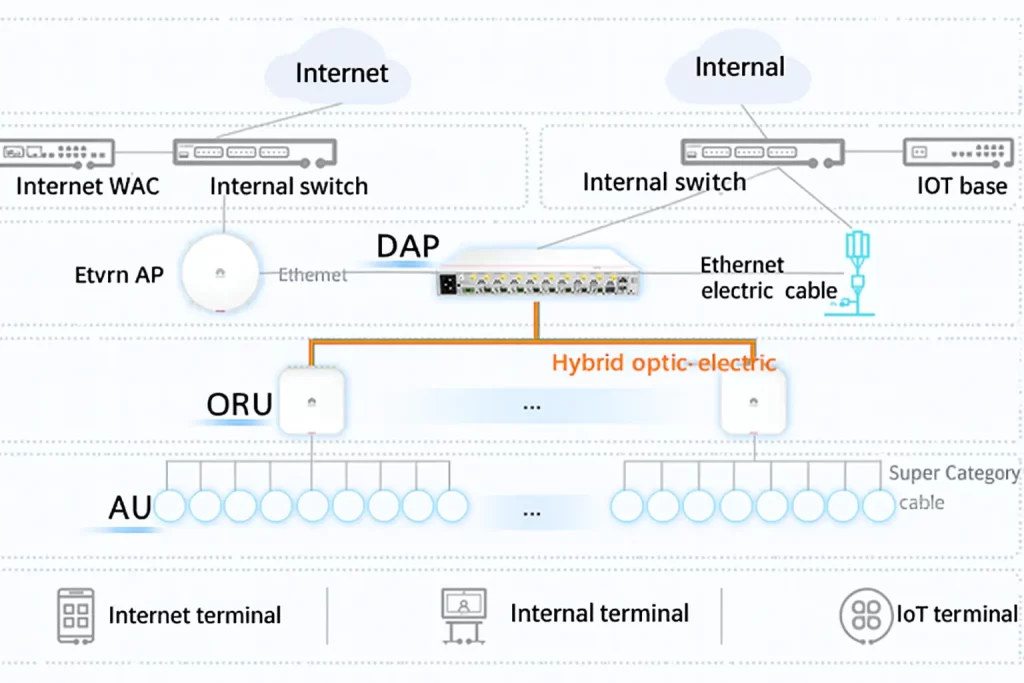
1.How Do Distributed APs Work?
A Wi-Fi 6 zero-roaming distributed solution consists of:
- Distributed AP (core unit)
- Optical Radio Unit (ORU)
- Antenna Unit (AU)
The ORU and AU are centrally managed by the Distributed AP. After simple physical connection, no additional configuration is required. Together, they function as a long-distance extended antenna system that brings AP signals to multiple rooms, forming a large, seamless Wi-Fi coverage area.
2.Distributed AP Functions
- Provides AP forwarding, RF processing, and unified management of ORUs
- Supports FIT mode (managed by a central WAC) or standalone FAT mode
- Connects to ORUs for remote signal coverage
- Can simultaneously connect external-network APs and IoT base stations
- Provides RF-to-optical conversion for long-distance coverage extension
Optical Radio Unit (ORU)
- Amplifies RF signals and transmits them through hybrid optical-electrical cables
- Supports ultra-long-distance deployment up to 500 meters
- Directly managed by the Distributed AP
Antenna Unit (AU)
- Sends and receives wireless signals
- Connects directly to the ORU via RF feeders
External Network Integration
Traditional WAC + FIT AP architecture is used for the external network.
By connecting an external-network AP directly to the Distributed AP through RF feeders, both networks can share the same antenna system, providing identical coverage areas while maintaining full data isolation.
IoT Network Integration, the distributed AP supports:
- Up to 4 × 2.4 GHz IoT base stations
- Up to 2 × 433 MHz IoT base stations
After connecting via RF feeders, IoT signals are converted to optical signals and extended through the ORU.
- 2.4 GHz IoT signals can share the same AU
- 433 MHz IoT signals require separate antennas mounted on the ORU
3.Wi-Fi 7 Zero-Roaming Distributed Architecture
Wi-Fi 7 introduces a further-enhanced zero-roaming solution consisting of:
- Zero-Roaming AP
- Antenna Units (AU)
A single Zero-Roaming AP can connect up to 8 AUs, forming a large unified coverage zone.
Zero-Roaming AP Features
- Handles AP forwarding, RF processing, and AU management
- Operates exclusively in FIT mode and is centrally managed by AC
- Built-in dual-CPU architecture for superior performance
- Supports simultaneous uplink connections to internal and external network switches
- Can connect to IoT base stations or IoT modules
- Achieves three-network integrated deployment with physical data isolation
Antenna Unit (AU)
- Directly connected to the Zero-Roaming AP
- Functions purely as a managed antenna—plug-and-play with no configuration needed
- Fully controllable via AC (status check, disable/enable, rename, etc.)
Summary of Benefits
The Distributed AP and Zero-Roaming architectures deliver:
- True zero-roaming connectivity in room-dense environments
- Stable, low-latency performance even with high mobility
- Three-network integration (Internal, External, IoT)
- Physically isolated services for enhanced security
- Lower deployment and maintenance costs
- Flexible long-distance coverage, especially with Wi-Fi 6 ORUs
These solutions are ideal for hospitals, hotels, campuses, enterprises, dormitories, and any scenario requiring seamless mobility and unified multi-network coverage.
The following products are Huawei’s Wi-Fi 6 zero-roaming distributed solutions launched in 2023. The relevant products are listed below for your reference. If you have any questions pls contact csd@telecomat.com.
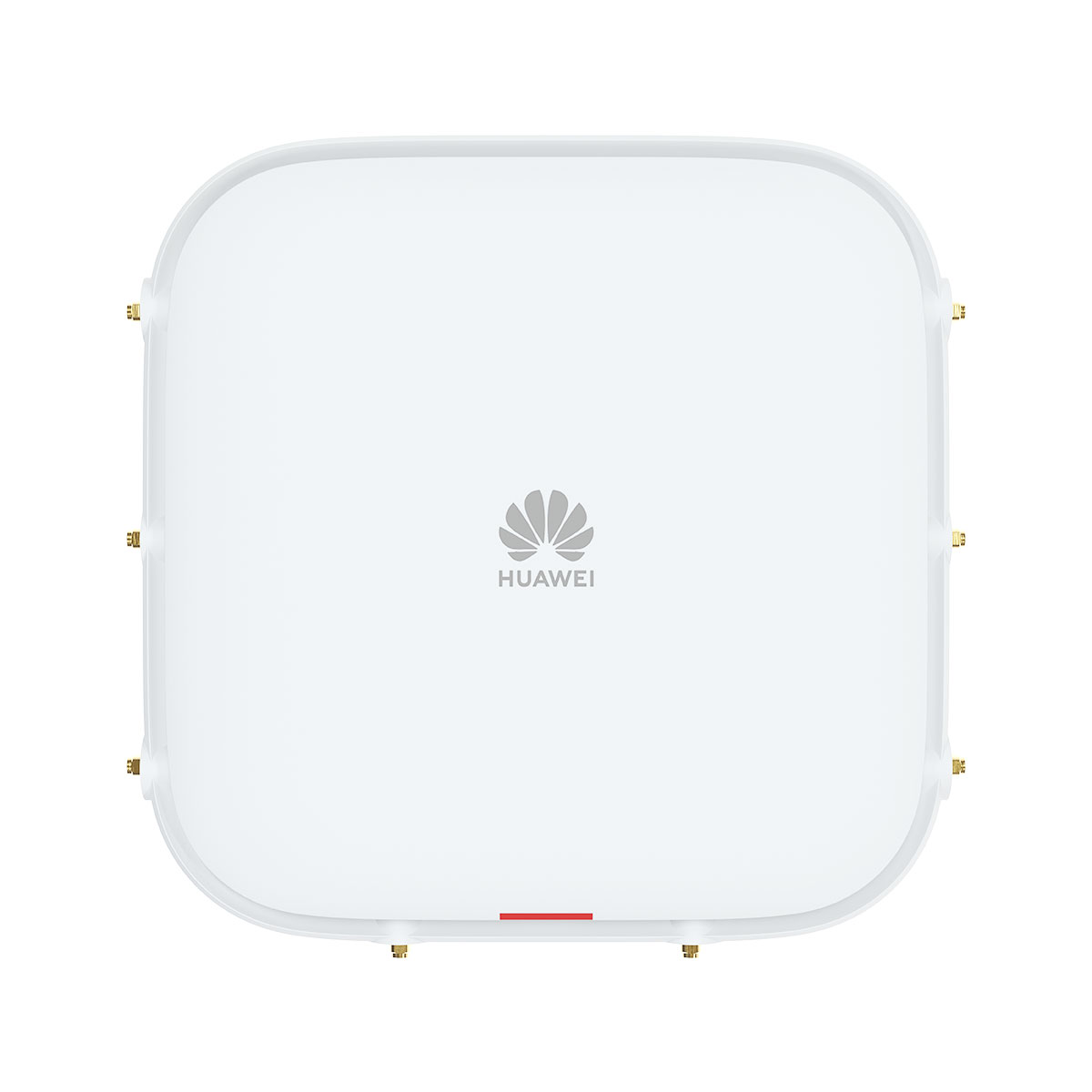
AirEngine 6760-X1E
Huawei AirEngine 6760-X1E indoor access point (AP) with 11ax indoor, 4+6 dual bands, external antenna, USB, IoT Slot, BLE, Optional RTU upgrade to 4+8/4+4+4/4+6+Scan

Leave a comment