
What: This comprehensive whitepaper explores the technical architecture, operational mechanisms, and strategic deployment of the 10GBASE-LR SFP+ optical transceiver. It serves as the cornerstone for high-speed, long-reach data transmission over Single-Mode Fiber (SMF) in modern telecommunications and data center environments.
Why: As enterprise networks migrate from legacy 1G infrastructures to 10G, 25G, and beyond, understanding the physical layer components becomes critical. The 10GBASE-LR (Long Reach) standard is uniquely positioned to bridge campus buildings, interconnect data centers (DCI), and provide robust ISP backhaul, supporting escalating bandwidth demands driven by cloud computing and AI workloads.
How: Readers will learn how to design flawless optical links, calculate precise optical power budgets, leverage Digital Optical Monitoring (DOM) for proactive troubleshooting, and navigate Multi-Source Agreement (MSA) compatibility to deploy cost-effective, high-availability fiber networks using 10GBASE-LR technology.
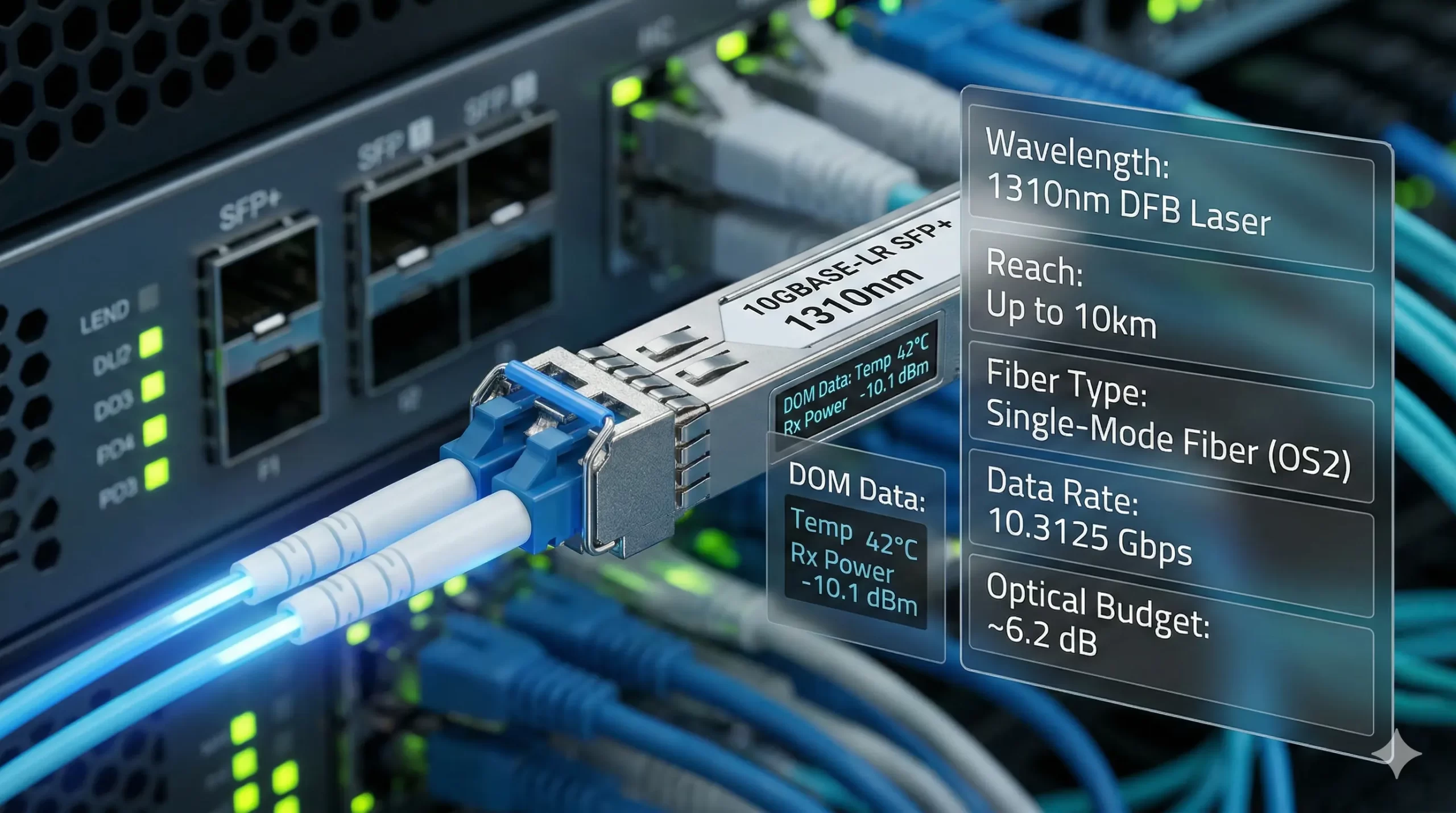
1. Understanding the 10GBASE-LR SFP+ Optical Transceiver Architecture
To master high-speed optical networking, network engineers must look beyond the switch CLI and understand the physical layer components dictating data transmission. The 10GBASE-LR SFP+ (Small Form-factor Pluggable Plus) is not merely a “plug,” but a complex electro-optical bridge. It converts high-speed electrical signals from a network switch’s ASIC into pulses of light for transmission over fiber optic cables, and vice versa.
The SFP+ form factor was developed as an enhancement to the original SFP standard, engineered specifically to support data rates up to 16 Gbps, making it the perfect vessel for 10 Gigabit Ethernet (10GbE). The “LR” designation specifically refers to “Long Reach,” operating under the IEEE 802.3ae standard ratified to ensure global interoperability.
1.1 Core Specifications and the IEEE 802.3ae Standard
The IEEE 802.3ae standard, finalized in 2002, laid the groundwork for 10GbE over fiber. Within this standard, the 10GBASE-LR physical layer specifies transmission over Single-Mode Fiber (SMF) at a nominal wavelength of 1310 nanometers (nm).
Unlike earlier Ethernet standards that used 8B/10B encoding, 10GbE utilizes a highly efficient 64B/66B encoding scheme. This reduces the encoding overhead from 25% down to just 3.125%. Consequently, to deliver a payload of 10.0 Gbps, the 10GBASE-LR transceiver actually operates at a line baud rate of 10.3125 Gbps. This precise clocking is managed by a sophisticated internal Retimer and Clock and Data Recovery (CDR) circuit built directly into the SFP+ module, ensuring signal integrity over long distances by eliminating jitter accumulated in the host board.
1.2 The Role of 1310nm Distributed Feedback (DFB) Lasers
The optical engine of a 10GBASE-LR SFP+ module is its Transmitter Optical Sub-Assembly (TOSA). For the LR standard, the TOSA utilizes a Distributed Feedback (DFB) laser.
Why a DFB laser at 1310nm? In fiber optics, signal degradation is primarily caused by two factors: attenuation (loss of power) and dispersion (spreading of the signal).
Zero Dispersion Window: Single-Mode Fiber has a “zero dispersion wavelength” naturally occurring right around 1310nm. Chromatic dispersion—where different spectral components of the light pulse travel at slightly different speeds, causing the pulse to smear and overlap (Inter-Symbol Interference)—is practically eliminated at this wavelength.
Spectral Width: A DFB laser differs from cheaper Fabry-Perot (FP) lasers by utilizing a diffraction grating within the active region of the laser diode. This grating acts as a highly selective filter, forcing the laser to emit a very narrow, single longitudinal mode (a very pure color of light).
This combination of a narrow spectral width from the DFB laser and the zero-dispersion characteristics of the 1310nm window in SMF is exactly what allows the 10GBASE-LR standard to reliably achieve distances up to 10 kilometers (6.2 miles) without requiring expensive dispersion compensation modules.
2. Single-Mode Fiber (SMF) vs. Multi-Mode Fiber (MMF) in 10G Deployments
A critical decision in network architecture is pairing the correct transceiver with the correct fiber plant. 10GBASE-LR is strictly designed for Single-Mode Fiber (OS1 or OS2), which fundamentally differs from the Multi-Mode Fiber (OM3, OM4) used with 10GBASE-SR (Short Reach) optics.
2.1 The Physics of Light Propagation
Multi-Mode Fiber possesses a larger core diameter (typically 50 microns). This large core allows light to travel down multiple distinct paths, or “modes.” Over short distances, this is fine. However, over longer distances, modal dispersion occurs—light traveling straight down the center arrives faster than light bouncing off the cladding. At 10 Gbps, this smearing makes the data unreadable by the receiver after just 300 meters on OM3 fiber.
Single-Mode Fiber, used by the 10GBASE-LR SFP+, has a microscopic core diameter of just 9 microns. This core is so narrow that it only permits a single mode of light to propagate directly down the center. Because there are no multiple paths, modal dispersion is physically impossible. This single physical trait is what unlocks the kilometer-scale reach of the LR module.
2.2 Comparative Analysis: 10GBASE-LR vs. 10GBASE-SR
To understand the strategic positioning of the 10GBASE-LR, network architects frequently compare it against the short-reach alternative.
| Comparison Dimension | 10GBASE-LR SFP+ | 10GBASE-SR SFP+ |
| Target Application | Campus uplinks, DCI, Metro access, Long backhaul | Intra-rack, Row-to-Row data center connectivity |
| Fiber Cable Type | Single-Mode Fiber (SMF: OS1, OS2) | Multi-Mode Fiber (MMF: OM3, OM4, OM5) |
| Operating Wavelength | 1310 nm | 850 nm |
| Laser Technology | DFB (Distributed Feedback) Laser | VCSEL (Vertical-Cavity Surface-Emitting Laser) |
| Maximum Distance | Up to 10 Kilometers (10,000 meters) | Up to 300 meters (on OM3) / 400 meters (on OM4) |
| Core Diameter | 9 / 125 μm | 50 / 125 μm |
| Relative Cost (Module) | Medium/High | Low |
(Source: Multi-Source Agreement Standards & IEEE 802.3, 2024)
The choice is clear: while SR optics and MMF cabling are cheaper for connecting servers within the same data hall, the 10GBASE-LR SFP+ is the mandatory choice the moment data must leave the immediate facility or traverse an enterprise campus.
3. Key Technical Metrics for Evaluating 10GBASE-LR Optical Modules
When provisioning optics for a Tier-1 data center, network engineers do not just plug in cables and hope for link lights. They engage in rigorous optical engineering, heavily relying on the performance metrics of the SFP+ modules.
3.1 Mastering the Optical Power Budget and Insertion Loss
The most critical calculation in fiber optic deployment is the Optical Power Budget. This ensures that the light leaving the transmit (Tx) port of one 10GBASE-LR module is strong enough to be read by the receive (Rx) port of the module at the other end, but not so strong that it burns out the receiver.
The standard optical metrics for a typical MSA-compliant 10GBASE-LR SFP+ are:
-
Minimum Transmit Power (Tx Min): -8.2 dBm
-
Maximum Transmit Power (Tx Max): +0.5 dBm
-
Receiver Sensitivity (Rx Sens): -14.4 dBm
-
Receiver Overload (Rx Max): +0.5 dBm
The total optical budget is calculated by subtracting the Receiver Sensitivity from the Minimum Transmit Power:
Optical Budget = Tx Min (-8.2 dBm) - Rx Sens (-14.4 dBm) = 6.2 dB
This 6.2 dB represents the absolute maximum amount of light loss (attenuation) the fiber link can sustain before the link drops or begins generating CRC errors.
In a real-world scenario, attenuation occurs from the fiber itself (OS2 fiber at 1310nm loses about 0.35 dB per kilometer) and from passive components like LC connector mating pairs (0.5 dB per connection) and splice points (0.1 dB per splice). A 10km link on OS2 fiber perfectly spliced would incur roughly 3.5 dB of cable loss, well within the 6.2 dB budget of the 10GBASE-LR, leaving a comfortable 2.7 dB safety margin for component aging.
3.2 Digital Optical Monitoring (DOM/DDM) Capabilities
Modern 10GBASE-LR SFP+ modules are not “dumb” media converters; they are highly intelligent diagnostic tools. Governed by the SFF-8472 MSA standard, they feature a micro-controller and an EEPROM chip that provide Digital Optical Monitoring (DOM) or Digital Diagnostic Monitoring (DDM).
Through the switch CLI (using commands like show interfaces transceiver detail), engineers can read real-time telemetry directly from the I2C interface of the SFP+ module. The five core metrics monitored are:
-
Temperature: Ensures the module is operating within its specified range (usually 0°C to 70°C for commercial grade, or -40°C to 85°C for industrial grade). High heat degrades laser lifespan exponentially.
-
Vcc (Voltage): Monitors internal supply voltage (nominally 3.3V). Voltage drops can cause bit errors.
-
Tx Bias Current: The electrical current driving the laser. As lasers age, they require more bias current to achieve the same optical output. Monitoring this allows engineers to proactively replace failing optics before an outage occurs.
-
Tx Power (Transmit Power): Real-time measurement of the outgoing optical signal strength.
-
Rx Power (Receive Power): Real-time measurement of incoming light. If this value drops suddenly, it instantly indicates a fiber cut or a dirty connector somewhere on the link.
By feeding DOM data into Network Monitoring Systems (NMS) via SNMP, enterprise networks achieve >99.999% availability by moving from reactive troubleshooting to predictive optical maintenance.
4. Strategic Implementation of 10GBASE-LR SFP+ in Enterprise and ISP Networks
Deploying 10GBASE-LR modules successfully requires strict adherence to physical layer hygiene and an understanding of vendor compatibility dynamics.
4.1 Campus Network Uplinks and Cross-Facility Connectivity
The most ubiquitous use case for the 10GBASE-LR is the “Campus Core to Distribution” uplink. In a large enterprise, university, or hospital campus, network switches are distributed across multiple buildings. These buildings are often separated by hundreds of meters or several kilometers—distances far exceeding the 300m limit of 10GBASE-SR.
Engineers deploy OS2 Single-Mode fiber trenches between buildings. A pair of 10GBASE-LR SFP+ transceivers is then used to create a resilient 10 Gbps trunk (often aggregated into 20G or 40G EtherChannels using LACP) back to the core data center.
Critical Implementation Rule: End-Face Geometry and Cleaning.
A single speck of dust on the 9-micron core of an LC connector can completely block a 1310nm signal, causing massive reflection (Return Loss) that can actually bounce back and physically damage the DFB laser in the TOSA. Professional network engineers never connect a 10GBASE-LR transceiver without first inspecting the fiber patch cable with a fiber microscope and cleaning it with a “click-to-clean” dry swab tool. Over 80% of all 10G fiber link failures are attributed to contaminated connector end-faces (Source: Gartner IT Infrastructure Metrics, 2023).
4.2 Defeating Vendor Lock-in: The Third-Party Optics Strategy
Historically, Original Equipment Manufacturers (OEMs) like Cisco, Juniper, and Arista have utilized aggressive “vendor lock-in” tactics. They achieve this by writing a proprietary cryptographic key or specific manufacturer string into the EEPROM (specifically in the A0h memory address map dictated by the MSA) of their branded optical modules. When a switch boots up, the operating system (like Cisco IOS-XE) queries the I2C bus of the SFP+. If it doesn’t read the exact OEM code, the switch will disable the port and throw an err-disable or “unsupported transceiver” error.
This practice forces enterprises to pay markups of up to 400% for OEM-branded optics. However, the optical transceivers themselves are virtually all manufactured by the same 3 or 4 Tier-1 foundries globally.
To optimize CapEx, modern IT leaders employ highly reliable third-party optics. By utilizing a high-quality 10G SFP+ Transceiver from Telecomate, organizations can procure modules where the EEPROM has been perfectly coded to mirror the exact bit-structure of the target OEM (e.g., flashed to look identical to a Cisco SFP-10G-LR). These third-party modules are 100% MSA compliant, pass all hardware diagnostics, and allow IT budgets to be reallocated from overpriced optics to core routing infrastructure.
5. The Evolution of Optical Networks: Transitioning Beyond 10GBASE-LR
While 10GBASE-LR remains the undisputed workhorse for enterprise uplinks and metro-edge networks, the core of the data center is rapidly evolving. The exponential growth of AI clusters, NVMe-over-Fabrics (NVMe-oF), and 4K/8K video transport is pushing aggregation layers to demand higher throughput.
5.1 Migrating from 10G to 25G/40G/100G Architectures
The brilliance of deploying Single-Mode Fiber infrastructure for 10GBASE-LR is investment protection. Because OS2 SMF has virtually unlimited bandwidth capacity, the physical cabling plant does not need to be ripped and replaced when migrating to higher speeds.
The 25GBASE-LR Step: The most direct upgrade path is the 25G SFP28 form factor. It shares the exact same physical dimensions as the SFP+, uses the same LC duplex connectors, and operates over the same 1310nm SMF for 10km. It simply utilizes a faster 25 Gbps laser (often utilizing forward error correction – FEC). A seamless swap of the transceiver and switch port upgrades the link by 2.5x.
The 100GBASE-LR4 Step: For core interconnects, 100G is the standard. A 100GBASE-LR4 QSFP28 module achieves 100 Gbps by utilizing Wavelength Division Multiplexing (WDM). It takes four distinct 25 Gbps signals, each at a slightly different wavelength around 1310nm (e.g., 1295nm, 1300nm, 1304nm, 1309nm), multiplexes them into a single beam, and shoots them down the exact same strand of SMF originally laid for the 10GBASE-LR.
By strategically sourcing adaptable components like the Optical Transceivers from Telecomate, organizations ensure their physical layer is primed for future bandwidth scaling without exorbitant recabling costs.
6. Frequently Asked Questions (FAQs) About 10GBASE-LR SFP+
Q1: What is the maximum distance a 10GBASE-LR SFP+ can transmit?
A: Under the IEEE 802.3ae standard, a 10GBASE-LR transceiver can transmit up to 10 kilometers (6.2 miles) over standard Single-Mode Fiber (OS1 or OS2) without requiring signal regeneration or amplification.
Q2: Can I connect a 10GBASE-LR module directly to a 10GBASE-SR module?
A: No. They are fundamentally incompatible. 10GBASE-LR uses a 1310nm laser over Single-Mode fiber, while 10GBASE-SR uses an 850nm laser over Multi-Mode fiber. Connecting them will result in no link and could potentially damage the sensitive SR receiver due to the higher power output of the LR laser.
Q3: Does 10GBASE-LR work with Multi-Mode Fiber (MMF)?
A: Generally, no. 10GBASE-LR is designed for Single-Mode Fiber (SMF). While an LR module might push a signal through a very short patch of MMF using a specialized Mode Conditioning Patch (MCP) cable, it is highly discouraged in 10G environments due to severe differential mode delay and jitter. Always use SMF.
Q4: What does “MSA Compliant” mean for an SFP+ module?
A: Multi-Source Agreement (MSA) compliance means the transceiver strictly adheres to industry-agreed physical dimensions, electrical interfaces, and signaling protocols. This ensures that an MSA-compliant module will physically fit and electrically function in any standard SFP+ port, regardless of the switch vendor.
Q5: Why is my Cisco switch showing an “unsupported transceiver” error with my 10GBASE-LR?
A: OEMs like Cisco often restrict ports to only accept their branded optics via EEPROM checks. To fix this, you either need a third-party SFP+ specifically coded for Cisco compatibility, or you can run hidden bypass commands in the switch CLI, such as service unsupported-transceiver and no errdisable detect cause gbic-invalid.
Q6: What is the difference between 10GBASE-LR and 10GBASE-LRM?
A: 10GBASE-LR reaches 10km over Single-Mode Fiber at 1310nm. 10GBASE-LRM (Long Reach Multimode) is a legacy standard designed to achieve 220 meters over older, low-grade FDDI-grade Multi-Mode Fiber. LRM requires specialized Electronic Dispersion Compensation (EDC) chips on the host switch and is largely obsolete today.
Q7: What type of fiber connector does the 10GBASE-LR SFP+ use?
A: The standard 10GBASE-LR SFP+ utilizes a Duplex LC connector. One strand is dedicated to transmitting data (Tx), and the other strand is dedicated to receiving data (Rx). Always ensure the connector end-faces are meticulously polished (UPC is standard).
Q8: Is Digital Optical Monitoring (DOM) necessary for 10G links?
A: While a link will function without it, DOM is highly recommended. DOM allows network administrators to proactively monitor critical metrics like laser temperature, transmit power, and receive sensitivity in real-time, preventing sudden outages by identifying degrading optics before they fail completely.
7. Conclusion and Strategic Recommendations
The 10GBASE-LR SFP+ remains an indispensable architectural pillar for modern enterprise networks, ISPs, and data center operators. By combining the precision of 1310nm DFB lasers with the zero-dispersion characteristics of Single-Mode Fiber, it delivers the massive 10 Gbps bandwidth required for today’s data-heavy applications across kilometer-scale distances flawlessly.
Mastering the physical layer—understanding optical power budgets, adhering to strict fiber cleaning protocols, and leveraging DOM telemetry—is what separates reactive IT departments from highly resilient, Tier-1 engineering organizations. Furthermore, understanding the EEPROM architecture allows operators to strategically utilize third-party optics, breaking free from OEM vendor lock-in and drastically reducing network CapEx.
As you plan your next data center interconnect or campus network upgrade, ensure you are building upon a foundation of uncompromising optical quality.
Ready to optimize your optical network infrastructure? Explore the full range of meticulously engineered, MSA-compliant Optical Transceivers at Telecomate to build high-performance, cost-effective 10G, 25G, and 100G fiber networks.

Leave a comment