
Abstract
As hyperscale data centers and telecommunications networks transition to the terabit era, the demand for carrier-class reliability, deep packet inspection, and massive bandwidth aggregation has never been higher. This article provides a comprehensive architectural deep-dive into the Huawei NE40E-X16A DC—a flagship Universal Service Router designed to handle extreme data loads at the IP edge and core.
Why is this critical right now? The rapid adoption of 5G, cloud-native applications, and artificial intelligence workloads requires backbone networks to support non-blocking terabit switching and advanced traffic engineering. Legacy protocols are struggling to keep up, making the transition to IPv6 and SRv6 an immediate operational necessity.
By reading this whitepaper, network architects and infrastructure directors will learn how the NE40E-X16A DC’s CLOS architecture eliminates head-of-line blocking, how to leverage its native SDN capabilities for automated traffic steering, and actionable strategies for optimizing power efficiency in large-scale Data Center Interconnect (DCI) deployments.
What is the Huawei NE40E-X16A DC? A Universal Service Router for the Terabit Era
The NE40E-X16A DC is a high-end, carrier-grade Universal Service Router (USR) manufactured by Huawei, specifically engineered for deployment at the core nodes of enterprise Wide Area Networks (WANs), IP Metropolitan Area Networks (MANs), and the edge of large-scale Internet Data Centers (IDCs). As the nomenclature suggests, the “X16A” denotes its massive capacity, featuring 16 primary service slots for Line Processing Units (LPUs), while the “DC” signifies its integration with Direct Current (-48V) telecommunications power infrastructures.
In the modern networking landscape, the boundary between the local enterprise network and the cloud has dissolved. The NE40E-X16A acts as the critical bridge, offering a staggering switching capacity of up to 9.12 Tbps depending on the fabric generation deployed. It operates on Huawei’s highly mature Versatile Routing Platform (VRP) operating system, which provides a unified, programmable interface for both traditional routing protocols (BGP, OSPF, IS-IS) and next-generation traffic engineering.
The router is built to accommodate the relentless growth of bandwidth. By supporting up to 480G, 1T, and even 2T line cards per slot, it allows organizations to scale their throughput without requiring a complete chassis replacement. This “pay-as-you-grow” scalability is a cornerstone of modern B2B network infrastructure, ensuring that capital expenditures (CapEx) are strictly aligned with actual bandwidth utilization. For a comprehensive look at the chassis specifications and configuration options, network planners can refer directly to https://www.telecomate.com/huawei-routers/ne40e-x16a/.
Deep Dive into the Hardware Architecture: CLOS Switching and Component Isolation
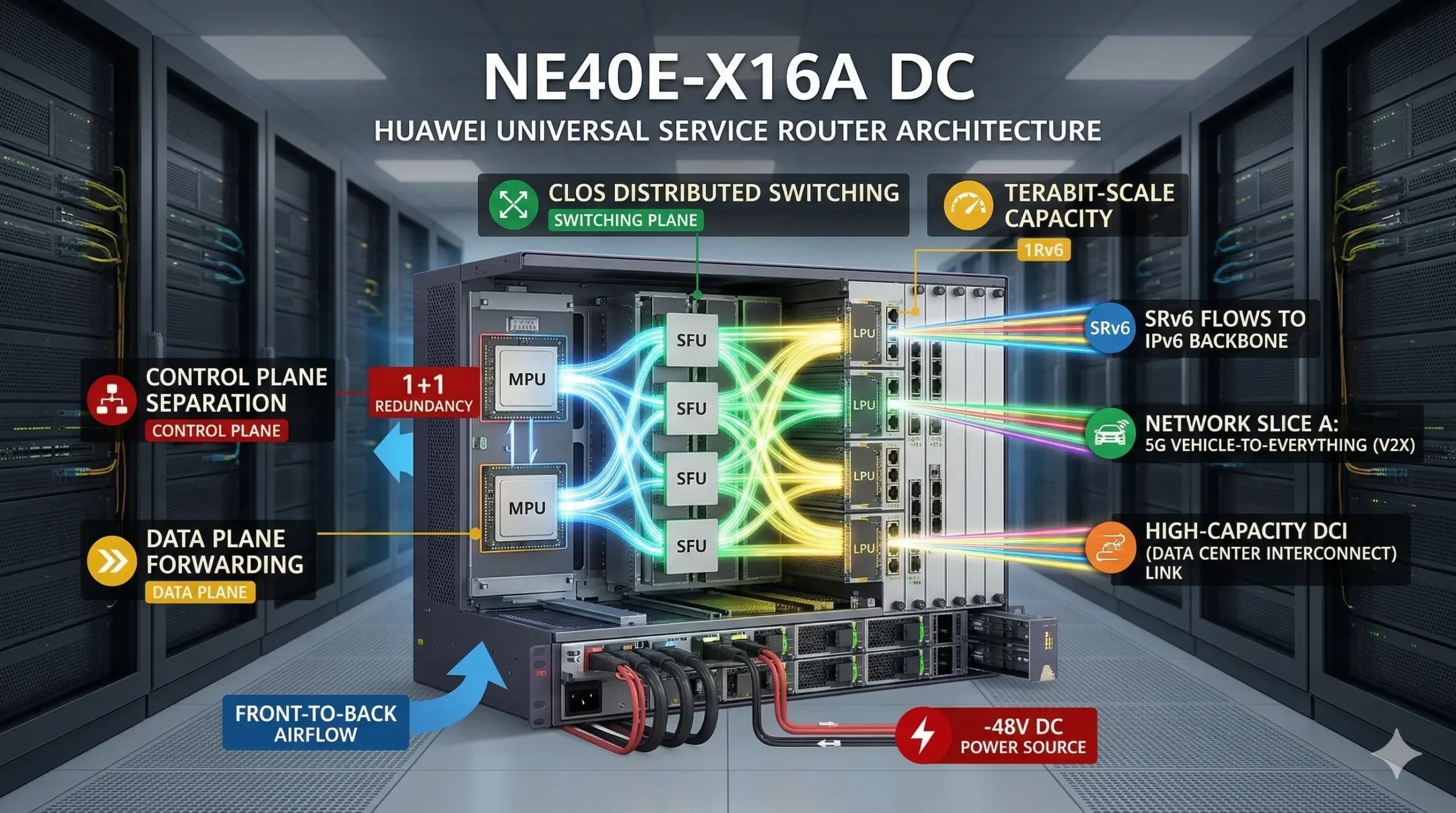
To achieve true line-rate forwarding without packet drops, the NE40E-X16A DC abandons traditional shared-bus designs in favor of a strictly non-blocking CLOS distributed switching architecture. Invented by Charles Clos for telecommunications networks, this matrix design ensures that traffic from any ingress port can reach any egress port without bottlenecking at the backplane.
The architecture is physically and logically divided into three distinct functional planes, ensuring that a spike in data traffic never overwhelms the router’s brain:
Main Processing Units (MPUs) – The Control Plane: The chassis supports dual MPUs operating in a 1:1 active/standby redundancy mode. The MPU is responsible for routing protocol calculations, system management, and maintaining the Routing Information Base (RIB). By physically isolating the control plane, the NE40E-X16A DC ensures that malicious DDoS attacks or massive BGP route-flaps do not consume the CPU cycles required for actual data forwarding.
Switch Fabric Units (SFUs) – The Switching Plane: The NE40E-X16A incorporates multiple SFUs operating in a load-sharing redundancy matrix (typically N+1 or N+M depending on the configuration). When an ingress packet arrives, it is broken down into fixed-size cells and sprayed evenly across all available SFUs. This dynamic cell-switching mechanism entirely eliminates head-of-line blocking, ensuring deterministic latency for critical applications.
Line Processing Units (LPUs) – The Data Forwarding Plane: These are the physical interfaces where fiber optic cables connect. The LPUs house the dedicated Network Processors (NPs) that handle Forwarding Information Base (FIB) lookups, Quality of Service (QoS) queuing, and Access Control List (ACL) enforcement at hardware speeds.
According to the Gartner Magic Quadrant for Enterprise Network Infrastructure (2024), architectural separation of the control and data planes is a mandatory requirement for inclusion in the “Leaders” quadrant, a standard the NE40E series exceeds with its multi-stage CLOS fabric.
The Core Brain: Huawei Solar NP Chipsets and Programmable Forwarding
Traditional routers often rely on generic Application-Specific Integrated Circuits (ASICs). While ASICs are fast, their silicon is hard-coded; if a new protocol (like a new variation of IPv6 extension headers) is ratified by the IETF, an ASIC-based router often requires a complete hardware replacement to support it.
The NE40E-X16A DC solves this hardware-obsolescence problem by utilizing Huawei’s proprietary Solar Network Processor (NP) chipsets.
Microcode Programmability: The Solar NP combines the raw speed of an ASIC with the flexibility of a CPU. Through firmware updates to the VRP operating system, the NPs can be reprogrammed via microcode to support entirely new network protocols without altering the physical hardware.
Deep Packet Inspection (DPI): The NP architecture allows the router to look beyond the standard Layer 3 IP headers. It can analyze payloads at wire-speed to apply granular QoS policies, ensuring that latency-sensitive Voice over IP (VoIP) or financial trading data is strictly prioritized over bulk file transfers.
Hardware-Based HQoS: Hierarchical Quality of Service (HQoS) allows ISPs to guarantee bandwidth not just at the port level, but on a per-user, per-service basis. The Solar chips can manage hundreds of thousands of individual traffic queues simultaneously, a critical feature for broadband aggregation.
Key Capabilities: SRv6, Network Slicing, and Cloud-Native SDN Integration
As telecommunications networks evolve toward cloud-native architectures, legacy protocols like MPLS (Multiprotocol Label Switching) and LDP (Label Distribution Protocol) are becoming too complex and rigid to manage at scale. The NE40E-X16A DC is engineered to accelerate the transition to the next generation of routing: Segment Routing over IPv6 (SRv6).
The Shift to SRv6
SRv6 simplifies the network control plane by embedding routing instructions directly into the IPv6 packet headers using Segment Identifiers (SIDs). Instead of maintaining complex state information at every hop in the network (as required by RSVP-TE), the ingress router simply attaches an SRv6 header dictating the exact path the packet must take.
Source Routing: This allows the NE40E-X16A DC to enforce strict traffic engineering, steering high-priority traffic over ultra-low-latency paths while pushing standard internet traffic over cheaper, high-latency links.
Protocol Simplification: By eliminating LDP and RSVP, network engineers can reduce protocol overhead by up to 40%, significantly lowering the operational expense (OpEx) of managing the core network.
SDN and Network Slicing
The router natively supports NETCONF and YANG data modeling, allowing it to interface seamlessly with modern Software-Defined Networking (SDN) controllers. This enables Network Slicing—the ability to carve out logically isolated virtual networks on the same physical infrastructure. A 5G provider, for example, can create an ultra-reliable, low-latency slice for autonomous vehicle telemetry, entirely separate from a high-bandwidth slice used for consumer video streaming. To build out these advanced SDN environments, combining the chassis with the correct high-capacity line cards is essential. You can review compatible enterprise infrastructure at https://www.telecomate.com/huawei-routers/ne40e-series/.
NE40E-X16A DC Power System and Energy-Efficient Cooling
In the B2B infrastructure space, data center power density is a primary constraint. The “DC” designation of this router highlights its use of -48V Direct Current power, the global standard for telecommunications facilities.
Why -48V DC Power?
Safety and Reliability: -48V DC is below the threshold for dangerous electrical shocks, allowing technicians to perform hot-swaps safely.
Battery Plant Integration: Telecommunications centers use massive DC battery plants for uninterruptible power. Feeding DC directly into the router eliminates the power loss associated with converting battery DC to AC via an inverter, and then back to DC inside the router’s power supply. This direct-feed methodology can improve overall power efficiency by 10% to 15%.
Advanced Cooling and Efficiency Metrics
A fully loaded 16-slot chassis generating terabits of throughput produces significant thermal output. The NE40E-X16A DC employs an intelligent front-to-back airflow design, optimized for hot-aisle/cold-aisle data center containment systems.
The system utilizes modular, hot-swappable fan trays equipped with variable-speed sensors. The VRP operating system dynamically adjusts fan speeds based on real-time thermal readings from individual LPUs, rather than running all fans at maximum capacity globally.
Furthermore, the Huawei Solar NP chipsets feature dynamic frequency adjustment. When a specific port or bus is idle, the chipset automatically powers down that specific silicon pathway. According to industry energy benchmarks, this allows the NE40E series to achieve a power consumption rate of less than 1 Watt per Gigabit of forwarding capacity—one of the lowest carbon-footprint metrics in the enterprise routing industry. (Source: IEEE, Energy Efficiency in Next-Generation Routing Networks, 2023).
Comparison: NE40E-X16A DC vs. Standard Enterprise Edge Routers
To truly understand the value proposition of the NE40E-X16A DC, it must be contrasted with standard off-the-shelf enterprise aggregation routers. The table below outlines the core architectural and operational differences.
| Comparison Dimension | NE40E-X16A DC (Universal Service Core Router) | Standard Enterprise Edge Router |
| Architecture | Non-blocking CLOS Distributed Fabric | Shared Bus or Centralized CPU Forwarding |
| Forwarding Engine | Programmable Solar NP (Network Processor) | Fixed-function ASIC or general-purpose x86 |
| Routing Capacity | Up to 9.12 Tbps (Scalable via Fabric upgrades) | Typically 100 Gbps to 800 Gbps maximum |
| Traffic Engineering | Native SRv6, FlexE, and Hardware Network Slicing | Basic MPLS/RSVP-TE, software-based QoS |
| Redundancy | 1+1 MPU, N+1 SFU, 2+2 DC Power, Hot-swappable fans | Dual Power Supplies (Control plane often singular) |
| Power Infrastructure | Telecom-grade -48V DC (Direct battery plant integration) | Standard 110V/220V AC (Requires UPS inverters) |
| Target Use Case | ISP Core, Carrier Edge, Large DCI (Data Center Interconnect) | Branch Aggregation, Campus Edge, SME Gateway |
This comparison highlights that the NE40E-X16A is not merely a larger version of a standard router; it is fundamentally engineered from the ground up for massive concurrency, five-nines (99.999%) availability, and hardware-level traffic isolation.
Strategic Deployment for ISPs and Large-Scale Data Centers
Deploying the NE40E-X16A DC requires precise network engineering to maximize its capabilities. Here are the three primary deployment scenarios where this hardware excels:
1. BGP Peering and Core Routing
At the heart of an Internet Service Provider (ISP) network, routers must ingest the full global BGP routing table—which currently exceeds 900,000 IPv4 routes and 170,000 IPv6 routes. The massive onboard RAM and high-speed FIB lookup memory on the NE40E’s MPUs ensure rapid BGP convergence during internet topology changes. Its deep buffers prevent micro-burst packet loss during heavy BGP peering exchanges with Tier-1 transit providers.
2. Broadband Network Gateway (BNG) Edge Aggregation
For residential internet providers, the NE40E-X16A can function as a high-density BNG. It terminates thousands of PPPoE or IPoE subscriber sessions, applying individual bandwidth caps, QoS rules, and billing metrics at the hardware level. The distributed architecture ensures that authenticating new users on the control plane does not slow down the video streaming data of existing users on the forwarding plane.
3. Data Center Interconnect (DCI)
As enterprises deploy active-active geo-redundant data centers, the link between these facilities requires immense bandwidth and ultra-low latency. Utilizing 100G, 400G, or 800G coherent optical transceivers, the NE40E-X16A DC can push terabits of encrypted IPsec or MACsec traffic directly over dark fiber. To ensure seamless connectivity in these DCI setups, selecting verified optical components is highly recommended. You can source compatible high-speed optics at https://www.telecomate.com/optical-transceivers/100g-qsfp28/.
FAQs: Expert Answers on the NE40E-X16A DC
1. What is the maximum routing capacity of the NE40E-X16A DC?
Depending on the specific Switch Fabric Units (SFUs) and Main Processing Units (MPUs) installed, the NE40E-X16A DC can achieve a routing capacity ranging from 7.68 Tbps up to 9.12 Tbps, supporting dense 400G and future-ready line cards.
2. What is the fundamental difference between the DC and AC versions?
The DC version utilizes -48V Direct Current power supplies, designed to connect directly to telecommunications battery plants for maximum efficiency and redundancy. The AC version uses standard 110V/220V Alternating Current for traditional enterprise server rooms.
3. Does the NE40E-X16A natively support SRv6 and SDN environments?
Yes. The Versatile Routing Platform (VRP) software and Solar NP hardware fully support Segment Routing over IPv6 (SRv6) and utilize NETCONF/YANG models for seamless integration with external Software-Defined Networking (SDN) controllers.
4. What is the specific function of the Huawei Solar NP chipset?
The proprietary Solar Network Processor provides microcode-programmable, hardware-level packet forwarding. It combines the raw throughput speed of traditional ASICs with the flexibility to adopt new routing protocols via software updates without requiring hardware replacement.
5. How many service expansion slots does the chassis provide?
The “X16” designates 16 dedicated slots for Line Processing Units (LPUs). The entire chassis actually contains 22 slots, which includes the 16 LPU slots, plus dedicated slots for redundant MPUs and SFUs to maintain control and data plane isolation.
6. What are the primary deployment environments for this router?
The NE40E-X16A DC is engineered for core and edge nodes on large-scale ISP networks, enterprise WAN aggregation points, internet peering exchanges, and high-density Data Center Interconnect (DCI) networks.
7. How does the CLOS architecture prevent data packet loss?
The CLOS distributed switching matrix breaks incoming packets into cells and distributes them evenly across multiple parallel switch fabrics. This eliminates head-of-line blocking found in traditional shared-bus architectures, ensuring line-rate forwarding even during massive traffic micro-bursts.
8. What is the energy efficiency rating of the NE40E-X16A DC?
Through dynamic power allocation, intelligent fan speed adjustment, and Solar NP chipset optimizations, the router achieves highly efficient power consumption, utilizing less than 1 Watt per Gigabit of active forwarding capacity, drastically reducing data center carbon footprints.
Conclusion
The NE40E-X16A DC represents a pinnacle in carrier-grade routing infrastructure. By successfully isolating the control, switching, and forwarding planes through its robust CLOS architecture, it guarantees deterministic performance under the most extreme data center loads. Its reliance on programmable Solar NP chipsets and native support for SRv6 ensures that organizations are not just investing in current capacity, but are future-proofing their backbone against the rapidly evolving protocols of the cloud-native era.
For technical directors and network architects tasked with scaling B2B enterprise WANs or ISP cores, the mandate is clear: upgrading to a platform that balances massive throughput with sub-watt per gigabit energy efficiency is no longer optional.

Leave a comment