

MARKET POSITIONING
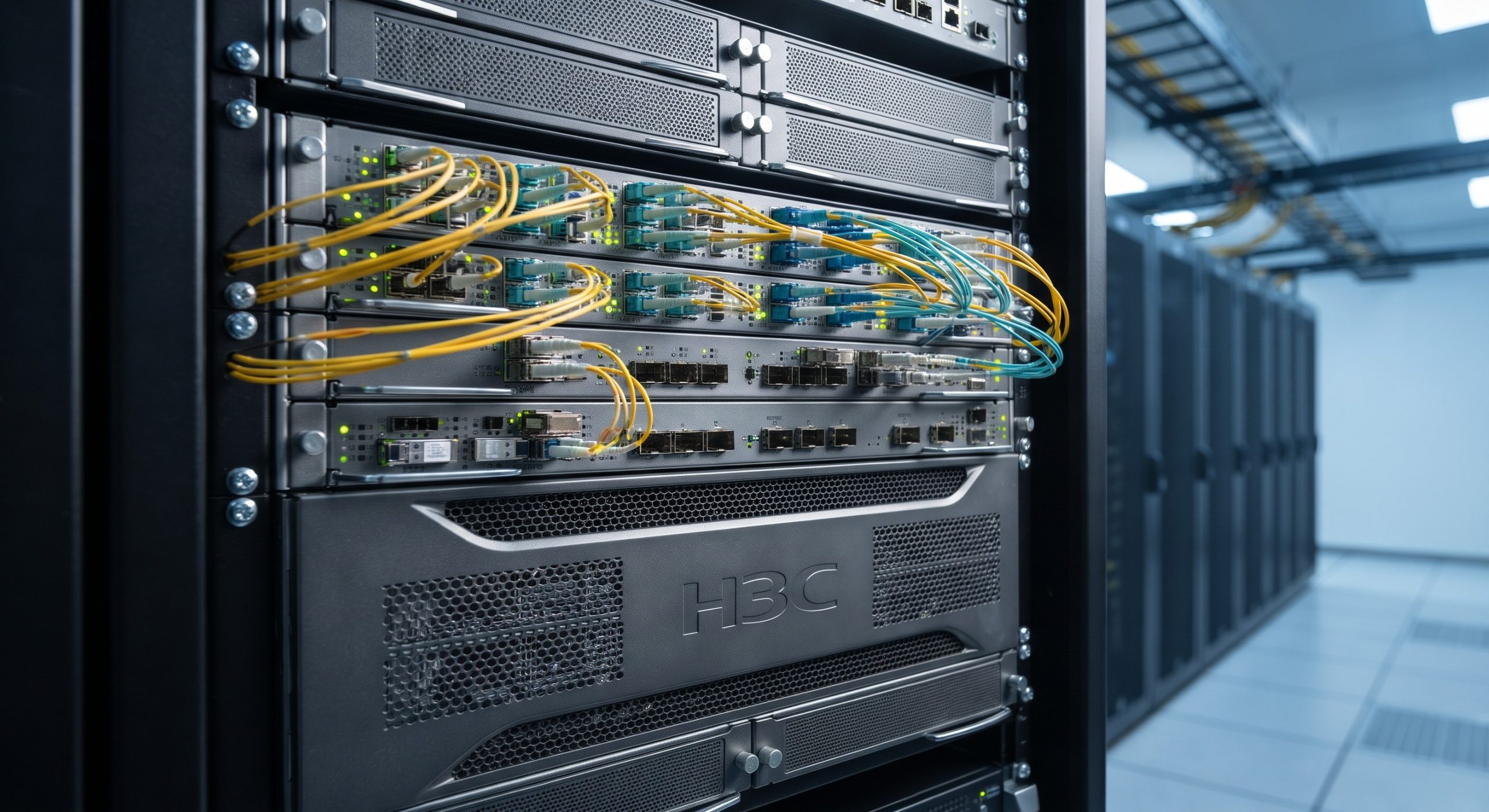
The H3C SR8800-X Series Core Router represents a purpose-built, carrier-grade platform designed for the rigorous demands of next-generation IP backbone and metropolitan area networks. Within the context of IPv6 Segment Routing (SRv6), the SR8800-X distinguishes itself as a validated, high-performance hardware foundation for Service Provider and large Enterprise networks transitioning toward simplified, programmable, and transport-agnostic network architectures. The platform has successfully obtained the SRv6 Ready certification from the China Academy of Information and Communications Technology (CAICT), affirming its compliance with rigorous industry standards for SRv6 Policy, SID allocation, and OAM capabilities . Positioned at the core or aggregation layer, the SR8800-X leverages its advanced CLOS architecture and distributed forwarding engines to deliver line-rate SRv6 encapsulation and processing, ensuring that the transition to IPv6-based segment routing does not compromise throughput or reliability.

HIGH-AVAILABILITY REDUNDANCY
Deploying SRv6 in a carrier environment necessitates a hardware foundation that guarantees service continuity under all failure scenarios. The H3C SR8800-X addresses this through a multi-layered redundancy design that integrates seamlessly with SRv6 protection mechanisms. At the chassis level, the system employs N+M redundancy for both switch fabric modules and power supplies, ensuring that no single component failure results in a total system outage . For SRv6 path protection, the hardware is optimized to support IPv6 TI-LFA FRR for SRv6, enabling sub-50ms protection switching upon link or node failure . The distributed OAM engine embedded within the line cards ensures that BFD for SRv6 and SBFD for SRv6 TE Policy are processed at hardware speed, decoupling fault detection from the central control plane CPU and maintaining deterministic convergence times even under heavy traffic loads . Furthermore, the platform supports hardware-based non-stop software upgrades, ensuring that SRv6 control plane enhancements or policy updates can be introduced without impacting live traffic.
PROTOCOL INTEROPERABILITY
The SR8800-X is engineered to operate within heterogeneous multi-vendor environments, a critical requirement for SRv6 deployments that often span legacy MPLS domains and greenfield IPv6 segments. The platform provides comprehensive support for IS-IS for SRv6, enabling the advertisement of locator and SID information across the IGP . For service overlay, the router supports EVPN L3VPN over SRv6 Policy and EVPN VPWS/VPLS over SRv6 Policy, allowing for the seamless migration of existing L2 and L3 VPN services onto an SRv6 transport without service disruption . The hardware also facilitates interworking between SRv6 and traditional MPLS domains, supporting SRv6 BE and SRv6 TE Policy with flexible traffic steering based on color and DSCP, ensuring that the SR8800-X can act as a cohesive gateway between networking paradigms . The support for COC32 locators further underscores the platform’s readiness for G-SRv6 compression, enabling efficient handling of compressed SID lists to reduce header overhead in encapsulation .
DETAILED PARAMETERS
The following table summarizes the key hardware and software specifications relevant to the SRv6 implementation on the H3C SR8800-X platform. These parameters are derived from official datasheets and configuration guides for the SR8800-X series.
| Parameter | Specification |
|---|---|
| Form Factor | Modular chassis; options include 4-slot (SR8804-X), 8-slot (SR8808-X), 12-slot (SR8812-X), and 16-slot (SR8816-X) variants |
| Switching Capacity | Up to 390.48 Tbps (depending on model and configuration) |
| Packet Forwarding Rate | Up to 345,600 Mpps (SR8816-X) |
| SRv6 Capabilities | SRv6 BE, SRv6 TE Policy, IS-IS for SRv6, SRv6 OAM, TI-LFA FRR for SRv6, G-SRv6 (COC32 locator support) |
| SID Allocation | Static and dynamic SRv6 SID allocation with configurable locator, static length, and args length |
| Power Supply | N+M redundant AC/DC power modules; up to 16 power supplies depending on chassis model |
| Redundancy | N+M switch fabric redundancy; 1+1 control plane redundancy; hot-swappable line cards, fans, and power |
| Operating System | Comware V7 |
LIFECYCLE ASSURANCE (MTBF)
H3C designs the SR8800-X for a targeted operational lifespan consistent with carrier-grade core infrastructure. The platform’s reliability is underpinned by the separation of the control, forwarding, OAM, and monitoring planes, a design philosophy that prevents faults in one domain from cascading into others . The use of hot-swappable line cards, fan trays, and power supplies allows for online maintenance without service interruption. For SRv6 deployments, the hardware supports comprehensive fault detection and isolation capabilities, including SRv6 SID route conflict notification via MIB traps (hh3cSrv6SidRouteConflict), which alerts operators to potential forwarding anomalies caused by conflicting SID advertisements . This proactive monitoring capability, combined with the deterministic forwarding behavior of the hardware pipeline, ensures that the SRv6 data plane remains stable even as the control plane undergoes policy adjustments or topology changes.
TARGET NETWORK TOPOLOGIES
The SR8800-X with SRv6 is optimally suited for several high-value deployment scenarios. In 5G transport networks, the platform can serve as a core or aggregation node, leveraging SRv6 TE Policy to provide differentiated, low-latency paths for network slices with strict SLA requirements . In enterprise and campus WAN cores, the SR8800-X enables simplified service chaining and traffic engineering without the complexity of RSVP-TE, using SRv6 to steer specific application flows through security or inspection nodes. For Internet Service Providers, the platform acts as a robust PE or P node, supporting high-density 100GE interfaces and providing a migration path from MPLS LDP to SRv6 while maintaining coexistence with legacy LDP domains through the support of Segment Routing over MPLS and SRv6 simultaneously. The platform‘s support for EVPN multi-homing and SRv6 Policy-based traffic steering makes it equally viable for data center interconnect (DCI) scenarios requiring scalable, overlay-based L2/L3 connectivity.
📥 Download Technical Specification
Click the button below to view or download the full official PDF datasheet.

Leave a comment