

CARRIER-GRADE INFRASTRUCTURE SOLUTION BRIEF: DEPLOYING 5G BACKHAUL ROUTER TECHNICAL REQUIREMENTS
1. MARKET POSITIONING
The exponential surge in mobile data traffic, driven by 5G New Radio (NR) and massive IoT deployments, necessitates a fundamental overhaul of the transport network. The 5G Backhaul Router is architected as a pivotal element in this evolution, bridging the disaggregated Radio Access Network (RAN) and the next-generation 5G Core (5GC). This platform is engineered to address the stringent demands of Enhanced Mobile Broadband (eMBB), Ultra-Reliable Low-Latency Communications (URLLC), and massive Machine-Type Communications (mMTC). By converging high-capacity switching, deterministic low latency, and advanced synchronization, this router ensures that mobile operators can monetize their 5G spectrum investments while maintaining carrier-grade reliability. It serves not merely as a transport node but as an intelligent edge anchor, facilitating network slicing and edge computing capabilities directly at the cell site aggregation layer.

2. HIGH-AVAILABILITY REDUNDANCY
In the context of 5G services, network uptime is synonymous with user experience continuity. The system architecture is founded on a hardware redundancy model that eliminates single points of failure. Key components, including the Route Processor (RP), Switch Fabric (SF), and power supply units, operate on a 1:1 or N+1 active/standby model. Hitless failover is supported via stateful switchover (SSO) and Non-Stop Routing (NSR), ensuring that routing adjacencies and forwarding tables are preserved during hardware or software events. Additionally, the chassis is designed with redundant cooling fan trays and temperature monitoring zones to sustain operation in diverse environmental conditions, adhering to Telcordia GR-63-CORE and GR-1089-CORE standards for network equipment building systems (NEBS) Level 3 compliance.
3. PROTOCOL INTEROPERABILITY
To seamlessly integrate into the heterogeneous 5G transport ecosystem, the router supports an exhaustive suite of routing and MPLS protocols. This includes full IP/MPLS capabilities with Segment Routing (SR-MPLS) and SRv6, enabling highly scalable and flexible traffic engineering. The control plane leverages a modular network operating system that supports BGP-LS, PCEP, and Netconf/YANG for robust programmability. Interoperability with legacy TDM and Ethernet backhaul links is facilitated through Circuit Emulation Services (CES) and SAToP. The platform is validated against leading 3GPP standards for 5G timing, including SyncE and IEEE 1588v2 (PTP) with boundary clock and ordinary clock functionalities, ensuring phase alignment critical for TDD networks and CoMP (Coordinated Multi-Point) transmission.
4. DETAILED PARAMETERS
The operational philosophy of the 5G Backhaul Router is defined by its capacity to process data at line rate while maintaining intelligent packet classification. The forwarding engine, built on a proprietary network processor (NPU), enables deep packet inspection (DPI) for application-aware routing. Key programmable parameters include the ability to designate forwarding classes and drop probabilities, enabling a granular Differentiated Services (DiffServ) architecture. The router supports up to 16,000 QoS queues per system and hundreds of thousands of Access Control List (ACL) entries. For Layer 2 and Layer 3 VPN services, the platform can terminate thousands of VRF instances, making it an ideal PE node for 5G network slicing, where each slice requires isolated routing tables and guaranteed bandwidth.
| Parameter | Specification |
|---|---|
| Form Factor | 2RU (19-inch ETSI/ANSI Compliant Chassis) |
| Switching Capacity | 1.2 Tbps (Non-Blocking Architecture) |
| Power Supply | 1+1 Redundant AC (110-240V) / DC (-48V) with Dual Input Feeds |
| Packet Forwarding Rate | Up to 900 Mpps (64-byte packets) |
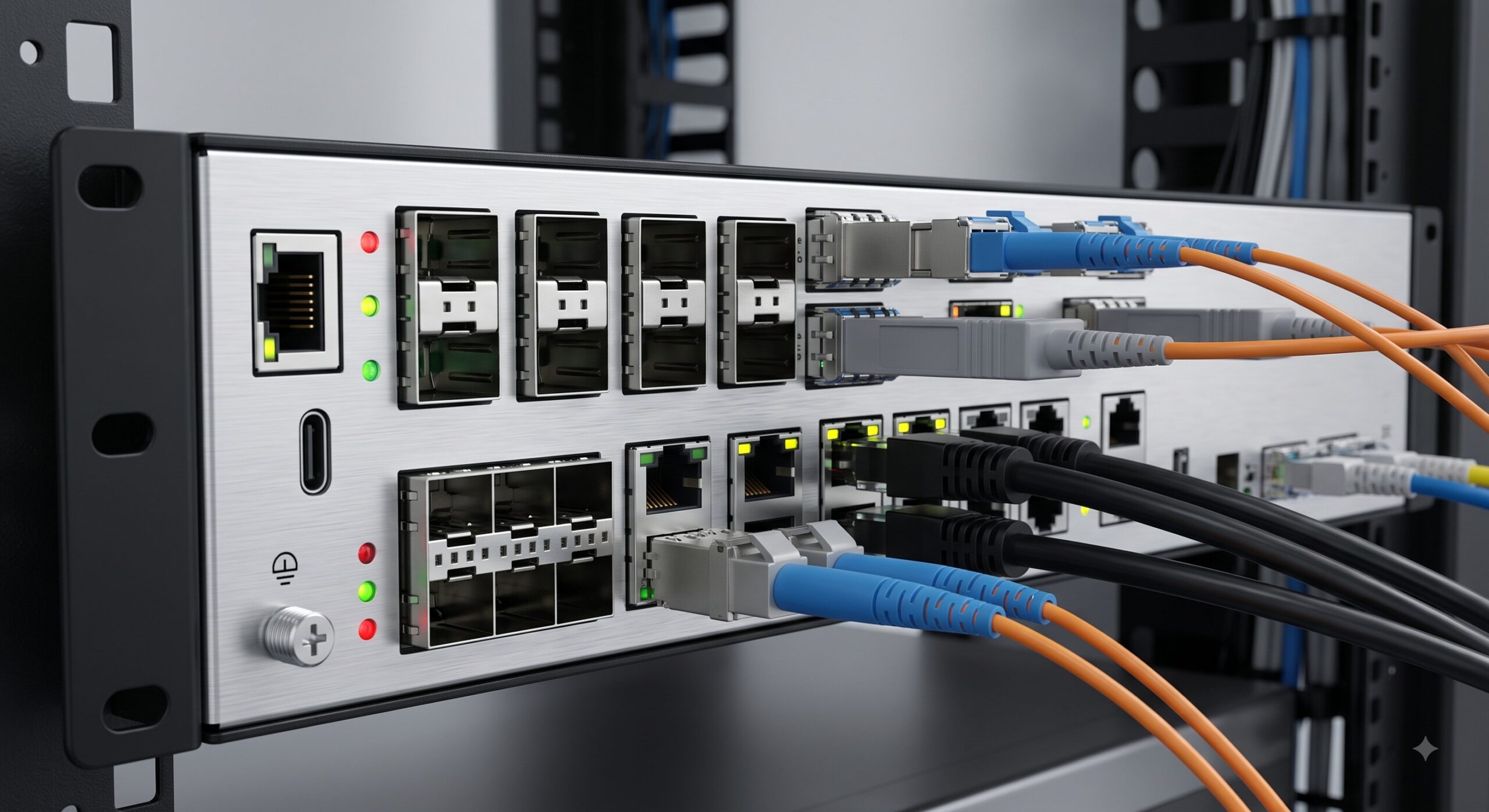
| Port Density | Up to 24 x 10GE (SFP+) + 8 x 100GE (QSFP28) OR 48 x 10GE |
| Temperature Range | -40°C to +65°C (Extended Range Operating) |
| Timing Accuracy | PTP Telecom Profile (G.8275.1) |
5. LIFECYCLE ASSURANCE (MTBF)
Reliability is quantitatively assured through rigorous design validation and component selection, targeting a system Mean Time Between Failures (MTBF) exceeding 300,000 hours at 40°C ambient temperature. The hardware undergoes extensive burn-in testing and employs electrochemical migration (ECM) resistant materials for extended field life. Mean Time To Repair (MTTR) is optimized to under 30 minutes, facilitated by a hot-swappable design for all field-replaceable units (FRUs), including line cards, power supplies, and fan trays. The software architecture supports In-Service Software Upgrade (ISSU), permitting the application of security patches and feature enhancements without disrupting data traffic.
6. TARGET NETWORK TOPOLOGIES
This router is optimized for various 5G transport topologies, including Hub-and-Spoke, Ring, and Meshed architectures. Its compact form factor allows for deployment in street cabinets, cell towers, and central office locations. It supports Ethernet Linear Protection Switching (ELPS) and Ethernet Ring Protection Switching (ERPS) to guarantee sub-50ms network convergence in ring topologies. The integration of advanced timing over packet (ToP) ensures that the router can serve as a Grandmaster or Boundary Clock, making it equally suitable for fronthaul (eCPRI) and midhaul aggregation, effectively unifying the network layers and reducing operational complexity.
📥 Download Technical Specification
Click the button below to view or download the full official PDF datasheet.

Leave a comment