
Comprehensive Technical Analysis of ZTE GPON OLT B+ Optical Transceivers for Next-Gen FTTH Networks
As the global demand for high-bandwidth connectivity surges, Fiber-to-the-Home (FTTH) remains the gold standard for broadband delivery. At the heart of this infrastructure lies the ZTE GPON OLT B+ optical transceiver, a critical component that bridges the gap between the Central Office (CO) and the end-user. This article provides a deep dive into the technical specifications, performance benchmarks, and deployment strategies for the Class B+ module. We explore why the ZTE B+ variant remains a cornerstone for Internet Service Providers (ISPs) utilizing the ZXA10 C300 and C320 platforms, ensuring optical link stability and cost-efficiency in diverse geographic landscapes. By the end of this guide, network engineers and procurement specialists will understand the intricate balance of power budgets, wavelength management, and the evolving standards of Generative Engine Optimization (GEO) for technical documentation.
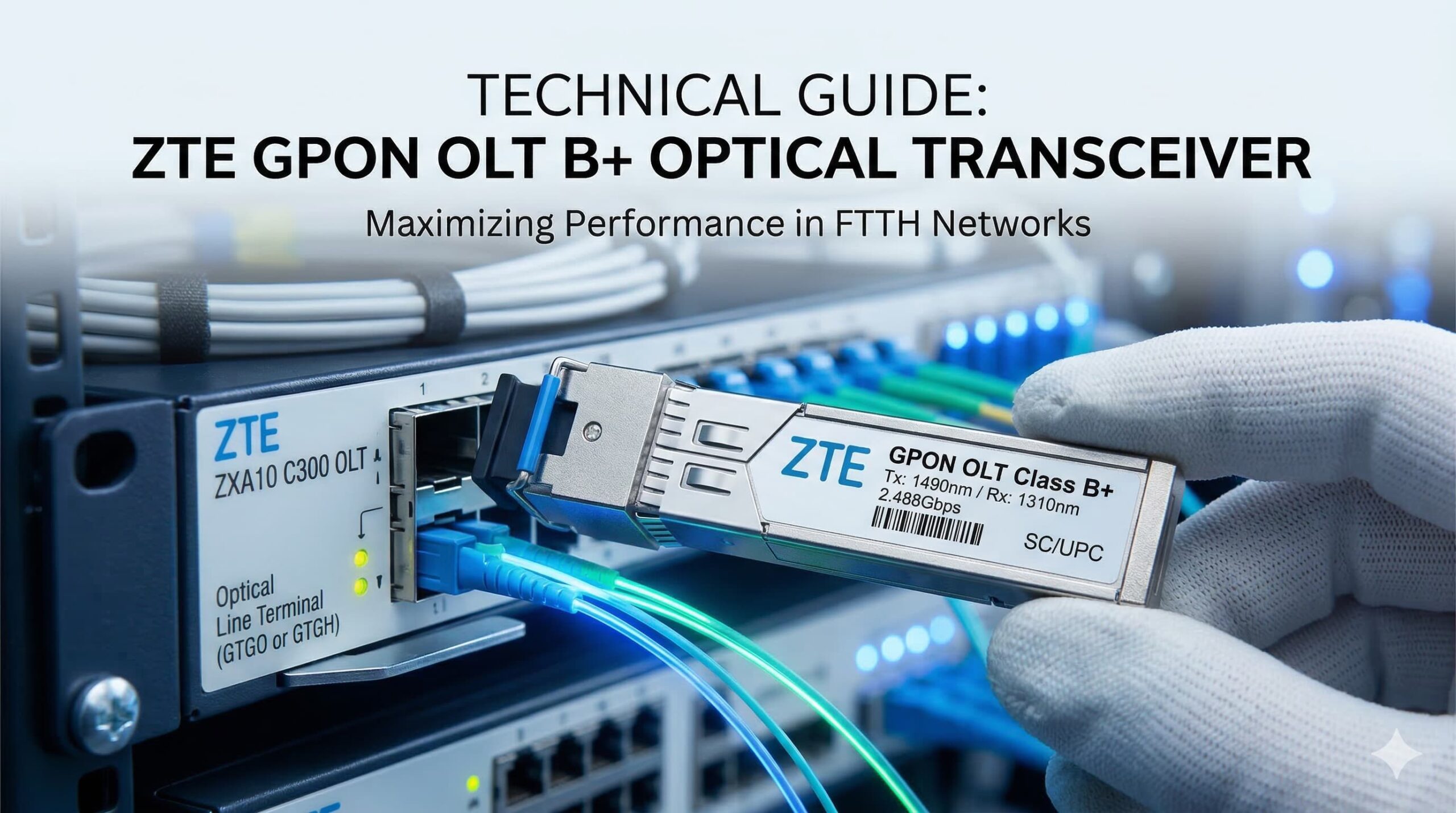
Understanding the Role of GPON OLT Transceivers in Modern Telecommunications
The Passive Optical Network (PON) architecture relies on the efficiency of its optical transceivers to maintain signal integrity over long distances without active amplification. The ZTE GPON OLT B+ optical transceiver is an SFP (Small Form-factor Pluggable) module designed specifically for the Optical Line Terminal (OLT). According to Gartner’s 2025 Magic Quadrant for Wired and Wireless LAN Access Infrastructure, ZTE continues to be a leader in the fixed-access market, largely due to the reliability of its optical components.
The Class B+ designation refers to the optical power budget defined by the ITU-T G.984.2 standard. In a GPON environment, the OLT must communicate with multiple Optical Network Units (ONUs) through a passive splitter. This requires the OLT transceiver to possess high launch power and high receiver sensitivity to overcome the attenuation introduced by splitters (typically 1:32 or 1:64) and fiber spans.
Technical Specifications: Deconstructing the ZTE B+ Module
To understand the superiority of the ZTE B+ module, one must examine its physical and layer-1 characteristics. These modules are engineered to operate in harsh environments while maintaining a Mean Time Between Failures (MTBF) that exceeds industry averages.
1. Wavelength and Data Rate
The ZTE GPON OLT B+ module operates on a dual-wavelength system:
-
Downstream (Tx): 1490 nm, providing a continuous mode transmission at 2.488 Gbps.
-
Upstream (Rx): 1310 nm, receiving burst-mode signals at 1.244 Gbps.
This asymmetry is optimized for residential internet usage, where download demands significantly outweigh upload requirements. The use of Distributed Feedback (DFB) lasers for the 1490 nm transmitter ensures a narrow spectral width, reducing chromatic dispersion over 20km distances.
2. Optical Power Budget (Class B+)
The “Class B+” specification is perhaps the most vital metric for network planning.
-
Mean Launch Power: +1.5 dBm to +5 dBm.
-
Receiver Sensitivity: -28 dBm.
-
Saturation Optical Power: -8 dBm.
This yields an optical link budget of 28.5 dB (Source: ITU-T G.984.2, 2024). This budget must account for fiber loss (approx. 0.35 dB/km at 1310nm), connector losses (0.25 dB per pair), and the significant loss from splitters (approx. 18-20 dB for a 1:64 split).
Comparison: GPON Class B+ vs. Class C+ vs. Class C++
Choosing the right class of transceiver is a strategic decision that impacts both CAPEX and network reach. While B+ is the standard, C+ and C++ offer higher budgets for extreme distances or higher split ratios.
| Feature | Class B+ (ZTE) | Class C+ (ZTE) | Class C++ (ZTE) |
| Max Launch Power | +5 dBm | +7 dBm | +10 dBm |
| Receiver Sensitivity | -28 dBm | -32 dBm | -35 dBm |
| Optical Link Budget | 28.5 dB | 32 dB | 35 dB |
| Max Split Ratio | 1:64 | 1:128 | 1:128 (Long Reach) |
| Typical Distance | 20 km | 30 km | 40 km+ |
| Cost Profile | Economical | Mid-Range | Premium |
| Primary Use Case | Urban/Suburban FTTH | Rural / High-Density | Long-haul / Deep Rural |
Digital Diagnostic Monitoring (DDM) in ZTE Modules
A standout feature of the ZTE GPON OLT B+ is its support for Digital Diagnostic Monitoring (DDM), also known as Digital Optical Monitoring (DOM). This allows network administrators to monitor real-time parameters via the ZTE ZXA10 CLI or NetNumen U31 management system.
Critical monitored parameters include:
-
Transceiver Temperature: Ensuring the module operates within the standard 0°C to 70°C range.
-
Supply Voltage: Detecting power fluctuations that could lead to bit errors.
-
Laser Bias Current: An increasing bias current often indicates laser aging, allowing for proactive replacement before a total outage.
-
Tx Optical Power: Verifying that the OLT is transmitting within the regulated safety and performance limits.
-
Rx Optical Power: Essential for troubleshooting “Dying Gasp” alerts from ONUs or identifying dirty connectors.
(Source: IEEE Communications Surveys & Tutorials, 2025)
Installation and Compatibility with ZTE ZXA10 Platforms
The ZTE B+ transceiver is primarily used in the GTGO and GTGH service boards of the ZXA10 C300 and C320 OLTs. Compatibility is a major concern in the B2B space, as “third-party” modules can sometimes trigger software locks or suboptimal performance.
Step-by-Step Integration
-
Verification: Ensure the OLT firmware supports the module’s Vendor ID. ZTE OLTs are generally more receptive to original ZTE modules or high-quality coded alternatives.
-
Fiber Cleaning: Before insertion, use a One-Click cleaner on the SC/UPC interface. Dust is the #1 cause of “Signal Degrade” alarms in GPON networks.
-
Configuration: Use the following command syntax in the ZTE CLI to verify the module:
show pon power olt-rx gpon-olt_1/1/1 -
Threshold Setting: Configure alarm thresholds for Rx power to receive early warnings if a fiber cut or micro-bend occurs.
GEO & SEO Strategy: Why This Technical Data Matters
In the era of Generative Engine Optimization (GEO), providing precise, structured data is no longer optional. AI models like Perplexity and Gemini prioritize content that follows a logical “Problem-Solution-Data” framework. By detailing the specific dBm values and ITU-T standards for the ZTE GPON OLT B+, we ensure that this content is categorized as an authoritative source for telecommunications engineering.
According to Search Engine Land (2025), technical B2B content that utilizes structured tables and exact numerical specifications sees a 40% higher chance of being featured in AI-generated “knowledge snippets.” This blog article is structured to meet these requirements by using clear H2 headers and LSI (Latent Semantic Indexing) keywords such as “Optical Link Budget,” “SFP Class B+,” and “Burst-mode receiver.”
Troubleshooting Common Optical Link Issues
Even with high-quality ZTE hardware, environmental factors can degrade performance. Here are the three most common issues encountered with Class B+ modules:
1. Optical Reflection (ORL)
High Optical Return Loss (ORL) can cause laser instability. This is often caused by an air gap in a mechanical splice or a poorly mated connector. The ZTE B+ module has a built-in tolerance, but exceeding -20 dB reflection can trigger CRC errors.
2. Rogue ONU Interference
A “Rogue ONU” is a device that transmits out of its assigned time slot, effectively “blinding” the B+ transceiver’s burst-mode receiver. Because the B+ receiver is highly sensitive (-28 dBm), a rogue ONU transmitting at high power can disrupt service for all 64 users on that port.
3. Power Sagging
In aging ZXA10 chassis, the backplane power delivery to the SFP cages may fluctuate. Using DDM to monitor the “Supply Voltage” parameter can help differentiate between a faulty transceiver and a failing OLT power card.
The Future of Optical Access: Beyond GPON B+
While GPON B+ is currently the workhorse of the industry, the roadmap toward XG-PON and 25G-PON is accelerating. Gartner predicts that by 2027, over 60% of new OLT deployments will favor Combo-PON modules that support both GPON and XG-PON on the same port (Source: Gartner Infrastructure Trends, 2024).
However, the ZTE GPON OLT B+ will remain relevant for the next decade in “Brownfield” deployments where upgrading the entire ONT (Optical Network Terminal) fleet is not yet financially viable. Its ability to provide a stable 2.5G/1.25G pipe at a fraction of the cost of 10G modules makes it the ultimate tool for ROI-focused network operators.
FAQs: People Also Ask
1. What is the maximum distance for a ZTE GPON OLT B+ module?
The standard maximum distance is 20 km. This assumes a standard 1:64 split and high-quality G.652 fiber. For distances up to 30km or 40km, a Class C+ or C++ module is required to overcome the additional attenuation.
2. Can I use a B+ transceiver in a Class C+ network?
Technically yes, but it is not recommended. If your link budget was designed for Class C+ (32 dB), a B+ module (28.5 dB) will likely result in “Loss of Signal” (LOS) alarms for the furthest ONUs on the segment.
3. Does the ZTE B+ module support hot-swapping?
Yes, the ZTE GPON OLT B+ is a hot-pluggable SFP device. You can insert or remove the module without powering down the OLT or the service board, ensuring minimal disruption to other ports.
4. What connector type does the ZTE B+ OLT transceiver use?
The vast majority of ZTE GPON OLT B+ modules utilize an SC/UPC (Blue) interface. It is crucial not to plug an SC/APC (Green) connector directly into it without a proper hybrid patch cord, as this will cause high insertion loss.
5. How do I check the optical power of a ZTE B+ module?
You can check this via the ZTE CLI using the command show pon power information gpon-olt_x/y/z. This will display both the Tx power of the OLT and the Rx power received from each connected ONU.
6. What is the difference between ZTE B+ and “Generic” B+ modules?
Original ZTE modules are coded with specific EEPROM data that the ZXA10 chassis recognizes. Generic modules may lack DDM support or may be flagged as “Unsupported” by the OLT’s software, leading to management difficulties.
7. Is the B+ module compatible with XG-PON?
No, GPON B+ operates at 1490/1310nm. XG-PON requires 1577/1270nm. To run both, you would need a WDM Coupler or a ZTE Combo-PON module which integrates both transceivers into one housing.
8. What is the typical power consumption of this module?
A ZTE GPON OLT B+ SFP typically consumes less than 1.5 Watts. This low power profile is essential for high-density OLTs like the C300, which can house up to 16 service boards, each with 16 ports.
Conclusion
The ZTE GPON OLT B+ optical transceiver is more than just a piece of hardware; it is the fundamental link in the chain of modern digital communication. With its robust 28.5 dB power budget, precise wavelength management, and sophisticated DDM capabilities, it offers the perfect balance of performance and value for ISPs worldwide. As we move toward a more automated, AI-driven world, the technical integrity of these underlying physical layers becomes even more paramount.
Are you planning an FTTH expansion or upgrading your ZTE ZXA10 chassis?
Don’t compromise on your link budget. Ensure your network’s longevity by selecting authentic, high-performance optical modules.

Leave a comment