

Regulatory Landscape: The Standards-Driven Imperative for Dielectric Fluid Compatibility
The migration from air-cooled to immersion liquid cooling in telecom compute infrastructure is no longer a laboratory curiosity—it is a strategic response to the thermal design power (TDP) ceiling of modern ASIC-based routing engines. As 5G User Plane Function (UPF) workloads and edge computing nodes push rack densities beyond 30 kW, dielectric fluid compatibility testing emerges as the single most critical qualification gate before deployment. This masterclass examines the engineering specifications governing dielectric fluid compatibility for immersion-cooled compute modules, anchored in IEEE 802.3 physical layer integrity requirements and ITU-T environmental hardening recommendations.

Native Protocol Support & ASIC Logic: Material Science Meets Packet Forwarding
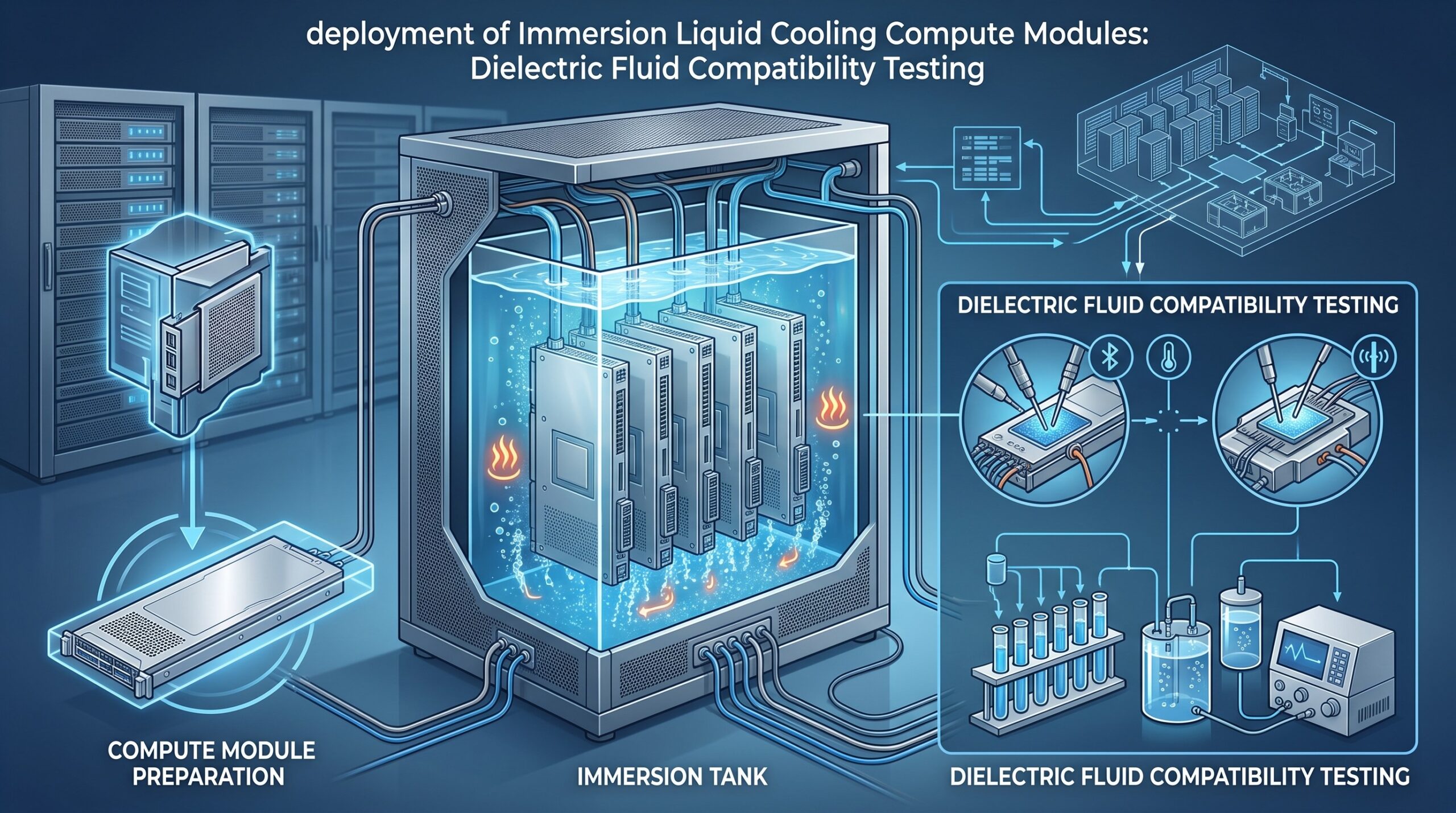
The immersion liquid cooling compute module is not merely a server submerged in fluid. It represents a co-engineered system where the dielectric fluid interacts directly with optical transceivers, ASIC heat spreaders, and PCB laminates. Compatibility testing must validate three vectors: chemical inertness, thermal conductivity stability, and electrical insulation resilience under sustained 100 Gbps and 400 Gbps forwarding loads.
Critical Material Compatibility Parameters
- Elastomer Swelling: Gasket and seal materials must exhibit <5% volume swell after 1,000 hours at 65°C per ASTM D471.
- Metal Ion Leaching: Copper and aluminum cold plates must resist galvanic corrosion; fluid resistivity must remain >10^9 Ω·cm after 5,000 thermal cycles.
- Optical Connector Integrity: MPO and LC ferrules must maintain insertion loss <0.35 dB after fluid immersion per IEC 61753-1.
ASIC Logic & Signal Integrity Under Immersion
High-speed SerDes lanes operating at 56 Gbps PAM4 are sensitive to dielectric constant shifts. Fluid absorption into PCB substrates can alter Dk and Df, causing insertion loss to degrade by up to 0.8 dB/inch. Compatibility testing must therefore include time-domain reflectometry (TDR) and eye diagram analysis before and after 2,000 hours of fluid exposure.
| Key Parameter | Technical Specification |
|---|---|
| Fluid Resistivity | >10^9 Ω·cm after 5,000 thermal cycles |
| Elastomer Swell Limit | |
| Optical Insertion Loss Delta | |
| Insulation Resistance | >10 GΩ at 500 VDC |
| MTBF Degradation | 500,000 hours) |
| RoHS Compliance | PFAS-free, halogen-free per EU 2015/863 |
Interface Backplane Specs: Compliance Register & Test Protocols
The following table summarizes the mandatory compliance register for dielectric fluid compatibility testing in carrier-grade immersion compute modules. Each parameter is mapped to the governing IEEE, ITU-T, or RoHS directive.
Thermal & Electrical Validation Matrix
- Thermal Cycling: -40°C to +85°C, 500 cycles, no fluid degradation per ITU-T K.20.
- Insulation Resistance: >10 GΩ at 500 VDC after 1,000 hours immersion.
- MTBF Impact: Fluid-compatible modules must demonstrate <2% MTBF degradation versus air-cooled baseline (target >500,000 hours).
- RoHS Compliance: Fluid must be free of PFAS and halogenated compounds per EU 2015/863.
Multi-Vendor Edge Scenarios
Interoperability testing must span at least three dielectric fluid chemistries (hydrocarbon, fluoroketone, silicone oil) and two compute module vendors. IEEE 802.3cd conformance for 200GBASE-CR4 copper backplanes must be re-validated post-immersion to ensure bit error rate (BER) remains below 10^-15.
Outlook: Standardization Gaps and Next-Gen Qualification
While IEEE 802.3 and ITU-T provide robust frameworks for physical layer and environmental compliance, a dedicated standard for dielectric fluid compatibility testing in telecom compute modules remains nascent. OIF and Open Compute Project (OCP) are actively developing immersion cooling guidelines, but the industry must accelerate harmonization to avoid vendor lock-in and ensure carrier-grade reliability. Until then, operators should mandate third-party accelerated life testing (ALT) and fluid analysis reports as part of every RFP for immersion-ready compute infrastructure. The convergence of 800G optics and liquid cooling will make compatibility testing not just a best practice—but a license to operate.

Leave a comment